Catherine A Fitton, Madeleine M R Quigley, Jill J F Belch
{"title":"Risk factors for wet macular degeneration: a systematic review, with novel insights from the Scottish Heart Health Extended Cohort.","authors":"Catherine A Fitton, Madeleine M R Quigley, Jill J F Belch","doi":"10.1186/s12886-025-03868-5","DOIUrl":null,"url":null,"abstract":"<p><strong>Background: </strong>Age-related macular degeneration (AMD) is a major cause of vision loss worldwide. This study aimed to assess risk factors for wet AMD by two methods: assessing risk factors measured in the Scottish Heart Health Extended Cohort (SHHEC), and to systematically review the literature.</p><p><strong>Methods: </strong>Eighteen thousand one hundred seven volunteers were recruited to SHHEC between 1984-1995, with risk factor data collected on recruitment. Hospital records were linked to study data up to 2017 and survival analysis was used to analyse risk factors and wet AMD. Literature published between 2000-2023 was searched for studies assessing risk factors for wet AMD, resulting in 5,503 papers. Following review, 7 studies were included in the systematic review.</p><p><strong>Results: </strong>Within the SHHEC data, 231 cases of wet AMD were reported. Increasing age (Hazard Ratio (HR) 10.51; 99% Confidence Interval (CI) 4.78-23.11) and smoking (HR 1.67; 99% CI 1.17-2.38) were significantly associated with an increased risk of wet AMD. Increased dietary intake of vitamin K (HR 0.56; 99% CI 0.34-0.94) was associated with a decreased risk of wet AMD. According to a systematic review, smoking, high Body mass index, heavy alcohol intake, increased systolic blood pressure, increased pulse pressure, and high levels of C-reactive protein and serum triglycerides in the blood may be associated with an increased risk of wet AMD. However, the studies provide mixed evidence and no conclusive results.</p><p><strong>Conclusion: </strong>We have demonstrated that increasing age and smoking are high-risk factors for the development of wet AMD, while vitamin K is associated with a reduced risk of wet AMD.</p>","PeriodicalId":9058,"journal":{"name":"BMC Ophthalmology","volume":"25 1","pages":"67"},"PeriodicalIF":1.7000,"publicationDate":"2025-02-10","publicationTypes":"Journal Article","fieldsOfStudy":null,"isOpenAccess":false,"openAccessPdf":"https://www.ncbi.nlm.nih.gov/pmc/articles/PMC11809110/pdf/","citationCount":"0","resultStr":null,"platform":"Semanticscholar","paperid":null,"PeriodicalName":"BMC Ophthalmology","FirstCategoryId":"3","ListUrlMain":"https://doi.org/10.1186/s12886-025-03868-5","RegionNum":4,"RegionCategory":"医学","ArticlePicture":[],"TitleCN":null,"AbstractTextCN":null,"PMCID":null,"EPubDate":"","PubModel":"","JCR":"Q3","JCRName":"OPHTHALMOLOGY","Score":null,"Total":0}
引用次数: 0
Abstract
Background: Age-related macular degeneration (AMD) is a major cause of vision loss worldwide. This study aimed to assess risk factors for wet AMD by two methods: assessing risk factors measured in the Scottish Heart Health Extended Cohort (SHHEC), and to systematically review the literature.
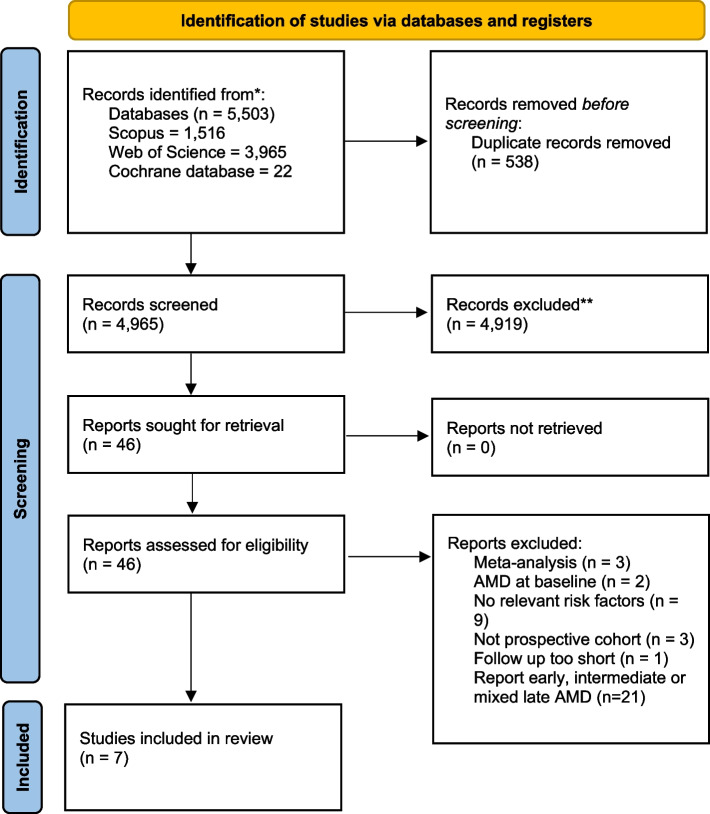
Methods: Eighteen thousand one hundred seven volunteers were recruited to SHHEC between 1984-1995, with risk factor data collected on recruitment. Hospital records were linked to study data up to 2017 and survival analysis was used to analyse risk factors and wet AMD. Literature published between 2000-2023 was searched for studies assessing risk factors for wet AMD, resulting in 5,503 papers. Following review, 7 studies were included in the systematic review.
Results: Within the SHHEC data, 231 cases of wet AMD were reported. Increasing age (Hazard Ratio (HR) 10.51; 99% Confidence Interval (CI) 4.78-23.11) and smoking (HR 1.67; 99% CI 1.17-2.38) were significantly associated with an increased risk of wet AMD. Increased dietary intake of vitamin K (HR 0.56; 99% CI 0.34-0.94) was associated with a decreased risk of wet AMD. According to a systematic review, smoking, high Body mass index, heavy alcohol intake, increased systolic blood pressure, increased pulse pressure, and high levels of C-reactive protein and serum triglycerides in the blood may be associated with an increased risk of wet AMD. However, the studies provide mixed evidence and no conclusive results.
Conclusion: We have demonstrated that increasing age and smoking are high-risk factors for the development of wet AMD, while vitamin K is associated with a reduced risk of wet AMD.
背景:年龄相关性黄斑变性(AMD)是世界范围内视力丧失的主要原因。本研究旨在通过两种方法评估湿性AMD的危险因素:评估苏格兰心脏健康扩展队列(SHHEC)测量的危险因素,并系统地回顾文献。方法:1984-1995年间,在SHHEC招募了一万八千一百七十七名志愿者,并收集了招募时的危险因素数据。医院记录与截至2017年的研究数据相关联,生存分析用于分析风险因素和湿性AMD。检索2000-2023年间发表的文献,以评估湿性AMD的危险因素,共有5503篇论文。随后,系统评价纳入了7项研究。结果:在SHHEC数据中,报告了231例湿性AMD。年龄增加(风险比10.51;99%置信区间(CI) 4.78-23.11)和吸烟(HR 1.67;99% CI 1.17-2.38)与湿性AMD风险增加显著相关。膳食中维生素K摄入量增加(HR 0.56;99% CI 0.34-0.94)与湿性AMD风险降低相关。根据一项系统综述,吸烟、高体重指数、大量饮酒、收缩压升高、脉压升高、血液中c反应蛋白和血清甘油三酯水平升高可能与湿性AMD的风险增加有关。然而,这些研究提供了混杂的证据,没有结论性的结果。结论:我们已经证明,年龄增长和吸烟是湿性AMD发展的高危因素,而维生素K与湿性AMD的风险降低有关。
期刊介绍:
BMC Ophthalmology is an open access, peer-reviewed journal that considers articles on all aspects of the prevention, diagnosis and management of eye disorders, as well as related molecular genetics, pathophysiology, and epidemiology.



 京公网安备 11010802042870号
京ICP备2023020795号-1
京公网安备 11010802042870号
京ICP备2023020795号-1

 分享
分享
 求助内容:
求助内容: 应助结果提醒方式:
 扫码关注我们
