Fasting appetite-related gut hormone responses after weight loss induced by calorie restriction, exercise, or both in people with overweight or obesity: a meta‐analysis
Zhuoxiu Jin, Jiajin Li, Alice E. Thackray, Tonghui Shen, Kevin Deighton, James A. King, David J. Stensel
{"title":"Fasting appetite-related gut hormone responses after weight loss induced by calorie restriction, exercise, or both in people with overweight or obesity: a meta‐analysis","authors":"Zhuoxiu Jin, Jiajin Li, Alice E. Thackray, Tonghui Shen, Kevin Deighton, James A. King, David J. Stensel","doi":"10.1038/s41366-025-01726-4","DOIUrl":null,"url":null,"abstract":"Altered appetite-related gut hormone concentrations may reflect a physiological adaptation facilitating weight regain after weight loss. This review investigates hormonal changes after weight loss achieved through calorie restriction (CR), exercise (EX), or both combined (CREX). A systematic search of PubMed (MEDLINE), EMBASE, SPORTDiscus, Cochrane Library, Web of Science, and ClinicalTrials.gov was conducted to identify randomised controlled trials (RCTs) and non-RCTs reporting in a fasting state either pre- and post-intervention appetite-related hormone concentrations or the changes therein after weight loss. The hormones examined were ghrelin, peptide tyrosine tyrosine (PYY), glucagon-like peptide -1 (GLP-1), and cholecystokinin (CCK), in their total and/or active form. Standardised mean differences (SMD) were extracted as the effect size. 127 studies were identified: 19 RCTs, 108 non-RCTs, 1305 and 4725 participants, respectively. In response to weight loss induced by CR, EX or CREX, the meta-analysis revealed an increase in total ghrelin from both RCTs (SMD: 0.55, 95% CI: 0.07–1.04) and non-RCTs (SMD: 0.24, 95% CI: 0.14–0.35). A decrease in acylated ghrelin was identified for RCTs (SMD: –0.58, 95% CI: –1.09 to –0.06) but an increase was observed for non-RCTs (SMD: 0.15, 95% CI: 0.03 to 0.27). Findings also revealed a decrease in PYY (total PYY: SMD: –0.17, 95%CI: –0.28 to –0.06; PYY3-36: SMD: –0.17, 95%CI: –0.32 to –0.02) and active GLP-1 (SMD: -0.16, 95% CI: –0.28 to –0.05) from non-RCTs. Changes in hormones did not differ among the three interventions when controlling for weight loss. Meta-regression indicated that greater weight loss was associated with a greater increase in total ghrelin. Weight loss induced by CR, EX, or CREX elicits an increase in total ghrelin, but varied responses in other appetite-related hormones. The extent of weight loss influences changes in appetite-related gut hormone concentrations.","PeriodicalId":14183,"journal":{"name":"International Journal of Obesity","volume":"49 5","pages":"776-792"},"PeriodicalIF":3.8000,"publicationDate":"2025-02-10","publicationTypes":"Journal Article","fieldsOfStudy":null,"isOpenAccess":false,"openAccessPdf":"https://www.ncbi.nlm.nih.gov/pmc/articles/PMC12095072/pdf/","citationCount":"0","resultStr":null,"platform":"Semanticscholar","paperid":null,"PeriodicalName":"International Journal of Obesity","FirstCategoryId":"3","ListUrlMain":"https://www.nature.com/articles/s41366-025-01726-4","RegionNum":2,"RegionCategory":"医学","ArticlePicture":[],"TitleCN":null,"AbstractTextCN":null,"PMCID":null,"EPubDate":"","PubModel":"","JCR":"Q1","JCRName":"ENDOCRINOLOGY & METABOLISM","Score":null,"Total":0}
引用次数: 0
Abstract
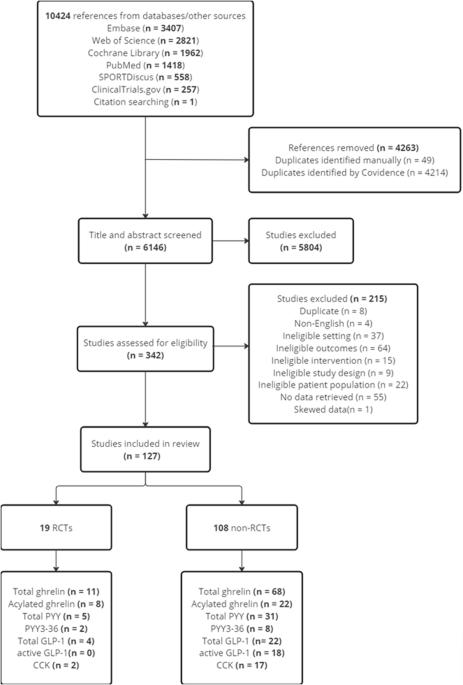
Altered appetite-related gut hormone concentrations may reflect a physiological adaptation facilitating weight regain after weight loss. This review investigates hormonal changes after weight loss achieved through calorie restriction (CR), exercise (EX), or both combined (CREX). A systematic search of PubMed (MEDLINE), EMBASE, SPORTDiscus, Cochrane Library, Web of Science, and ClinicalTrials.gov was conducted to identify randomised controlled trials (RCTs) and non-RCTs reporting in a fasting state either pre- and post-intervention appetite-related hormone concentrations or the changes therein after weight loss. The hormones examined were ghrelin, peptide tyrosine tyrosine (PYY), glucagon-like peptide -1 (GLP-1), and cholecystokinin (CCK), in their total and/or active form. Standardised mean differences (SMD) were extracted as the effect size. 127 studies were identified: 19 RCTs, 108 non-RCTs, 1305 and 4725 participants, respectively. In response to weight loss induced by CR, EX or CREX, the meta-analysis revealed an increase in total ghrelin from both RCTs (SMD: 0.55, 95% CI: 0.07–1.04) and non-RCTs (SMD: 0.24, 95% CI: 0.14–0.35). A decrease in acylated ghrelin was identified for RCTs (SMD: –0.58, 95% CI: –1.09 to –0.06) but an increase was observed for non-RCTs (SMD: 0.15, 95% CI: 0.03 to 0.27). Findings also revealed a decrease in PYY (total PYY: SMD: –0.17, 95%CI: –0.28 to –0.06; PYY3-36: SMD: –0.17, 95%CI: –0.32 to –0.02) and active GLP-1 (SMD: -0.16, 95% CI: –0.28 to –0.05) from non-RCTs. Changes in hormones did not differ among the three interventions when controlling for weight loss. Meta-regression indicated that greater weight loss was associated with a greater increase in total ghrelin. Weight loss induced by CR, EX, or CREX elicits an increase in total ghrelin, but varied responses in other appetite-related hormones. The extent of weight loss influences changes in appetite-related gut hormone concentrations.
期刊介绍:
The International Journal of Obesity is a multi-disciplinary forum for research describing basic, clinical and applied studies in biochemistry, physiology, genetics and nutrition, molecular, metabolic, psychological and epidemiological aspects of obesity and related disorders.
We publish a range of content types including original research articles, technical reports, reviews, correspondence and brief communications that elaborate on significant advances in the field and cover topical issues.



 京公网安备 11010802042870号
京ICP备2023020795号-1
京公网安备 11010802042870号
京ICP备2023020795号-1

 分享
分享
 求助内容:
求助内容: 应助结果提醒方式:
 扫码关注我们
