Johannes Lorenz, Juliane Zevano, Nils Otto, Bertrand Schneider, Cihan Papan, Markus Missler, Dogus Darici
{"title":"Looking at Social Interactions in Medical Education with Dual Eye-Tracking Technology: A Scoping Review.","authors":"Johannes Lorenz, Juliane Zevano, Nils Otto, Bertrand Schneider, Cihan Papan, Markus Missler, Dogus Darici","doi":"10.12688/mep.20577.2","DOIUrl":null,"url":null,"abstract":"<p><strong>Purpose: </strong>Social interactions are fundamental to effective medical practice, yet assessing these complex dynamics in educational settings remains challenging. This review critically examines the emerging use of dual eye-tracking technology as a novel method to quantify, analyze, and enhance social interactions within medical education contexts.</p><p><strong>Materials and methods: </strong>We performed a scoping review of the literature, focusing on studies that utilized dual eye-tracking within medical education contexts. Our search included multiple databases and journals. We extracted information on technical setups, areas of application, participant characteristics, dual eye-tracking metrics, and main findings.</p><p><strong>Results: </strong>Ten studies published between 2012 and 2021 met the inclusion criteria, with 90% utilizing dual screen-based- and 10% dual mobile eye-tracking. All studies were conducted in the context of surgical training, primarily focusing on laparoscopic surgery. We identified two main applications of dual eye-tracking: (1) as an educational <i>intervention</i> to improve collaboration, (2) as a diagnostic tool to identify interaction pattern that were associated with learning. Key metrics included joint visual attention, gaze delay and joint mental effort.</p><p><strong>Conclusion: </strong>Dual eye-tracking offers a promising technology for enhancing medical education by providing high-resolution, real-time data on social interactions. However, current research is limited by small sample sizes, outdated technology, and a narrow focus on surgical contexts. We discuss the broader implications and potential for medical education research and practice.</p>","PeriodicalId":74136,"journal":{"name":"MedEdPublish (2016)","volume":"14 ","pages":"215"},"PeriodicalIF":0.0000,"publicationDate":"2024-12-18","publicationTypes":"Journal Article","fieldsOfStudy":null,"isOpenAccess":false,"openAccessPdf":"https://www.ncbi.nlm.nih.gov/pmc/articles/PMC11809160/pdf/","citationCount":"0","resultStr":null,"platform":"Semanticscholar","paperid":null,"PeriodicalName":"MedEdPublish (2016)","FirstCategoryId":"1085","ListUrlMain":"https://doi.org/10.12688/mep.20577.2","RegionNum":0,"RegionCategory":null,"ArticlePicture":[],"TitleCN":null,"AbstractTextCN":null,"PMCID":null,"EPubDate":"2024/1/1 0:00:00","PubModel":"eCollection","JCR":"","JCRName":"","Score":null,"Total":0}
引用次数: 0
Abstract
Purpose: Social interactions are fundamental to effective medical practice, yet assessing these complex dynamics in educational settings remains challenging. This review critically examines the emerging use of dual eye-tracking technology as a novel method to quantify, analyze, and enhance social interactions within medical education contexts.
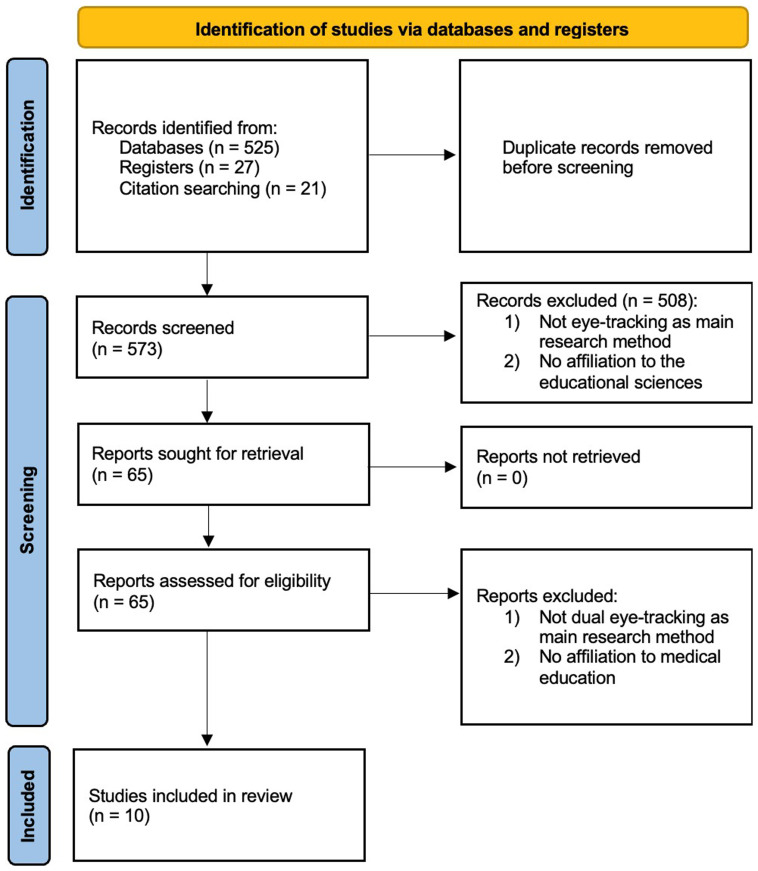
Materials and methods: We performed a scoping review of the literature, focusing on studies that utilized dual eye-tracking within medical education contexts. Our search included multiple databases and journals. We extracted information on technical setups, areas of application, participant characteristics, dual eye-tracking metrics, and main findings.
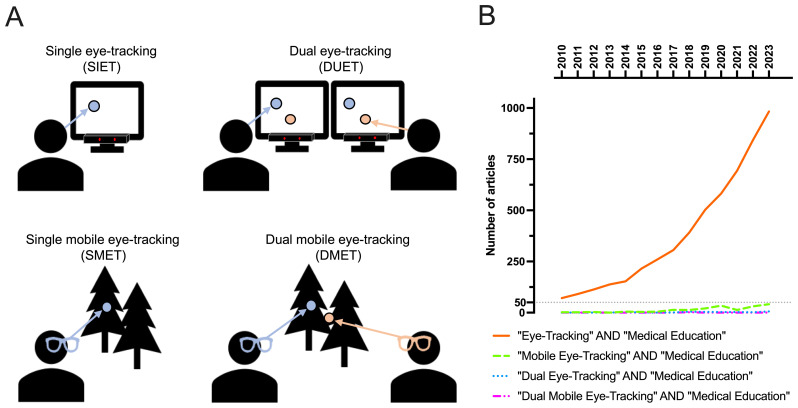
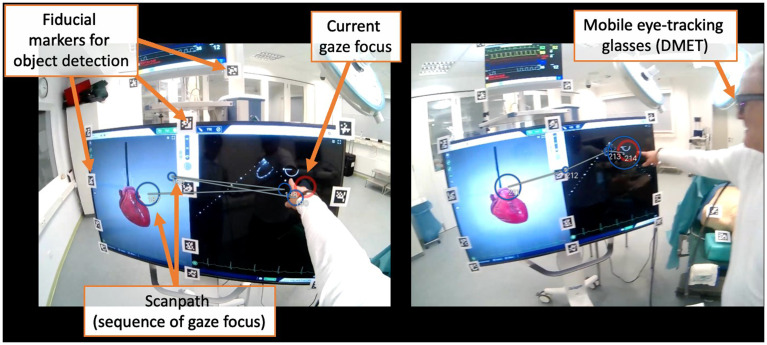
Results: Ten studies published between 2012 and 2021 met the inclusion criteria, with 90% utilizing dual screen-based- and 10% dual mobile eye-tracking. All studies were conducted in the context of surgical training, primarily focusing on laparoscopic surgery. We identified two main applications of dual eye-tracking: (1) as an educational intervention to improve collaboration, (2) as a diagnostic tool to identify interaction pattern that were associated with learning. Key metrics included joint visual attention, gaze delay and joint mental effort.
Conclusion: Dual eye-tracking offers a promising technology for enhancing medical education by providing high-resolution, real-time data on social interactions. However, current research is limited by small sample sizes, outdated technology, and a narrow focus on surgical contexts. We discuss the broader implications and potential for medical education research and practice.



 京公网安备 11010802042870号
京ICP备2023020795号-1
京公网安备 11010802042870号
京ICP备2023020795号-1

 分享
分享

 求助内容:
求助内容: 应助结果提醒方式:
 扫码关注我们
