Haoyu Cui, Qinhao Guo, Jun Xu, Xiaohua Wu, Chengfei Cai, Yiping Jiao, Wenlong Ming, Hao Wen, Xiangxue Wang
{"title":"Prediction of molecular subtypes for endometrial cancer based on hierarchical foundation model.","authors":"Haoyu Cui, Qinhao Guo, Jun Xu, Xiaohua Wu, Chengfei Cai, Yiping Jiao, Wenlong Ming, Hao Wen, Xiangxue Wang","doi":"10.1093/bioinformatics/btaf059","DOIUrl":null,"url":null,"abstract":"<p><strong>Motivation: </strong>Endometrial cancer is a prevalent gynecological malignancy that requires accurate identification of its molecular subtypes for effective diagnosis and treatment. Four molecular subtypes with different clinical outcomes have been identified: POLE mutation, mismatch repair deficient, p53 abnormal, and no specific molecular profile. However, determining these subtypes typically relies on expensive gene sequencing. To overcome this limitation, we propose a novel method that utilizes hematoxylin and eosin-stained whole slide images to predict endometrial cancer molecular subtypes.</p><p><strong>Results: </strong>Our approach leverages a hierarchical foundation model as a backbone, fine-tuned from the UNI computational pathology foundation model, to extract tissue embedding from different scales. We have achieved promising results through extensive experimentation on the Fudan University Shanghai Cancer Center cohort (N = 364). Our model demonstrates a macro-average AUROC of 0.879 (95% CI, 0.853-0.904) in a five-fold cross-validation. Compared to the current state-of-the-art molecular subtypes prediction for endometrial cancer, our method outperforms in terms of predictive accuracy and computational efficiency. Moreover, our method is highly reproducible, allowing for ease of implementation and widespread adoption. This study aims to address the cost and time constraints associated with traditional gene sequencing techniques. By providing a reliable and accessible alternative to gene sequencing, our method has the potential to revolutionize the field of endometrial cancer diagnosis and improve patient outcomes.</p><p><strong>Availability and implementation: </strong>The codes and data used for generating results in this study are available at https://github.com/HaoyuCui/hi-UNI for GitHub and https://doi.org/10.5281/zenodo.14627478 for Zenodo.</p>","PeriodicalId":93899,"journal":{"name":"Bioinformatics (Oxford, England)","volume":" ","pages":""},"PeriodicalIF":5.4000,"publicationDate":"2025-02-04","publicationTypes":"Journal Article","fieldsOfStudy":null,"isOpenAccess":false,"openAccessPdf":"https://www.ncbi.nlm.nih.gov/pmc/articles/PMC11878776/pdf/","citationCount":"0","resultStr":null,"platform":"Semanticscholar","paperid":null,"PeriodicalName":"Bioinformatics (Oxford, England)","FirstCategoryId":"1085","ListUrlMain":"https://doi.org/10.1093/bioinformatics/btaf059","RegionNum":0,"RegionCategory":null,"ArticlePicture":[],"TitleCN":null,"AbstractTextCN":null,"PMCID":null,"EPubDate":"","PubModel":"","JCR":"","JCRName":"","Score":null,"Total":0}
引用次数: 0
Abstract
Motivation: Endometrial cancer is a prevalent gynecological malignancy that requires accurate identification of its molecular subtypes for effective diagnosis and treatment. Four molecular subtypes with different clinical outcomes have been identified: POLE mutation, mismatch repair deficient, p53 abnormal, and no specific molecular profile. However, determining these subtypes typically relies on expensive gene sequencing. To overcome this limitation, we propose a novel method that utilizes hematoxylin and eosin-stained whole slide images to predict endometrial cancer molecular subtypes.
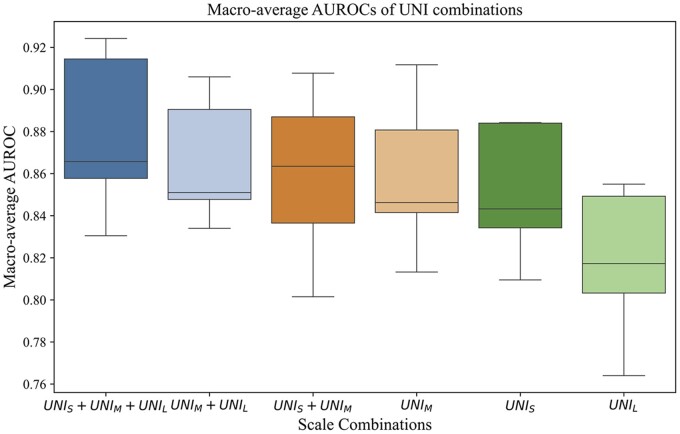
Results: Our approach leverages a hierarchical foundation model as a backbone, fine-tuned from the UNI computational pathology foundation model, to extract tissue embedding from different scales. We have achieved promising results through extensive experimentation on the Fudan University Shanghai Cancer Center cohort (N = 364). Our model demonstrates a macro-average AUROC of 0.879 (95% CI, 0.853-0.904) in a five-fold cross-validation. Compared to the current state-of-the-art molecular subtypes prediction for endometrial cancer, our method outperforms in terms of predictive accuracy and computational efficiency. Moreover, our method is highly reproducible, allowing for ease of implementation and widespread adoption. This study aims to address the cost and time constraints associated with traditional gene sequencing techniques. By providing a reliable and accessible alternative to gene sequencing, our method has the potential to revolutionize the field of endometrial cancer diagnosis and improve patient outcomes.
Availability and implementation: The codes and data used for generating results in this study are available at https://github.com/HaoyuCui/hi-UNI for GitHub and https://doi.org/10.5281/zenodo.14627478 for Zenodo.






 京公网安备 11010802042870号
京ICP备2023020795号-1
京公网安备 11010802042870号
京ICP备2023020795号-1

 分享
分享

 求助内容:
求助内容: 应助结果提醒方式:
 扫码关注我们
