Hemoglobin-loaded ZIF-8 nanoparticles equipped with PEGylated metal-phenolic network coatings: an oxygen carrier with antioxidant and stealth properties†
Clara Coll-Satue, Eva Cabrera-San Millan, Michelle Maria Theresia Jansman, Lisa Arnholdt and Leticia Hosta-Rigau
{"title":"Hemoglobin-loaded ZIF-8 nanoparticles equipped with PEGylated metal-phenolic network coatings: an oxygen carrier with antioxidant and stealth properties†","authors":"Clara Coll-Satue, Eva Cabrera-San Millan, Michelle Maria Theresia Jansman, Lisa Arnholdt and Leticia Hosta-Rigau","doi":"10.1039/D4TB01771D","DOIUrl":null,"url":null,"abstract":"<p >Hemoglobin-based oxygen carriers (HBOCs) offer a promising alternative to conventional blood transfusions in emergency scenarios. However, achieving optimal stability, functionality, and biocompatibility in HBOCs remains a significant challenge. In this study, we employed a HBOC formulation consisting of hemoglobin (Hb) encapsulated within zeolitic imidazolate framework-8 (ZIF-8) nanoparticles (NPs). These NPs were subsequently coated with metal phenolic networks (MPNs) and polyethylene glycol (PEG) to impart antioxidant properties and enhance their stability and biocompatibility. Hb-loaded ZIF-8 NPs were synthesized using a rapid, environmentally friendly protocol and exhibited desirable properties, including an average size of approximately 150 nm, a negative surface charge (zeta potential of −14 mV), high encapsulation efficiency (approximately 65%), and substantial drug loading capacity (around 70%). The MPN coating significantly enhanced stability across various buffers and cell media and endowed the NPs with antioxidant properties. Meanwhile, the PEG layer conferred stealth properties, potentially extending circulation times <em>in vivo</em>. Furthermore, the NPs showed excellent biocompatibility in terms of cell viability and hemolysis rate studies. They also efficiently bound and released oxygen across multiple cycles, demonstrating preserved functionality. These attributes highlight the potential of our novel HBOC as an effective oxygen delivery system and position our formulation as a promising candidate for clinical application in critical care, providing a strategic alternative to traditional blood transfusions.</p>","PeriodicalId":83,"journal":{"name":"Journal of Materials Chemistry B","volume":" 10","pages":" 3374-3389"},"PeriodicalIF":6.1000,"publicationDate":"2025-01-22","publicationTypes":"Journal Article","fieldsOfStudy":null,"isOpenAccess":false,"openAccessPdf":"","citationCount":"0","resultStr":null,"platform":"Semanticscholar","paperid":null,"PeriodicalName":"Journal of Materials Chemistry B","FirstCategoryId":"1","ListUrlMain":"https://pubs.rsc.org/en/content/articlelanding/2025/tb/d4tb01771d","RegionNum":3,"RegionCategory":"医学","ArticlePicture":[],"TitleCN":null,"AbstractTextCN":null,"PMCID":null,"EPubDate":"","PubModel":"","JCR":"Q1","JCRName":"MATERIALS SCIENCE, BIOMATERIALS","Score":null,"Total":0}
引用次数: 0
Abstract
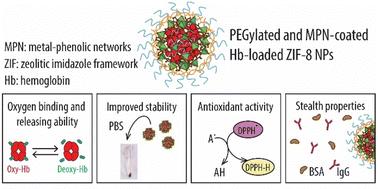
Hemoglobin-based oxygen carriers (HBOCs) offer a promising alternative to conventional blood transfusions in emergency scenarios. However, achieving optimal stability, functionality, and biocompatibility in HBOCs remains a significant challenge. In this study, we employed a HBOC formulation consisting of hemoglobin (Hb) encapsulated within zeolitic imidazolate framework-8 (ZIF-8) nanoparticles (NPs). These NPs were subsequently coated with metal phenolic networks (MPNs) and polyethylene glycol (PEG) to impart antioxidant properties and enhance their stability and biocompatibility. Hb-loaded ZIF-8 NPs were synthesized using a rapid, environmentally friendly protocol and exhibited desirable properties, including an average size of approximately 150 nm, a negative surface charge (zeta potential of −14 mV), high encapsulation efficiency (approximately 65%), and substantial drug loading capacity (around 70%). The MPN coating significantly enhanced stability across various buffers and cell media and endowed the NPs with antioxidant properties. Meanwhile, the PEG layer conferred stealth properties, potentially extending circulation times in vivo. Furthermore, the NPs showed excellent biocompatibility in terms of cell viability and hemolysis rate studies. They also efficiently bound and released oxygen across multiple cycles, demonstrating preserved functionality. These attributes highlight the potential of our novel HBOC as an effective oxygen delivery system and position our formulation as a promising candidate for clinical application in critical care, providing a strategic alternative to traditional blood transfusions.
期刊介绍:
Journal of Materials Chemistry A, B & C cover high quality studies across all fields of materials chemistry. The journals focus on those theoretical or experimental studies that report new understanding, applications, properties and synthesis of materials. Journal of Materials Chemistry A, B & C are separated by the intended application of the material studied. Broadly, applications in energy and sustainability are of interest to Journal of Materials Chemistry A, applications in biology and medicine are of interest to Journal of Materials Chemistry B, and applications in optical, magnetic and electronic devices are of interest to Journal of Materials Chemistry C.Journal of Materials Chemistry B is a Transformative Journal and Plan S compliant. Example topic areas within the scope of Journal of Materials Chemistry B are listed below. This list is neither exhaustive nor exclusive:
Antifouling coatings
Biocompatible materials
Bioelectronics
Bioimaging
Biomimetics
Biomineralisation
Bionics
Biosensors
Diagnostics
Drug delivery
Gene delivery
Immunobiology
Nanomedicine
Regenerative medicine & Tissue engineering
Scaffolds
Soft robotics
Stem cells
Therapeutic devices



 京公网安备 11010802042870号
京ICP备2023020795号-1
京公网安备 11010802042870号
京ICP备2023020795号-1

 分享
分享
 求助内容:
求助内容: 应助结果提醒方式:
 扫码关注我们
