{"title":"Self-Powered Water Electrolysis with Sulfide Waste as Consumable","authors":"Jucai Wei, Xu Wu","doi":"10.1021/acssuschemeng.4c09699","DOIUrl":null,"url":null,"abstract":"Water electrolysis is a powerful and environmentally friendly strategy for green H<sub>2</sub> production. However, the kinetics and efficiency of this process suffer seriously from the sluggish oxygen evolution reaction. Here, we report a fully self-powered H<sub>2</sub> production approach coupling a hydrogen evolution reaction with a sulfide oxidation reaction. Driven by a sulfidic spent caustic stream, the lab-scale flow reactor can deliver an open-circuit voltage of up to 0.44 V and a self-powered current density of up to 33.79 mA cm<sup>–2</sup>. A hybrid NiCu-doped MoS<sub>2</sub> catalyst is prepared using a nickel–copper etching waste fluid, which can effectively catalyze sulfide oxidation and hydrogen evolution. The conversion efficiencies for waste chemical energy to electricity and H<sub>2</sub> are >40% and >30%, respectively. This work strongly suggests a self-powered H<sub>2</sub> production potential and ability by coupling water splitting with small-molecule waste treatments, with substantial benefits concerning energy conservation, waste treatment, and resource optimization.","PeriodicalId":25,"journal":{"name":"ACS Sustainable Chemistry & Engineering","volume":"55 1","pages":""},"PeriodicalIF":7.3000,"publicationDate":"2025-02-11","publicationTypes":"Journal Article","fieldsOfStudy":null,"isOpenAccess":false,"openAccessPdf":"","citationCount":"0","resultStr":null,"platform":"Semanticscholar","paperid":null,"PeriodicalName":"ACS Sustainable Chemistry & Engineering","FirstCategoryId":"92","ListUrlMain":"https://doi.org/10.1021/acssuschemeng.4c09699","RegionNum":1,"RegionCategory":"化学","ArticlePicture":[],"TitleCN":null,"AbstractTextCN":null,"PMCID":null,"EPubDate":"","PubModel":"","JCR":"Q1","JCRName":"CHEMISTRY, MULTIDISCIPLINARY","Score":null,"Total":0}
引用次数: 0
Abstract
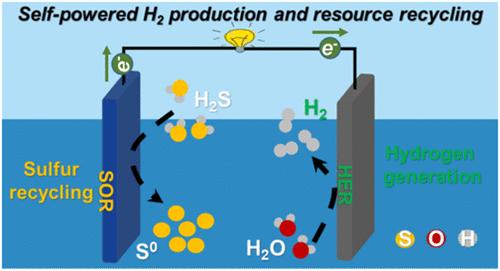
Water electrolysis is a powerful and environmentally friendly strategy for green H2 production. However, the kinetics and efficiency of this process suffer seriously from the sluggish oxygen evolution reaction. Here, we report a fully self-powered H2 production approach coupling a hydrogen evolution reaction with a sulfide oxidation reaction. Driven by a sulfidic spent caustic stream, the lab-scale flow reactor can deliver an open-circuit voltage of up to 0.44 V and a self-powered current density of up to 33.79 mA cm–2. A hybrid NiCu-doped MoS2 catalyst is prepared using a nickel–copper etching waste fluid, which can effectively catalyze sulfide oxidation and hydrogen evolution. The conversion efficiencies for waste chemical energy to electricity and H2 are >40% and >30%, respectively. This work strongly suggests a self-powered H2 production potential and ability by coupling water splitting with small-molecule waste treatments, with substantial benefits concerning energy conservation, waste treatment, and resource optimization.
水电解是一种强大而环保的绿色制氢策略。但析氧反应缓慢严重影响了该过程的动力学和效率。在这里,我们报告了一种完全自供电的制氢方法,将析氢反应与硫化物氧化反应耦合在一起。实验室规模的流动反应器由硫化物废碱流驱动,可提供高达0.44 V的开路电压和高达33.79 mA cm-2的自供电电流密度。利用镍铜蚀刻废液制备了掺杂nicu的MoS2杂化催化剂,该催化剂能有效催化硫化物氧化和析氢。废化学能转化为电能和氢气的效率分别为40%和30%。该研究强烈表明,将水裂解与小分子废物处理相结合,具有自供电制氢的潜力和能力,在节能、废物处理和资源优化方面具有实质性的效益。
期刊介绍:
ACS Sustainable Chemistry & Engineering is a prestigious weekly peer-reviewed scientific journal published by the American Chemical Society. Dedicated to advancing the principles of green chemistry and green engineering, it covers a wide array of research topics including green chemistry, green engineering, biomass, alternative energy, and life cycle assessment.
The journal welcomes submissions in various formats, including Letters, Articles, Features, and Perspectives (Reviews), that address the challenges of sustainability in the chemical enterprise and contribute to the advancement of sustainable practices. Join us in shaping the future of sustainable chemistry and engineering.



 京公网安备 11010802042870号
京ICP备2023020795号-1
京公网安备 11010802042870号
京ICP备2023020795号-1

 分享
分享
 求助内容:
求助内容: 应助结果提醒方式:
 扫码关注我们
