Keshet Pardo, Vadim Khasminsky, Ophir Keret, Felix Benninger, Ilan Goldberg, Ilan Shelef, Eitan Auriel, Amir Glik
{"title":"Alzheimer's disease patients have smaller venous drainage system compared to cognitively healthy controls","authors":"Keshet Pardo, Vadim Khasminsky, Ophir Keret, Felix Benninger, Ilan Goldberg, Ilan Shelef, Eitan Auriel, Amir Glik","doi":"10.1002/alz.14551","DOIUrl":null,"url":null,"abstract":"<div>\n \n \n <section>\n \n <h3> INTRODUCTION</h3>\n \n <p>One of the pathological hallmarks of Alzheimer's disease (AD) is the accumulation of amyloid beta 42 (Aβ42). Decreased venous drainage may enhance Aβ42 accumulation. We aimed to compare venous cross-sectional area (CSA) of AD patients to cognitively healthy controls.</p>\n </section>\n \n <section>\n \n <h3> METHODS</h3>\n \n <p>All patients underwent neurocognitive evaluation and brain magnetic resonance imaging, including time-of-flight sequence. Venous CSA was measured at the jugular foramen level.</p>\n </section>\n \n <section>\n \n <h3> RESULTS</h3>\n \n <p>Thirty-nine AD/mild cognitive impairment patients and 20 cognitively healthy controls were included. Total venous CSA was smaller in the cognitively impaired group (mean CSA 139.77 mm<sup>2</sup> [SD: 32.22] vs 166.55 mm<sup>2</sup> [SD: 33.1], <i>p</i> = 0.004]. When divided, both internal jugular and non-jugular systems were smaller within cognitively impaired patients; statistical significance was achieved only for the non-jugular system (mean CSA 41.21 mm<sup>2</sup> [SD: 21.52] vs 54.5 mm<sup>2</sup> [SD: 27.31], <i>p</i> = 0.045).</p>\n </section>\n \n <section>\n \n <h3> DISCUSSION</h3>\n \n <p>There is an association between smaller venous systems and cognitive impairment, most prominently in the non-jugular system. Venous narrowing may cause impaired venous drainage, leading to an accumulation of Aβ42.</p>\n </section>\n \n <section>\n \n <h3> Highlights</h3>\n \n <div>\n <ul>\n \n <li>The non-jugular venous system, including the vertebral plexus and pterygopalatine plexus, plays an important role in cerebral drainage.</li>\n \n <li>The total venous CSA is significantly smaller in cognitively impaired patients compared to healthy controls.</li>\n \n <li>Reduced venous drainage may contribute to the accumulation of Aβ and other waste products and potentially plays a role in AD pathology.</li>\n </ul>\n </div>\n </section>\n </div>","PeriodicalId":7471,"journal":{"name":"Alzheimer's & Dementia","volume":"21 2","pages":""},"PeriodicalIF":11.1000,"publicationDate":"2025-02-12","publicationTypes":"Journal Article","fieldsOfStudy":null,"isOpenAccess":false,"openAccessPdf":"https://onlinelibrary.wiley.com/doi/epdf/10.1002/alz.14551","citationCount":"0","resultStr":null,"platform":"Semanticscholar","paperid":null,"PeriodicalName":"Alzheimer's & Dementia","FirstCategoryId":"3","ListUrlMain":"https://alz-journals.onlinelibrary.wiley.com/doi/10.1002/alz.14551","RegionNum":1,"RegionCategory":"医学","ArticlePicture":[],"TitleCN":null,"AbstractTextCN":null,"PMCID":null,"EPubDate":"","PubModel":"","JCR":"Q1","JCRName":"CLINICAL NEUROLOGY","Score":null,"Total":0}
引用次数: 0
Abstract
INTRODUCTION
One of the pathological hallmarks of Alzheimer's disease (AD) is the accumulation of amyloid beta 42 (Aβ42). Decreased venous drainage may enhance Aβ42 accumulation. We aimed to compare venous cross-sectional area (CSA) of AD patients to cognitively healthy controls.
METHODS
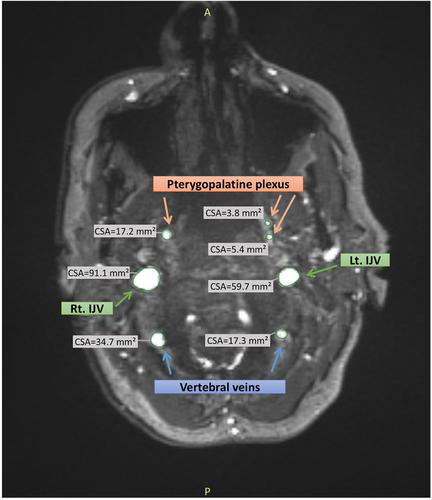
All patients underwent neurocognitive evaluation and brain magnetic resonance imaging, including time-of-flight sequence. Venous CSA was measured at the jugular foramen level.
RESULTS
Thirty-nine AD/mild cognitive impairment patients and 20 cognitively healthy controls were included. Total venous CSA was smaller in the cognitively impaired group (mean CSA 139.77 mm2 [SD: 32.22] vs 166.55 mm2 [SD: 33.1], p = 0.004]. When divided, both internal jugular and non-jugular systems were smaller within cognitively impaired patients; statistical significance was achieved only for the non-jugular system (mean CSA 41.21 mm2 [SD: 21.52] vs 54.5 mm2 [SD: 27.31], p = 0.045).
DISCUSSION
There is an association between smaller venous systems and cognitive impairment, most prominently in the non-jugular system. Venous narrowing may cause impaired venous drainage, leading to an accumulation of Aβ42.
Highlights
The non-jugular venous system, including the vertebral plexus and pterygopalatine plexus, plays an important role in cerebral drainage.
The total venous CSA is significantly smaller in cognitively impaired patients compared to healthy controls.
Reduced venous drainage may contribute to the accumulation of Aβ and other waste products and potentially plays a role in AD pathology.
期刊介绍:
Alzheimer's & Dementia is a peer-reviewed journal that aims to bridge knowledge gaps in dementia research by covering the entire spectrum, from basic science to clinical trials to social and behavioral investigations. It provides a platform for rapid communication of new findings and ideas, optimal translation of research into practical applications, increasing knowledge across diverse disciplines for early detection, diagnosis, and intervention, and identifying promising new research directions. In July 2008, Alzheimer's & Dementia was accepted for indexing by MEDLINE, recognizing its scientific merit and contribution to Alzheimer's research.





 京公网安备 11010802042870号
京ICP备2023020795号-1
京公网安备 11010802042870号
京ICP备2023020795号-1

 分享
分享
 求助内容:
求助内容: 应助结果提醒方式:
 扫码关注我们
