{"title":"Ranibizumab with luseogliflozin in type 2 diabetes with diabetic macular oedema: A randomised clinical trial","authors":"Ryoichi Ishibashi PhD, Yoko Takatsuna PhD, Masaya Koshizaka PhD, Tomoaki Tatsumi PhD, Sho Takahashi PhD, Kengo Nagashima PhD, Ko Ishikawa PhD, Tomomi Kaiho PhD, Noriko Asaumi M.D., Takayuki Baba PhD, Shuichi Yamamoto PhD, Koutaro Yokote PhD, The COMET Trial investigators","doi":"10.1111/dom.16244","DOIUrl":null,"url":null,"abstract":"<div>\n \n \n <section>\n \n <h3> Aims</h3>\n \n <p>Anti-vascular endothelial growth factor (VEGF) therapy is the standard treatment for diabetic macular oedema (DMO); however, unmet needs remain. This study aimed to assess the effectiveness of sodium-glucose cotransporter 2 inhibitors (SGLT2i) in treating DMO.</p>\n </section>\n \n <section>\n \n <h3> Materials and Methods</h3>\n \n <p>This multicentre randomised open-label trial included 60 patients with DMO who were eligible for anti-VEGF therapy. Patients were randomised to receive luseogliflozin or glimepiride. Ranibizumab was administered initially to the target eye, with additional doses per protocol. The number of ranibizumab doses up to week 48, and re-admission rates were evaluated. Fellow eye injections were also assessed.</p>\n </section>\n \n <section>\n \n <h3> Results</h3>\n \n <p>Sixty participants, mostly with diabetic retinopathy and half previously treated with anti-VEGF therapy, were included. SGLT2i and sulfonylurea (SU) groups achieved equivalent glycated haemoglobin, central retinal thickness (CRT), and best-corrected visual acuity improvements. Injection frequency for the target eye was similar between groups (SGLT2i vs. SU: 3.9 ± 0.7 vs. 4.7 ± 0.7 times, <i>p</i> = 0.36). Re-administration rates were decreased significantly after the fourth injection in the SGLT2i group (<i>p</i> = 0.030, hazard ratio: 0.45, 95% confidence interval: 0.22–0.92). Fellow eyes in the SGLT2i group showed significant CRT reduction and fewer injections compared with those in the SU group (1.3 ± 0.6 vs. 3.4 ± 0.8, <i>p</i> = 0.016).</p>\n </section>\n \n <section>\n \n <h3> Conclusions</h3>\n \n <p>Although the overall number of anti-VEGF injections in the target eye showed no significant difference, some patients responded favourably to SGLT2i and required fewer injections. The reduction in fellow eye injections suggests SGLT2i's efficacy in treating early-stage DMO.</p>\n </section>\n \n <section>\n \n <h3> Trial Registration</h3>\n \n <p>University Hospital Medical Information Network Clinical Trial Registry (UMIN000033961); Japan Registry of Clinical Trials (jRCTs031180210).</p>\n </section>\n </div>","PeriodicalId":158,"journal":{"name":"Diabetes, Obesity & Metabolism","volume":"27 5","pages":"2473-2484"},"PeriodicalIF":5.7000,"publicationDate":"2025-02-11","publicationTypes":"Journal Article","fieldsOfStudy":null,"isOpenAccess":false,"openAccessPdf":"https://onlinelibrary.wiley.com/doi/epdf/10.1111/dom.16244","citationCount":"0","resultStr":null,"platform":"Semanticscholar","paperid":null,"PeriodicalName":"Diabetes, Obesity & Metabolism","FirstCategoryId":"3","ListUrlMain":"https://dom-pubs.onlinelibrary.wiley.com/doi/10.1111/dom.16244","RegionNum":2,"RegionCategory":"医学","ArticlePicture":[],"TitleCN":null,"AbstractTextCN":null,"PMCID":null,"EPubDate":"","PubModel":"","JCR":"Q1","JCRName":"ENDOCRINOLOGY & METABOLISM","Score":null,"Total":0}
引用次数: 0
Abstract
Aims
Anti-vascular endothelial growth factor (VEGF) therapy is the standard treatment for diabetic macular oedema (DMO); however, unmet needs remain. This study aimed to assess the effectiveness of sodium-glucose cotransporter 2 inhibitors (SGLT2i) in treating DMO.
Materials and Methods
This multicentre randomised open-label trial included 60 patients with DMO who were eligible for anti-VEGF therapy. Patients were randomised to receive luseogliflozin or glimepiride. Ranibizumab was administered initially to the target eye, with additional doses per protocol. The number of ranibizumab doses up to week 48, and re-admission rates were evaluated. Fellow eye injections were also assessed.
Results
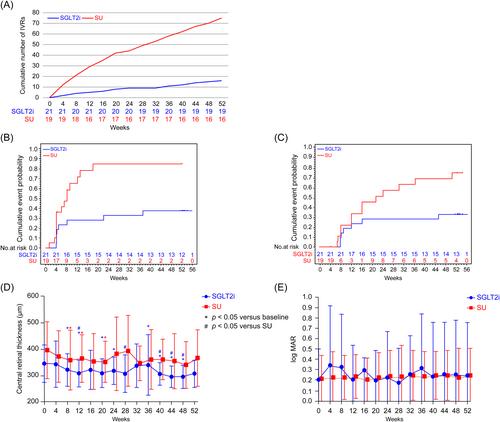
Sixty participants, mostly with diabetic retinopathy and half previously treated with anti-VEGF therapy, were included. SGLT2i and sulfonylurea (SU) groups achieved equivalent glycated haemoglobin, central retinal thickness (CRT), and best-corrected visual acuity improvements. Injection frequency for the target eye was similar between groups (SGLT2i vs. SU: 3.9 ± 0.7 vs. 4.7 ± 0.7 times, p = 0.36). Re-administration rates were decreased significantly after the fourth injection in the SGLT2i group (p = 0.030, hazard ratio: 0.45, 95% confidence interval: 0.22–0.92). Fellow eyes in the SGLT2i group showed significant CRT reduction and fewer injections compared with those in the SU group (1.3 ± 0.6 vs. 3.4 ± 0.8, p = 0.016).
Conclusions
Although the overall number of anti-VEGF injections in the target eye showed no significant difference, some patients responded favourably to SGLT2i and required fewer injections. The reduction in fellow eye injections suggests SGLT2i's efficacy in treating early-stage DMO.
Trial Registration
University Hospital Medical Information Network Clinical Trial Registry (UMIN000033961); Japan Registry of Clinical Trials (jRCTs031180210).
目的:抗血管内皮生长因子(VEGF)治疗是糖尿病性黄斑水肿(DMO)的标准治疗;然而,未满足的需求仍然存在。本研究旨在评估钠-葡萄糖共转运蛋白2抑制剂(SGLT2i)治疗DMO的有效性。材料和方法:这项多中心随机开放标签试验纳入了60例符合抗vegf治疗条件的DMO患者。患者随机接受鲁西格列净或格列美脲治疗。雷尼单抗最初施用于靶眼,每个方案增加剂量。评估到第48周的雷尼单抗剂量数和再入院率。对其他眼部注射患者也进行了评估。结果:60名参与者,大多数患有糖尿病视网膜病变,其中一半以前接受过抗vegf治疗。SGLT2i和磺酰脲(SU)组获得了相同的糖化血红蛋白、中央视网膜厚度(CRT)和最佳矫正视力改善。两组间靶眼注射次数相似(SGLT2i vs. SU: 3.9±0.7 vs. 4.7±0.7次,p = 0.36)。SGLT2i组第四次注射后再给药率显著降低(p = 0.030,风险比:0.45,95%可信区间:0.22-0.92)。与SU组相比,SGLT2i组的其他眼显示显着的CRT减少和注射次数减少(1.3±0.6比3.4±0.8,p = 0.016)。结论:虽然靶眼抗vegf注射总次数无显著差异,但部分患者对SGLT2i反应良好,所需注射次数较少。眼部注射的减少表明SGLT2i治疗早期DMO的有效性。试验注册:大学医院医学信息网临床试验注册(UMIN000033961);日本临床试验注册中心(jRCTs031180210)。
期刊介绍:
Diabetes, Obesity and Metabolism is primarily a journal of clinical and experimental pharmacology and therapeutics covering the interrelated areas of diabetes, obesity and metabolism. The journal prioritises high-quality original research that reports on the effects of new or existing therapies, including dietary, exercise and lifestyle (non-pharmacological) interventions, in any aspect of metabolic and endocrine disease, either in humans or animal and cellular systems. ‘Metabolism’ may relate to lipids, bone and drug metabolism, or broader aspects of endocrine dysfunction. Preclinical pharmacology, pharmacokinetic studies, meta-analyses and those addressing drug safety and tolerability are also highly suitable for publication in this journal. Original research may be published as a main paper or as a research letter.





 京公网安备 11010802042870号
京ICP备2023020795号-1
京公网安备 11010802042870号
京ICP备2023020795号-1

 分享
分享
 求助内容:
求助内容: 应助结果提醒方式:
 扫码关注我们
