A rapid and effective approach to building a life-saving multidisciplinary team for transferred postpartum haemorrhage patients: leveraging trauma experience-a retrospective study.
{"title":"A rapid and effective approach to building a life-saving multidisciplinary team for transferred postpartum haemorrhage patients: leveraging trauma experience-a retrospective study.","authors":"Pei-Hsiu Yu, Kuo-Shu Hung, Lin Kang, Tsung-Han Yang, Chun-Hsien Wu, Pei-Yin Tsai, Chih-Jung Wang, Yi-Ting Yen, Chen-Hsiang Yu, Chiung-Hsin Chang","doi":"10.1186/s12884-025-07204-z","DOIUrl":null,"url":null,"abstract":"<p><strong>Background: </strong>Establishing an efficient multidisciplinary team for transferred postpartum haemorrhage (PPH) cases is challenging due to limited clinical exposure. We hypothesised that leveraging trauma team experience could effectively facilitate the development of such a team within a short timeframe.</p><p><strong>Methods: </strong>In September 2019, a multidisciplinary team was established at our tertiary care centre to provide rapid management of critical PPH cases transferred from the obstetric clinic, prioritising immediate resuscitation and haemostatic interventions. This historical cohort study (2017-2022) compared outcomes before (2017-2018, before group [BG]) and after (2019-2022, after group [AG]) team establishment. Outcomes included process-related quality indicators, clinical measures such as length of hospital stay, intensive care unit (ICU) days, presence of the lethal triad, and hysterectomy rate.</p><p><strong>Results: </strong>Of the 71 PPH patients transferred during the study period, 24 were in the BG and 47 in the AG. The AG demonstrated higher use of tranexamic acid (33.33% vs. 74.47%, P = 0.002), shorter time to the first blood transfusion (11 vs. 8 min, P = 0.029), and increased rates of arrival in the operating room within 60 min (25% vs. 80%, P = 0.014). Clinical outcomes showed reduced rates of cardiopulmonary resuscitation (16.67% vs. 0%, P = 0.011) and shorter ICU stays (4 vs. 1 day, P = 0.005) in the AG.</p><p><strong>Conclusions: </strong>Leveraging trauma team expertise is an effective strategy for establishing a multidisciplinary PPH team, significantly improving outcomes for critically ill PPH patients transferred from obstetric clinics.</p>","PeriodicalId":9033,"journal":{"name":"BMC Pregnancy and Childbirth","volume":"25 1","pages":"137"},"PeriodicalIF":2.7000,"publicationDate":"2025-02-11","publicationTypes":"Journal Article","fieldsOfStudy":null,"isOpenAccess":false,"openAccessPdf":"https://www.ncbi.nlm.nih.gov/pmc/articles/PMC11817719/pdf/","citationCount":"0","resultStr":null,"platform":"Semanticscholar","paperid":null,"PeriodicalName":"BMC Pregnancy and Childbirth","FirstCategoryId":"3","ListUrlMain":"https://doi.org/10.1186/s12884-025-07204-z","RegionNum":2,"RegionCategory":"医学","ArticlePicture":[],"TitleCN":null,"AbstractTextCN":null,"PMCID":null,"EPubDate":"","PubModel":"","JCR":"Q1","JCRName":"OBSTETRICS & GYNECOLOGY","Score":null,"Total":0}
引用次数: 0
Abstract
Background: Establishing an efficient multidisciplinary team for transferred postpartum haemorrhage (PPH) cases is challenging due to limited clinical exposure. We hypothesised that leveraging trauma team experience could effectively facilitate the development of such a team within a short timeframe.
Methods: In September 2019, a multidisciplinary team was established at our tertiary care centre to provide rapid management of critical PPH cases transferred from the obstetric clinic, prioritising immediate resuscitation and haemostatic interventions. This historical cohort study (2017-2022) compared outcomes before (2017-2018, before group [BG]) and after (2019-2022, after group [AG]) team establishment. Outcomes included process-related quality indicators, clinical measures such as length of hospital stay, intensive care unit (ICU) days, presence of the lethal triad, and hysterectomy rate.
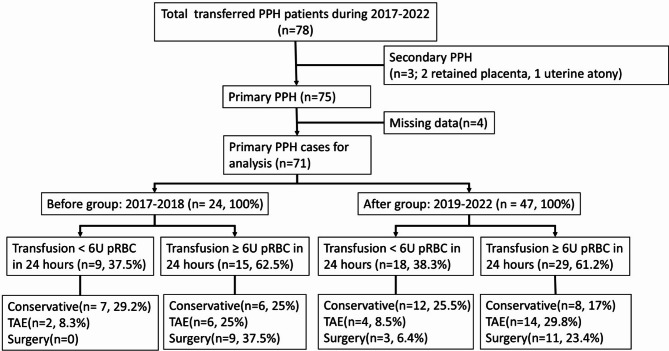
Results: Of the 71 PPH patients transferred during the study period, 24 were in the BG and 47 in the AG. The AG demonstrated higher use of tranexamic acid (33.33% vs. 74.47%, P = 0.002), shorter time to the first blood transfusion (11 vs. 8 min, P = 0.029), and increased rates of arrival in the operating room within 60 min (25% vs. 80%, P = 0.014). Clinical outcomes showed reduced rates of cardiopulmonary resuscitation (16.67% vs. 0%, P = 0.011) and shorter ICU stays (4 vs. 1 day, P = 0.005) in the AG.
Conclusions: Leveraging trauma team expertise is an effective strategy for establishing a multidisciplinary PPH team, significantly improving outcomes for critically ill PPH patients transferred from obstetric clinics.
背景:由于临床暴露有限,建立一个高效的多学科团队来治疗转移性产后出血(PPH)病例具有挑战性。我们假设,利用创伤团队的经验可以在短时间内有效地促进这样一个团队的发展。方法:2019年9月,我们在三级保健中心成立了一个多学科团队,为从产科诊所转来的PPH危重病例提供快速管理,优先考虑立即复苏和止血干预。本历史队列研究(2017-2022)比较了团队成立前(2017-2018,组[BG])和团队成立后(2019-2022,组[AG])的结果。结果包括过程相关的质量指标、临床指标,如住院时间、重症监护病房(ICU)天数、致死性三联征的存在和子宫切除术率。结果:在研究期间转移的71例PPH患者中,BG 24例,AG 47例。AG组氨甲环酸使用率较高(33.33% vs. 74.47%, P = 0.002),第一次输血时间较短(11 vs. 8 min, P = 0.029), 60 min内到达手术室率较高(25% vs. 80%, P = 0.014)。临床结果显示,AG组的心肺复苏率降低(16.67%对0%,P = 0.011), ICU住院时间缩短(4天对1天,P = 0.005)。结论:利用创伤团队的专业知识是建立多学科PPH团队的有效策略,可显著改善从产科转院的重症PPH患者的预后。
期刊介绍:
BMC Pregnancy & Childbirth is an open access, peer-reviewed journal that considers articles on all aspects of pregnancy and childbirth. The journal welcomes submissions on the biomedical aspects of pregnancy, breastfeeding, labor, maternal health, maternity care, trends and sociological aspects of pregnancy and childbirth.





 京公网安备 11010802042870号
京ICP备2023020795号-1
京公网安备 11010802042870号
京ICP备2023020795号-1

 分享
分享
 求助内容:
求助内容: 应助结果提醒方式:
 扫码关注我们
