Association between isolated abnormal 1-hour glucose challenge test and adverse pregnancy outcomes: a retrospective review from an urban tertiary care center in the United States.
Hillary Hosier, Lisbet S Lundsberg, Jennifer Culhane, Caitlin Partridge, Moeun Son
{"title":"Association between isolated abnormal 1-hour glucose challenge test and adverse pregnancy outcomes: a retrospective review from an urban tertiary care center in the United States.","authors":"Hillary Hosier, Lisbet S Lundsberg, Jennifer Culhane, Caitlin Partridge, Moeun Son","doi":"10.1186/s12884-025-07214-x","DOIUrl":null,"url":null,"abstract":"<p><strong>Background: </strong>The objective of this study was to investigate whether an isolated abnormal 1-hour glucose challenge test (GCT) among patients without gestational diabetes (GDM) is associated with adverse outcomes.</p><p><strong>Methods: </strong>This is a retrospective cohort study of patients who underwent GDM screening at ≥ 24 weeks' gestation with a 1-hour GCT and delivered a singleton fetus at > 35 weeks' gestation at an urban tertiary hospital from 1/2013 to 10/2021. Data were extracted from an electronic medical record data warehouse using standardized billing/diagnosis codes. Individuals were categorized into 3 groups: normal screening (1-hour GCT value < 140 mg/dL), intermediate screening (1-hour GCT value ≥ 140 and < 200 but normal 3-hour glucose tolerance test (GTT)), and GDM (1-hour GCT ≥ 200 mg/dL or abnormal 3-hour GTT). The primary composite perinatal morbidity outcome included any of the following: large for gestational age (LGA) birthweight, birth injury, hypoglycemia with neonatal intensive care unit (NICU) admission, respiratory distress syndrome, transient tachypnea of the newborn, apnea, NICU admission, or perinatal death. Multiple secondary outcomes were also evaluated. Bivariable analyses and multivariable logistic regression modeling were performed.</p><p><strong>Results: </strong>Of 37,277 eligible patients, 29,698 (79.7%) had normal screening results, 5092 (13.7%) had intermediate screening results, and 2487 (6.6%) were diagnosed with GDM. There were significant differences in baseline characteristics between the three groups, including age, parity, race and ethnicity, payer-type, obesity, and pre-pregnancy metformin use. Compared to normal screening, intermediate screening was associated with an increased risk for the composite perinatal morbidity outcome (OR 1.23, 95% CI 1.15-1.32), cesarean (OR 1.37, 95% CI 1.28-1.46), and hypertensive disorders of pregnancy (OR 1.30, 95% CI 1.20-1.40). Associations for these outcomes were further pronounced in those with GDM compared to normal screening (OR 1.86, 95% CI 1.70-2.03; OR 1.69, 95% CI 1.56-1.84; and OR 1.57, 95% CI 1.42-1.74, respectively). After adjusting for potential confounders, increased risks for the composite perinatal morbidity outcome persisted for those with intermediate screening (aOR 1.18, 95% CI 1.10-1.26).</p><p><strong>Conclusions: </strong>In addition to patients with GDM, individuals an isolated abnormal 1-hour GCT without GDM were also at increased risks for adverse pregnancy outcomes. Further investigation is needed to understand if patients with mild dysregulation may still benefit from other interventions.</p>","PeriodicalId":9033,"journal":{"name":"BMC Pregnancy and Childbirth","volume":"25 1","pages":"145"},"PeriodicalIF":2.7000,"publicationDate":"2025-02-11","publicationTypes":"Journal Article","fieldsOfStudy":null,"isOpenAccess":false,"openAccessPdf":"https://www.ncbi.nlm.nih.gov/pmc/articles/PMC11817534/pdf/","citationCount":"0","resultStr":null,"platform":"Semanticscholar","paperid":null,"PeriodicalName":"BMC Pregnancy and Childbirth","FirstCategoryId":"3","ListUrlMain":"https://doi.org/10.1186/s12884-025-07214-x","RegionNum":2,"RegionCategory":"医学","ArticlePicture":[],"TitleCN":null,"AbstractTextCN":null,"PMCID":null,"EPubDate":"","PubModel":"","JCR":"Q1","JCRName":"OBSTETRICS & GYNECOLOGY","Score":null,"Total":0}
引用次数: 0
Abstract
Background: The objective of this study was to investigate whether an isolated abnormal 1-hour glucose challenge test (GCT) among patients without gestational diabetes (GDM) is associated with adverse outcomes.
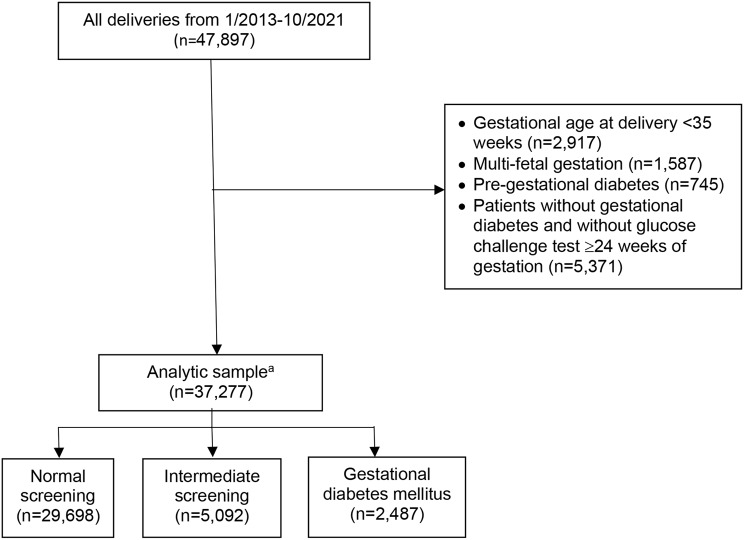
Methods: This is a retrospective cohort study of patients who underwent GDM screening at ≥ 24 weeks' gestation with a 1-hour GCT and delivered a singleton fetus at > 35 weeks' gestation at an urban tertiary hospital from 1/2013 to 10/2021. Data were extracted from an electronic medical record data warehouse using standardized billing/diagnosis codes. Individuals were categorized into 3 groups: normal screening (1-hour GCT value < 140 mg/dL), intermediate screening (1-hour GCT value ≥ 140 and < 200 but normal 3-hour glucose tolerance test (GTT)), and GDM (1-hour GCT ≥ 200 mg/dL or abnormal 3-hour GTT). The primary composite perinatal morbidity outcome included any of the following: large for gestational age (LGA) birthweight, birth injury, hypoglycemia with neonatal intensive care unit (NICU) admission, respiratory distress syndrome, transient tachypnea of the newborn, apnea, NICU admission, or perinatal death. Multiple secondary outcomes were also evaluated. Bivariable analyses and multivariable logistic regression modeling were performed.
Results: Of 37,277 eligible patients, 29,698 (79.7%) had normal screening results, 5092 (13.7%) had intermediate screening results, and 2487 (6.6%) were diagnosed with GDM. There were significant differences in baseline characteristics between the three groups, including age, parity, race and ethnicity, payer-type, obesity, and pre-pregnancy metformin use. Compared to normal screening, intermediate screening was associated with an increased risk for the composite perinatal morbidity outcome (OR 1.23, 95% CI 1.15-1.32), cesarean (OR 1.37, 95% CI 1.28-1.46), and hypertensive disorders of pregnancy (OR 1.30, 95% CI 1.20-1.40). Associations for these outcomes were further pronounced in those with GDM compared to normal screening (OR 1.86, 95% CI 1.70-2.03; OR 1.69, 95% CI 1.56-1.84; and OR 1.57, 95% CI 1.42-1.74, respectively). After adjusting for potential confounders, increased risks for the composite perinatal morbidity outcome persisted for those with intermediate screening (aOR 1.18, 95% CI 1.10-1.26).
Conclusions: In addition to patients with GDM, individuals an isolated abnormal 1-hour GCT without GDM were also at increased risks for adverse pregnancy outcomes. Further investigation is needed to understand if patients with mild dysregulation may still benefit from other interventions.
背景:本研究的目的是探讨无妊娠糖尿病(GDM)患者中单独异常的1小时葡萄糖激发试验(GCT)是否与不良结局相关。方法:本研究是一项回顾性队列研究,研究对象为2013年1月至2021年10月在某城市三级医院接受妊娠≥24周GDM筛查、妊娠1小时GCT检查、妊娠50 ~ 35周分娩单胎的患者。使用标准化计费/诊断代码从电子病历数据仓库中提取数据。结果:37277例符合条件的患者中,筛查结果正常的29698例(79.7%),中等筛查结果的5092例(13.7%),诊断为GDM的2487例(6.6%)。三组之间的基线特征有显著差异,包括年龄、胎次、种族和民族、付款人类型、肥胖和孕前二甲双胍使用情况。与常规筛查相比,中期筛查与围产期综合发病结局(OR 1.23, 95% CI 1.15-1.32)、剖宫产(OR 1.37, 95% CI 1.28-1.46)和妊娠高血压疾病(OR 1.30, 95% CI 1.20-1.40)的风险增加相关。与正常筛查相比,GDM患者这些结果的相关性进一步显著(OR 1.86, 95% CI 1.70-2.03;或1.69,95% ci 1.56-1.84;OR为1.57,95% CI为1.42-1.74)。在对潜在混杂因素进行校正后,中间筛查组围产期综合发病结局的风险持续增加(aOR 1.18, 95% CI 1.10-1.26)。结论:除了GDM患者外,单独异常1小时GCT无GDM的个体发生不良妊娠结局的风险也增加。需要进一步的研究来了解轻度失调的患者是否仍然可以从其他干预措施中获益。
期刊介绍:
BMC Pregnancy & Childbirth is an open access, peer-reviewed journal that considers articles on all aspects of pregnancy and childbirth. The journal welcomes submissions on the biomedical aspects of pregnancy, breastfeeding, labor, maternal health, maternity care, trends and sociological aspects of pregnancy and childbirth.



 京公网安备 11010802042870号
京ICP备2023020795号-1
京公网安备 11010802042870号
京ICP备2023020795号-1

 分享
分享
 求助内容:
求助内容: 应助结果提醒方式:
 扫码关注我们
