{"title":"Complications after treatment of type B aortic dissection with TEVAR stent-graft deployment in zone 2.","authors":"Xiao-Biao Zhou, Xin Chen, Zhan Wang, Ding-Qiang Chen, Rui Li, Li Li, Lin-Xi Xu, Zhi-Huang Chen, Man Song, Jian Huang, Jia-Wei Zhuang, Gang-Yi Cheng, Qing-Xin Xu, Zhuang-Hui Zhu, Zhong-Gui Shan","doi":"10.1186/s12872-025-04533-x","DOIUrl":null,"url":null,"abstract":"<p><strong>Objective: </strong>To analyze the outcome of 147 cases of type B aortic dissection with thoracic endovascular aortic repair (TEVAR).</p><p><strong>Methods: </strong>We systematically reviewed 147 patients of type B aortic dissection with stent graft deployment in zone 2 or zone 3 by TEVAR from January 2012 to December 2022. These patients were observed by computed tomography angiography after the first and third months and annually thereafter during follow-up. Statistical analysis was performed by SPSS.16.</p><p><strong>Results: </strong>The stent graft of 107 patients was deployed in zone 3, and the stent graft of 40 patients was deployed in zone 2. Severe dissection and surgery-related complications after TEVAR occurred in 19 patients, with complications arising more frequently in zone 2 than in zone 3 (12/40 vs. 7/107, P < 0.005). Endoleak was detected in 10 (6.8%, 10/147) cases, which included 6 cases of endoleak in zone 2, exceeding the 4 cases of endoleak in zone 3 (6/40 vs. 4/107, P < 0.05). Twelve (8.16%, 12/147) cases underwent re-intervention, and the 8 patients who underwent re-intervention in zone 2 exceeded the 4 patients who underwent re-intervention in zone 3 (8/40 vs. 4/107, P < 0.05). One case of subclavian steal in zone 2 (0.68%, 1/147). Two (1.36%, 2/147) cases died after TEVAR. The 1-year, 3-year, and 5-year overall survival rates were 99.3%, 98.6%, and 98.6%, respectively. The re-intervention rates were 5.4%, 7.5%, and 8.2%, respectively. The re-intervention rates in zone 2 were 15%, 20%, and 20%, respectively. The re-intervention rates in zone 3 were 1.9%, 2.8%, and 3.7%, respectively.</p><p><strong>Conclusion: </strong>TEVAR is the major treatment to use if the stent graft can be deployed in zone 3. However, with the higher rate of complications and re-intervention after TEVAR, for patients whose stent graft can only be deployed in zone 2, it is not recommended that TEVAR be chosen as the preferred treatment.</p>","PeriodicalId":9195,"journal":{"name":"BMC Cardiovascular Disorders","volume":"25 1","pages":"91"},"PeriodicalIF":2.3000,"publicationDate":"2025-02-11","publicationTypes":"Journal Article","fieldsOfStudy":null,"isOpenAccess":false,"openAccessPdf":"https://www.ncbi.nlm.nih.gov/pmc/articles/PMC11817873/pdf/","citationCount":"0","resultStr":null,"platform":"Semanticscholar","paperid":null,"PeriodicalName":"BMC Cardiovascular Disorders","FirstCategoryId":"3","ListUrlMain":"https://doi.org/10.1186/s12872-025-04533-x","RegionNum":3,"RegionCategory":"医学","ArticlePicture":[],"TitleCN":null,"AbstractTextCN":null,"PMCID":null,"EPubDate":"","PubModel":"","JCR":"Q3","JCRName":"CARDIAC & CARDIOVASCULAR SYSTEMS","Score":null,"Total":0}
引用次数: 0
Abstract
Objective: To analyze the outcome of 147 cases of type B aortic dissection with thoracic endovascular aortic repair (TEVAR).
Methods: We systematically reviewed 147 patients of type B aortic dissection with stent graft deployment in zone 2 or zone 3 by TEVAR from January 2012 to December 2022. These patients were observed by computed tomography angiography after the first and third months and annually thereafter during follow-up. Statistical analysis was performed by SPSS.16.
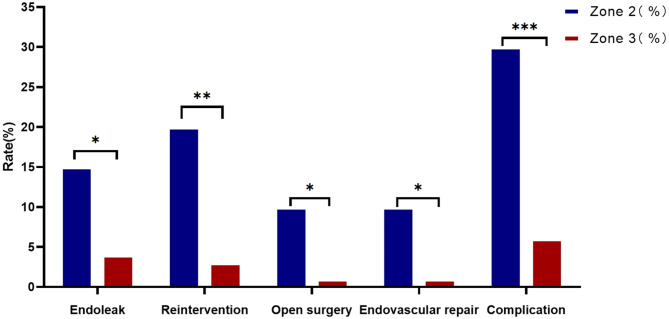
Results: The stent graft of 107 patients was deployed in zone 3, and the stent graft of 40 patients was deployed in zone 2. Severe dissection and surgery-related complications after TEVAR occurred in 19 patients, with complications arising more frequently in zone 2 than in zone 3 (12/40 vs. 7/107, P < 0.005). Endoleak was detected in 10 (6.8%, 10/147) cases, which included 6 cases of endoleak in zone 2, exceeding the 4 cases of endoleak in zone 3 (6/40 vs. 4/107, P < 0.05). Twelve (8.16%, 12/147) cases underwent re-intervention, and the 8 patients who underwent re-intervention in zone 2 exceeded the 4 patients who underwent re-intervention in zone 3 (8/40 vs. 4/107, P < 0.05). One case of subclavian steal in zone 2 (0.68%, 1/147). Two (1.36%, 2/147) cases died after TEVAR. The 1-year, 3-year, and 5-year overall survival rates were 99.3%, 98.6%, and 98.6%, respectively. The re-intervention rates were 5.4%, 7.5%, and 8.2%, respectively. The re-intervention rates in zone 2 were 15%, 20%, and 20%, respectively. The re-intervention rates in zone 3 were 1.9%, 2.8%, and 3.7%, respectively.
Conclusion: TEVAR is the major treatment to use if the stent graft can be deployed in zone 3. However, with the higher rate of complications and re-intervention after TEVAR, for patients whose stent graft can only be deployed in zone 2, it is not recommended that TEVAR be chosen as the preferred treatment.
目的:分析147例B型主动脉夹层胸椎血管内主动脉修复术(TEVAR)的治疗效果。方法:我们系统回顾了2012年1月至2022年12月147例在2区或3区放置支架的B型主动脉夹层患者。这些患者在随访后的第一个月和第三个月通过计算机断层血管造影进行观察,此后每年随访一次。采用SPSS.16进行统计学分析。结果:107例患者支架部署在3区,40例患者支架部署在2区。19例患者发生TEVAR术后严重的夹层和手术相关并发症,2区并发症发生率高于3区(12/40 vs. 7/107) P结论:如果可以在3区部署支架,TEVAR是主要的治疗方法。然而,由于TEVAR术后并发症和再干预率较高,对于只能在2区部署支架的患者,不建议选择TEVAR作为首选治疗。
期刊介绍:
BMC Cardiovascular Disorders is an open access, peer-reviewed journal that considers articles on all aspects of the prevention, diagnosis and management of disorders of the heart and circulatory system, as well as related molecular and cell biology, genetics, pathophysiology, epidemiology, and controlled trials.



 京公网安备 11010802042870号
京ICP备2023020795号-1
京公网安备 11010802042870号
京ICP备2023020795号-1

 分享
分享
 求助内容:
求助内容: 应助结果提醒方式:
 扫码关注我们
