Gabriel Pereira Nunes , Gabriella de Farias Batista , Priscila Toninatto Alves de Toledo , Tamires Passadori Martins , Renata de Oliveira Alves , Ana Vitória Pereira Fernandes , Alberto Carlos Botazzo Delbem
{"title":"Synthesis and application of calcium cyclotriphosphate in bleaching formulations: Effects on dental enamel properties","authors":"Gabriel Pereira Nunes , Gabriella de Farias Batista , Priscila Toninatto Alves de Toledo , Tamires Passadori Martins , Renata de Oliveira Alves , Ana Vitória Pereira Fernandes , Alberto Carlos Botazzo Delbem","doi":"10.1016/j.jdent.2025.105614","DOIUrl":null,"url":null,"abstract":"<div><h3>Objectives</h3><div>This study aimed to synthesize and evaluate the in vitro effects of varying concentrations (0.25%, 0.5%, and 1%) of calcium-substituted sodium trimetaphosphate (CaNaTMP) incorporated into 17.5% and 35% hydrogen peroxide (HP) whitening formulations on enamel color change, microhardness, morphology, surface roughness, mineral content, and transamelodentinal diffusion of HP.</div></div><div><h3>Materials and Methods</h3><div>Enamel/dentin discs (N = 288) were allocated into eight groups according to the bleaching gel: (1) 35% HP; (2) 35% HP + 0.25% CaNaTMP; (3) 35% HP + 0.5% CaNaTMP; (4) 35% HP + 1% CaNaTMP; (5) 17.5% HP; (6) 17.5% HP + 0.25% CaNaTMP; (7) 17.5% HP + 0.5% CaNaTMP; and (8) 17.5% HP + 1% CaNaTMP. Gels were applied for 40 min across three weekly sessions. Evaluated parameters included total color change according to CIELab (ΔE), CIEDE2000 equation (ΔE<sub>00</sub>), whiteness index (ΔWI<sub>D</sub>), surface hardness (SH), surface roughness (Ra), enamel mineral content (g<sub>HAp</sub> × cm⁻³ × µm), and transamelodentinal of HP. Scanning Electron Microscopy (SEM) and Energy Dispersive X-ray (EDX) analyses were used to assess enamel surface characteristics. Data were analyzed using ANOVA and the Student-Newman-Keuls test (p < 0.05).</div></div><div><h3>Results</h3><div>All bleaching gels caused significant color changes after treatment (p < 0.001), with similar ΔE, ΔE<sub>00</sub>, and ΔWI<sub>D</sub> values among them. Mineral loss (SH, g<sub>HAp</sub> × cm⁻³ × µm), Ra, and HP diffusion were highest with the 35% HP gel (p < 0.001) and lowest in groups containing CaNaTMP, particularly at 1% (p < 0.001). SEM/EDX analysis revealed no visible surface alterations in the 17.5% HP group, with prominent amorphous apatite precipitation in the 1% CaTMP-containing group. Incorporating CaNaTMP, particularly at 0.5% and 1%, into the 35% HP gel reduced surface changes.</div></div><div><h3>Conclusions</h3><div>This study demonstrated that the addition of CaNaTMP to bleaching gels with 17.5% and 35% HP reduces mineral loss, changes in roughness, and surface morphology of enamel, as well as decreasing trans-amelodentinal diffusion of H₂O₂, without compromising the bleaching efficacy. The incorporation of 1% CaNaTMP was particularly more effective in protecting the dental enamel.</div></div><div><h3>Clinical Relevance</h3><div>The incorporation of CaNaTMP to 17.5% and 35% HP bleaching gels enhances safety and biocompatibility by reducing enamel damage. The lower HP concentration (17.5%) combined with 1% CaNaTMP provides a safer whitening option, maintaining effectiveness while minimizing adverse enamel changes, aimed at improving patient comfort during treatment.</div></div>","PeriodicalId":15585,"journal":{"name":"Journal of dentistry","volume":"155 ","pages":"Article 105614"},"PeriodicalIF":5.5000,"publicationDate":"2025-04-01","publicationTypes":"Journal Article","fieldsOfStudy":null,"isOpenAccess":false,"openAccessPdf":"","citationCount":"0","resultStr":null,"platform":"Semanticscholar","paperid":null,"PeriodicalName":"Journal of dentistry","FirstCategoryId":"3","ListUrlMain":"https://www.sciencedirect.com/science/article/pii/S0300571225000594","RegionNum":2,"RegionCategory":"医学","ArticlePicture":[],"TitleCN":null,"AbstractTextCN":null,"PMCID":null,"EPubDate":"2025/2/9 0:00:00","PubModel":"Epub","JCR":"Q1","JCRName":"DENTISTRY, ORAL SURGERY & MEDICINE","Score":null,"Total":0}
引用次数: 0
Abstract
Objectives
This study aimed to synthesize and evaluate the in vitro effects of varying concentrations (0.25%, 0.5%, and 1%) of calcium-substituted sodium trimetaphosphate (CaNaTMP) incorporated into 17.5% and 35% hydrogen peroxide (HP) whitening formulations on enamel color change, microhardness, morphology, surface roughness, mineral content, and transamelodentinal diffusion of HP.
Materials and Methods
Enamel/dentin discs (N = 288) were allocated into eight groups according to the bleaching gel: (1) 35% HP; (2) 35% HP + 0.25% CaNaTMP; (3) 35% HP + 0.5% CaNaTMP; (4) 35% HP + 1% CaNaTMP; (5) 17.5% HP; (6) 17.5% HP + 0.25% CaNaTMP; (7) 17.5% HP + 0.5% CaNaTMP; and (8) 17.5% HP + 1% CaNaTMP. Gels were applied for 40 min across three weekly sessions. Evaluated parameters included total color change according to CIELab (ΔE), CIEDE2000 equation (ΔE00), whiteness index (ΔWID), surface hardness (SH), surface roughness (Ra), enamel mineral content (gHAp × cm⁻³ × µm), and transamelodentinal of HP. Scanning Electron Microscopy (SEM) and Energy Dispersive X-ray (EDX) analyses were used to assess enamel surface characteristics. Data were analyzed using ANOVA and the Student-Newman-Keuls test (p < 0.05).
Results
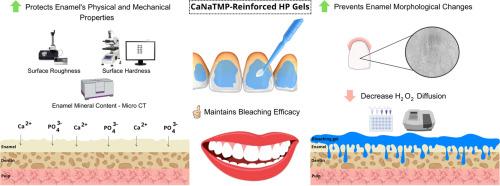
All bleaching gels caused significant color changes after treatment (p < 0.001), with similar ΔE, ΔE00, and ΔWID values among them. Mineral loss (SH, gHAp × cm⁻³ × µm), Ra, and HP diffusion were highest with the 35% HP gel (p < 0.001) and lowest in groups containing CaNaTMP, particularly at 1% (p < 0.001). SEM/EDX analysis revealed no visible surface alterations in the 17.5% HP group, with prominent amorphous apatite precipitation in the 1% CaTMP-containing group. Incorporating CaNaTMP, particularly at 0.5% and 1%, into the 35% HP gel reduced surface changes.
Conclusions
This study demonstrated that the addition of CaNaTMP to bleaching gels with 17.5% and 35% HP reduces mineral loss, changes in roughness, and surface morphology of enamel, as well as decreasing trans-amelodentinal diffusion of H₂O₂, without compromising the bleaching efficacy. The incorporation of 1% CaNaTMP was particularly more effective in protecting the dental enamel.
Clinical Relevance
The incorporation of CaNaTMP to 17.5% and 35% HP bleaching gels enhances safety and biocompatibility by reducing enamel damage. The lower HP concentration (17.5%) combined with 1% CaNaTMP provides a safer whitening option, maintaining effectiveness while minimizing adverse enamel changes, aimed at improving patient comfort during treatment.
期刊介绍:
The Journal of Dentistry has an open access mirror journal The Journal of Dentistry: X, sharing the same aims and scope, editorial team, submission system and rigorous peer review.
The Journal of Dentistry is the leading international dental journal within the field of Restorative Dentistry. Placing an emphasis on publishing novel and high-quality research papers, the Journal aims to influence the practice of dentistry at clinician, research, industry and policy-maker level on an international basis.
Topics covered include the management of dental disease, periodontology, endodontology, operative dentistry, fixed and removable prosthodontics, dental biomaterials science, long-term clinical trials including epidemiology and oral health, technology transfer of new scientific instrumentation or procedures, as well as clinically relevant oral biology and translational research.
The Journal of Dentistry will publish original scientific research papers including short communications. It is also interested in publishing review articles and leaders in themed areas which will be linked to new scientific research. Conference proceedings are also welcome and expressions of interest should be communicated to the Editor.




 京公网安备 11010802042870号
京ICP备2023020795号-1
京公网安备 11010802042870号
京ICP备2023020795号-1

 分享
分享
 求助内容:
求助内容: 应助结果提醒方式:
 扫码关注我们
