{"title":"FBXO45 restricts HIV-1 replication by inducing SQSTM1/p62-mediated autophagic degradation of Tat.","authors":"Mingxiu Xu, Haobo Hu, Weijing Yang, Jiaxiang Zhang, Hong Wang, Wenyan Zhang, Chen Huan","doi":"10.1128/jvi.01912-24","DOIUrl":null,"url":null,"abstract":"<p><p>As a key regulator of human immunodeficiency virus type 1 (HIV-1) transcription, Tat plays an essential role in viral replication and latency, making it a promising target for designing viral control strategies. Identifying host factors that modulate Tat and exploring the underlying mechanisms will benefit our understanding of HIV-1 transcriptional regulation and provide valuable insights into Tat-based therapeutic strategies. Here, by employing the TurboID approach, we discovered high-affinity binding between FBXO45 and Tat. Our findings demonstrate that FBXO45 negatively regulates Tat by promoting Tat ubiquitination and directing it to autophagic degradation. Autophagic degradation of Tat has been reported, but the specific underlying mechanisms remain unidentified. We elucidated this issue by providing evidence that FBXO45-mediated Tat polyubiquitination is an essential prerequisite for this process. Silencing of FBXO45 leads to a deficiency of autophagy receptor SQSTM1/p62 to bind and facilitate the autophagic degradation of Tat. Our results further underscore the crosstalk between post-translational modifications of Tat by demonstrating that the phosphorylation site of the Tat S62 residue is required for ubiquitination induced by FBXO45. Furthermore, in the context of the regulation of HIV-1, FBXO45 inhibits viral replication and maintains the latency of HIV-1 by suppressing viral transcription. Importantly, FBXO45 overexpression significantly attenuated viral rebound after antiretroviral therapy withdrawal. In summary, our findings suggest a novel role for FBXO45 in regulating HIV-1 replication by inducing the ubiquitination and SQSTM1/p62-dependent autophagic degradation of Tat. Considering the indispensable role of Tat in the regulation of HIV-1 replication and reactivation, FBXO45 may be a potential target for therapeutic intervention against HIV-1.IMPORTANCEHIV-1 Tat plays an indispensable role in regulating viral transcription and is a promising target for achieving a functional cure for AIDS. Identifying the host factors that modulate Tat expression could benefit the development of anti-HIV-1 strategies targeting Tat. Using TurboID assay, we identified a significant interaction between FBXO45 and Tat. Functionally, FBXO45 ubiquitinates and directs Tat for SQSTM1/p62-mediated autophagic degradation, thereby effectively restricting HIV-1 replication and maintaining HIV-1 latency by suppressing Tat-dependent viral transcription. These findings uncover a novel role for FBXO45 in regulating Tat and broaden our understanding of the host mechanisms involved in Tat processing.</p>","PeriodicalId":17583,"journal":{"name":"Journal of Virology","volume":" ","pages":"e0191224"},"PeriodicalIF":3.8000,"publicationDate":"2025-03-18","publicationTypes":"Journal Article","fieldsOfStudy":null,"isOpenAccess":false,"openAccessPdf":"https://www.ncbi.nlm.nih.gov/pmc/articles/PMC11916737/pdf/","citationCount":"0","resultStr":null,"platform":"Semanticscholar","paperid":null,"PeriodicalName":"Journal of Virology","FirstCategoryId":"3","ListUrlMain":"https://doi.org/10.1128/jvi.01912-24","RegionNum":2,"RegionCategory":"医学","ArticlePicture":[],"TitleCN":null,"AbstractTextCN":null,"PMCID":null,"EPubDate":"2025/2/12 0:00:00","PubModel":"Epub","JCR":"Q2","JCRName":"VIROLOGY","Score":null,"Total":0}
引用次数: 0
Abstract
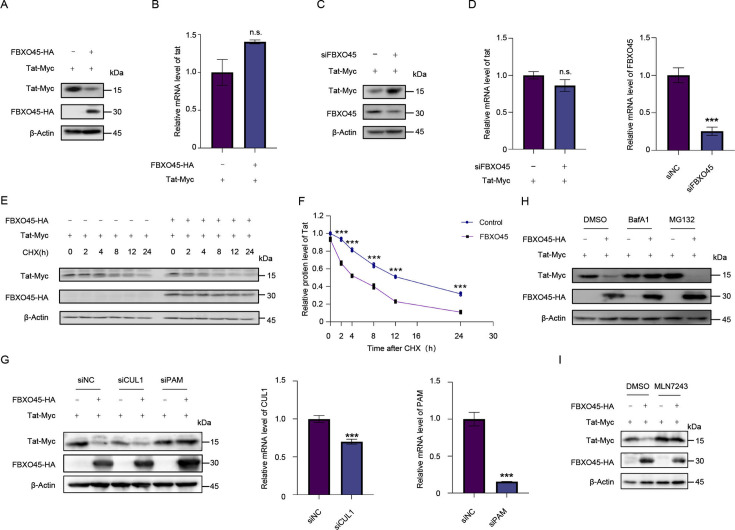
As a key regulator of human immunodeficiency virus type 1 (HIV-1) transcription, Tat plays an essential role in viral replication and latency, making it a promising target for designing viral control strategies. Identifying host factors that modulate Tat and exploring the underlying mechanisms will benefit our understanding of HIV-1 transcriptional regulation and provide valuable insights into Tat-based therapeutic strategies. Here, by employing the TurboID approach, we discovered high-affinity binding between FBXO45 and Tat. Our findings demonstrate that FBXO45 negatively regulates Tat by promoting Tat ubiquitination and directing it to autophagic degradation. Autophagic degradation of Tat has been reported, but the specific underlying mechanisms remain unidentified. We elucidated this issue by providing evidence that FBXO45-mediated Tat polyubiquitination is an essential prerequisite for this process. Silencing of FBXO45 leads to a deficiency of autophagy receptor SQSTM1/p62 to bind and facilitate the autophagic degradation of Tat. Our results further underscore the crosstalk between post-translational modifications of Tat by demonstrating that the phosphorylation site of the Tat S62 residue is required for ubiquitination induced by FBXO45. Furthermore, in the context of the regulation of HIV-1, FBXO45 inhibits viral replication and maintains the latency of HIV-1 by suppressing viral transcription. Importantly, FBXO45 overexpression significantly attenuated viral rebound after antiretroviral therapy withdrawal. In summary, our findings suggest a novel role for FBXO45 in regulating HIV-1 replication by inducing the ubiquitination and SQSTM1/p62-dependent autophagic degradation of Tat. Considering the indispensable role of Tat in the regulation of HIV-1 replication and reactivation, FBXO45 may be a potential target for therapeutic intervention against HIV-1.IMPORTANCEHIV-1 Tat plays an indispensable role in regulating viral transcription and is a promising target for achieving a functional cure for AIDS. Identifying the host factors that modulate Tat expression could benefit the development of anti-HIV-1 strategies targeting Tat. Using TurboID assay, we identified a significant interaction between FBXO45 and Tat. Functionally, FBXO45 ubiquitinates and directs Tat for SQSTM1/p62-mediated autophagic degradation, thereby effectively restricting HIV-1 replication and maintaining HIV-1 latency by suppressing Tat-dependent viral transcription. These findings uncover a novel role for FBXO45 in regulating Tat and broaden our understanding of the host mechanisms involved in Tat processing.
期刊介绍:
Journal of Virology (JVI) explores the nature of the viruses of animals, archaea, bacteria, fungi, plants, and protozoa. We welcome papers on virion structure and assembly, viral genome replication and regulation of gene expression, genetic diversity and evolution, virus-cell interactions, cellular responses to infection, transformation and oncogenesis, gene delivery, viral pathogenesis and immunity, and vaccines and antiviral agents.





 京公网安备 11010802042870号
京ICP备2023020795号-1
京公网安备 11010802042870号
京ICP备2023020795号-1

 分享
分享
 求助内容:
求助内容: 应助结果提醒方式:
 扫码关注我们
