E.M. Ofuchi , H. Stel , E. Mancilla , R.E.M. Morales
{"title":"Two-phase flow Investigation in a centrifugal rotor through particle image velocimetry","authors":"E.M. Ofuchi , H. Stel , E. Mancilla , R.E.M. Morales","doi":"10.1016/j.ces.2025.121360","DOIUrl":null,"url":null,"abstract":"<div><div>This work uses Particle Image Velocimetry (PIV) to calculate the liquid flow field in a radial centrifugal rotor operating with single and two-phase air–water flows. Different liquid and gas flow rates, as well as different rotating speeds, were tested. Results have shown that the liquid velocity presented slight changes, whereas the turbulent kinetic energy and the turbulent shear stress increased for a small gas volume fraction. However, increasing the mean bubble diameter at the intake has reduced the turbulent kinetic energy. This effect could be due to the energy absorption on the surface of the bubbles. Moreover, the turbulent has increased by increasing the liquid flow rate while keeping the gas flow rate fixed. The findings from this work shed light on the gas-phase effect over the liquid flow field, especially on bubble-induced turbulence. Furthermore, the results presented herein can be useful for numerical modeling validation and for improving models such as turbulence enhancement or suppression caused by bubbles.</div></div>","PeriodicalId":271,"journal":{"name":"Chemical Engineering Science","volume":"307 ","pages":"Article 121360"},"PeriodicalIF":4.3000,"publicationDate":"2025-03-15","publicationTypes":"Journal Article","fieldsOfStudy":null,"isOpenAccess":false,"openAccessPdf":"","citationCount":"0","resultStr":null,"platform":"Semanticscholar","paperid":null,"PeriodicalName":"Chemical Engineering Science","FirstCategoryId":"5","ListUrlMain":"https://www.sciencedirect.com/science/article/pii/S0009250925001836","RegionNum":2,"RegionCategory":"工程技术","ArticlePicture":[],"TitleCN":null,"AbstractTextCN":null,"PMCID":null,"EPubDate":"2025/2/12 0:00:00","PubModel":"Epub","JCR":"Q2","JCRName":"ENGINEERING, CHEMICAL","Score":null,"Total":0}
引用次数: 0
Abstract
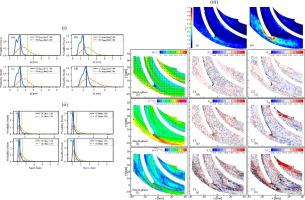
This work uses Particle Image Velocimetry (PIV) to calculate the liquid flow field in a radial centrifugal rotor operating with single and two-phase air–water flows. Different liquid and gas flow rates, as well as different rotating speeds, were tested. Results have shown that the liquid velocity presented slight changes, whereas the turbulent kinetic energy and the turbulent shear stress increased for a small gas volume fraction. However, increasing the mean bubble diameter at the intake has reduced the turbulent kinetic energy. This effect could be due to the energy absorption on the surface of the bubbles. Moreover, the turbulent has increased by increasing the liquid flow rate while keeping the gas flow rate fixed. The findings from this work shed light on the gas-phase effect over the liquid flow field, especially on bubble-induced turbulence. Furthermore, the results presented herein can be useful for numerical modeling validation and for improving models such as turbulence enhancement or suppression caused by bubbles.
期刊介绍:
Chemical engineering enables the transformation of natural resources and energy into useful products for society. It draws on and applies natural sciences, mathematics and economics, and has developed fundamental engineering science that underpins the discipline.
Chemical Engineering Science (CES) has been publishing papers on the fundamentals of chemical engineering since 1951. CES is the platform where the most significant advances in the discipline have ever since been published. Chemical Engineering Science has accompanied and sustained chemical engineering through its development into the vibrant and broad scientific discipline it is today.





 京公网安备 11010802042870号
京ICP备2023020795号-1
京公网安备 11010802042870号
京ICP备2023020795号-1

 分享
分享
 求助内容:
求助内容: 应助结果提醒方式:
 扫码关注我们
