Bohan Feng , Yicong Bao , Yuechang Wei , Dong Li , Jing Xiong , Zhen Zhao , Yunpeng Liu , Weiyu Song , Chunming Xu , Jian Liu
{"title":"Lattice-Confined single cobalt atom in ZrO2 for propane non-oxidative dehydrogenation","authors":"Bohan Feng , Yicong Bao , Yuechang Wei , Dong Li , Jing Xiong , Zhen Zhao , Yunpeng Liu , Weiyu Song , Chunming Xu , Jian Liu","doi":"10.1016/j.ces.2025.121349","DOIUrl":null,"url":null,"abstract":"<div><div>The single atom sites have been identified as the optimal structure for structure-insensitive alkane dehydrogenation reaction. However, single atoms with high surface energy suffer from sintering deactivation due to high-temperature conditions. Herein, we report the single cobalt (Co) atoms confined by the ZrO<sub>2</sub> lattice for the propane non-oxidative dehydrogenation (PDH) reaction. Compared with surface Co species, the lattice-confined effect of ZrO<sub>2</sub> basement prevents the structural transformation of single Co atoms and enriches the active site of Co-O-Zr. The Co single-atom catalyst shows remarkable activity (1.58 mmol g<sup>-1</sup>h<sup>−1</sup>) and achieves significantly more substantial regeneration stability than the catalysts with surface CoO<sub>x</sub> species. The research on lattice-confined Co-ZrO<sub>2</sub> catalysts provides a novel cognition for the lattice-confined effect and gives opportunities for the application of thermodynamically stable single-atom catalysts in the future.</div></div>","PeriodicalId":271,"journal":{"name":"Chemical Engineering Science","volume":"307 ","pages":"Article 121349"},"PeriodicalIF":4.3000,"publicationDate":"2025-03-15","publicationTypes":"Journal Article","fieldsOfStudy":null,"isOpenAccess":false,"openAccessPdf":"","citationCount":"0","resultStr":null,"platform":"Semanticscholar","paperid":null,"PeriodicalName":"Chemical Engineering Science","FirstCategoryId":"5","ListUrlMain":"https://www.sciencedirect.com/science/article/pii/S0009250925001721","RegionNum":2,"RegionCategory":"工程技术","ArticlePicture":[],"TitleCN":null,"AbstractTextCN":null,"PMCID":null,"EPubDate":"2025/2/12 0:00:00","PubModel":"Epub","JCR":"Q2","JCRName":"ENGINEERING, CHEMICAL","Score":null,"Total":0}
引用次数: 0
Abstract
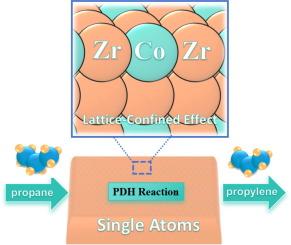
The single atom sites have been identified as the optimal structure for structure-insensitive alkane dehydrogenation reaction. However, single atoms with high surface energy suffer from sintering deactivation due to high-temperature conditions. Herein, we report the single cobalt (Co) atoms confined by the ZrO2 lattice for the propane non-oxidative dehydrogenation (PDH) reaction. Compared with surface Co species, the lattice-confined effect of ZrO2 basement prevents the structural transformation of single Co atoms and enriches the active site of Co-O-Zr. The Co single-atom catalyst shows remarkable activity (1.58 mmol g-1h−1) and achieves significantly more substantial regeneration stability than the catalysts with surface CoOx species. The research on lattice-confined Co-ZrO2 catalysts provides a novel cognition for the lattice-confined effect and gives opportunities for the application of thermodynamically stable single-atom catalysts in the future.
期刊介绍:
Chemical engineering enables the transformation of natural resources and energy into useful products for society. It draws on and applies natural sciences, mathematics and economics, and has developed fundamental engineering science that underpins the discipline.
Chemical Engineering Science (CES) has been publishing papers on the fundamentals of chemical engineering since 1951. CES is the platform where the most significant advances in the discipline have ever since been published. Chemical Engineering Science has accompanied and sustained chemical engineering through its development into the vibrant and broad scientific discipline it is today.





 京公网安备 11010802042870号
京ICP备2023020795号-1
京公网安备 11010802042870号
京ICP备2023020795号-1

 分享
分享
 求助内容:
求助内容: 应助结果提醒方式:
 扫码关注我们
