Design and fabrication of laser cladding pomegranate bionic structure FeCoNiCrAl high entropy alloy / AlN ceramic high temperature radar-infrared compatible hidden composite coating
Sanyang Gao , Xuming Pang , Sen Mu , Jibin Pu , Cheng Chen
{"title":"Design and fabrication of laser cladding pomegranate bionic structure FeCoNiCrAl high entropy alloy / AlN ceramic high temperature radar-infrared compatible hidden composite coating","authors":"Sanyang Gao , Xuming Pang , Sen Mu , Jibin Pu , Cheng Chen","doi":"10.1016/j.jallcom.2025.179166","DOIUrl":null,"url":null,"abstract":"<div><div>With the advancement of multi-target detection technology, radar-wave-infrared-compatible stealth coatings have emerged as crucial materials. To overcome the challenges associated with poor radar-wave-infrared stealth performance in harsh high-temperature environments, FeCoNiCrAl/AlN composite coatings with pomegranate bionic structures were designed and fabricated by laser cladding. Laser-induced FeCoNiCrAl / AlN generates TiN phase in situ in the molten pool and drives TiN to tightly stack around AlN through Marangoni convection, thereby self-assembling to form an AlN-TiN core-shell structure. Modifying the FeCoNiCrAl/AlN mass ratio substantially influences the heterogeneous interfacial polarization between metal and ceramic phases, thereby effectively regulating the coating's electromagnetic (EM) wave response. When the FeCoNiCrAl/AlN mass ratio is optimized to 8:2, the coating demonstrates excellent high-temperature radar wave and infrared (IR) stealth compatibility. With a coating thickness of 2 mm, it achieves a reflection loss (RL) of −15.1 dB at 14.75 GHz and a IR emissivity of 0.28 in the 3–5μm range. The material maintains stable performance at elevated temperatures of 500°C and 700°C, with RL values of −11 dB and −10 dB, and IR emissivity of 0.33 and 0.328, respectively. The laser-induced melt convection-driven bionic structure FeCoNiCrAl / AlN coating has high radar wave absorption and low infrared emission, which can achieve tunable design integration and efficient preparation of high-temperature compatible stealth coatings.</div></div>","PeriodicalId":344,"journal":{"name":"Journal of Alloys and Compounds","volume":"1018 ","pages":"Article 179166"},"PeriodicalIF":6.3000,"publicationDate":"2025-03-05","publicationTypes":"Journal Article","fieldsOfStudy":null,"isOpenAccess":false,"openAccessPdf":"","citationCount":"0","resultStr":null,"platform":"Semanticscholar","paperid":null,"PeriodicalName":"Journal of Alloys and Compounds","FirstCategoryId":"88","ListUrlMain":"https://www.sciencedirect.com/science/article/pii/S0925838825007248","RegionNum":2,"RegionCategory":"材料科学","ArticlePicture":[],"TitleCN":null,"AbstractTextCN":null,"PMCID":null,"EPubDate":"2025/2/13 0:00:00","PubModel":"Epub","JCR":"Q2","JCRName":"CHEMISTRY, PHYSICAL","Score":null,"Total":0}
引用次数: 0
Abstract
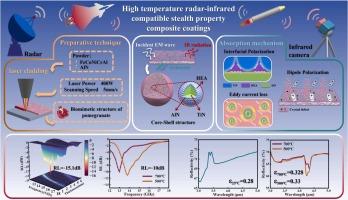
With the advancement of multi-target detection technology, radar-wave-infrared-compatible stealth coatings have emerged as crucial materials. To overcome the challenges associated with poor radar-wave-infrared stealth performance in harsh high-temperature environments, FeCoNiCrAl/AlN composite coatings with pomegranate bionic structures were designed and fabricated by laser cladding. Laser-induced FeCoNiCrAl / AlN generates TiN phase in situ in the molten pool and drives TiN to tightly stack around AlN through Marangoni convection, thereby self-assembling to form an AlN-TiN core-shell structure. Modifying the FeCoNiCrAl/AlN mass ratio substantially influences the heterogeneous interfacial polarization between metal and ceramic phases, thereby effectively regulating the coating's electromagnetic (EM) wave response. When the FeCoNiCrAl/AlN mass ratio is optimized to 8:2, the coating demonstrates excellent high-temperature radar wave and infrared (IR) stealth compatibility. With a coating thickness of 2 mm, it achieves a reflection loss (RL) of −15.1 dB at 14.75 GHz and a IR emissivity of 0.28 in the 3–5μm range. The material maintains stable performance at elevated temperatures of 500°C and 700°C, with RL values of −11 dB and −10 dB, and IR emissivity of 0.33 and 0.328, respectively. The laser-induced melt convection-driven bionic structure FeCoNiCrAl / AlN coating has high radar wave absorption and low infrared emission, which can achieve tunable design integration and efficient preparation of high-temperature compatible stealth coatings.
期刊介绍:
The Journal of Alloys and Compounds is intended to serve as an international medium for the publication of work on solid materials comprising compounds as well as alloys. Its great strength lies in the diversity of discipline which it encompasses, drawing together results from materials science, solid-state chemistry and physics.



 京公网安备 11010802042870号
京ICP备2023020795号-1
京公网安备 11010802042870号
京ICP备2023020795号-1

 分享
分享
 求助内容:
求助内容: 应助结果提醒方式:
 扫码关注我们
