{"title":"A Fluorescence-Based Temperature-Jump Apparatus for Illustrating Protein Dynamics on the Millisecond Time Scale","authors":"Liang-Che Kung, Li-Kang Chu","doi":"10.1021/acs.analchem.4c06501","DOIUrl":null,"url":null,"abstract":"A fluorescence-based temperature jump (T-jump) module was constructed to illustrate the large-domain motion of a given protein upon thermal stimulus on the millisecond time scale. The aqueous sample was readily heated by 5.0 °C in ca. 2 ms with a lasting high temperature plateau (>1 s) upon irradiation with the “optical Riemann sum” of the discrete infrared pulses of different energy sequences from a 1467 nm diode laser operated at 1k Hz. The temperature evolution was revealed by the time-evolved fluorescence intensity change of the dissolved tryptophan. Bovine serum albumin (BSA) and human serum albumin (HSA) were chosen as model proteins, and their fluorescence intensity evolutions were recorded at 36.6–39.9 °C upon T-jump from 35.0 °C, within the range of physiological temperatures. The observed protein dynamics of BSA was characterized with an apparent activation energy of 276 ± 23 kJ mol<sup>–1</sup>, whereas HSA did not manifest the dynamic component. In this measurement, only a tiny amount of sample, ca. 1 μL, was required due to the conjugation of the microspot objective, and the initial temperature was readily controlled by a homemade thermostatic pad. This millisecond-resolution technique is advantageous for illustrating the large-domain dynamics of the targeted protein, bridging the characterizations of the localized protein dynamics on nanosecond to microsecond time scales using the fast techniques and the steady-state protein conformational features by conventional methods, such as Fourier-transform infrared and circular dichroism spectroscopies.","PeriodicalId":27,"journal":{"name":"Analytical Chemistry","volume":"50 1","pages":""},"PeriodicalIF":6.7000,"publicationDate":"2025-02-13","publicationTypes":"Journal Article","fieldsOfStudy":null,"isOpenAccess":false,"openAccessPdf":"","citationCount":"0","resultStr":null,"platform":"Semanticscholar","paperid":null,"PeriodicalName":"Analytical Chemistry","FirstCategoryId":"92","ListUrlMain":"https://doi.org/10.1021/acs.analchem.4c06501","RegionNum":1,"RegionCategory":"化学","ArticlePicture":[],"TitleCN":null,"AbstractTextCN":null,"PMCID":null,"EPubDate":"","PubModel":"","JCR":"Q1","JCRName":"CHEMISTRY, ANALYTICAL","Score":null,"Total":0}
引用次数: 0
Abstract
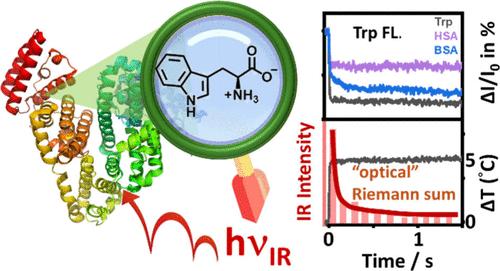
A fluorescence-based temperature jump (T-jump) module was constructed to illustrate the large-domain motion of a given protein upon thermal stimulus on the millisecond time scale. The aqueous sample was readily heated by 5.0 °C in ca. 2 ms with a lasting high temperature plateau (>1 s) upon irradiation with the “optical Riemann sum” of the discrete infrared pulses of different energy sequences from a 1467 nm diode laser operated at 1k Hz. The temperature evolution was revealed by the time-evolved fluorescence intensity change of the dissolved tryptophan. Bovine serum albumin (BSA) and human serum albumin (HSA) were chosen as model proteins, and their fluorescence intensity evolutions were recorded at 36.6–39.9 °C upon T-jump from 35.0 °C, within the range of physiological temperatures. The observed protein dynamics of BSA was characterized with an apparent activation energy of 276 ± 23 kJ mol–1, whereas HSA did not manifest the dynamic component. In this measurement, only a tiny amount of sample, ca. 1 μL, was required due to the conjugation of the microspot objective, and the initial temperature was readily controlled by a homemade thermostatic pad. This millisecond-resolution technique is advantageous for illustrating the large-domain dynamics of the targeted protein, bridging the characterizations of the localized protein dynamics on nanosecond to microsecond time scales using the fast techniques and the steady-state protein conformational features by conventional methods, such as Fourier-transform infrared and circular dichroism spectroscopies.
期刊介绍:
Analytical Chemistry, a peer-reviewed research journal, focuses on disseminating new and original knowledge across all branches of analytical chemistry. Fundamental articles may explore general principles of chemical measurement science and need not directly address existing or potential analytical methodology. They can be entirely theoretical or report experimental results. Contributions may cover various phases of analytical operations, including sampling, bioanalysis, electrochemistry, mass spectrometry, microscale and nanoscale systems, environmental analysis, separations, spectroscopy, chemical reactions and selectivity, instrumentation, imaging, surface analysis, and data processing. Papers discussing known analytical methods should present a significant, original application of the method, a notable improvement, or results on an important analyte.



 京公网安备 11010802042870号
京ICP备2023020795号-1
京公网安备 11010802042870号
京ICP备2023020795号-1

 分享
分享
 求助内容:
求助内容: 应助结果提醒方式:
 扫码关注我们
