Association between adjuvant radiotherapy in adults with gastric cancer and risk of second primary malignancy: a retrospective cohort study using the Surveillance, Epidemiology and End Results database.
{"title":"Association between adjuvant radiotherapy in adults with gastric cancer and risk of second primary malignancy: a retrospective cohort study using the Surveillance, Epidemiology and End Results database.","authors":"Zheng Li, Zefeng Li, Chongyuan Sun, Xiaojie Zhang, He Fei, Cheng Xing, Dongbing Zhao","doi":"10.1136/bmjopen-2024-086349","DOIUrl":null,"url":null,"abstract":"<p><strong>Objectives: </strong>This study aims to assess the association between adjuvant radiotherapy and the development of second primary malignancies (SPMs) and identify its determinants in patients who have undergone surgical treatment for gastric cancer.</p><p><strong>Design: </strong>Retrospective cohort study using the Surveillance, Epidemiology and End Results (SEER) database.</p><p><strong>Setting: </strong>Cohorts (18 registries, 2000-2018, from SEER) were screened for any malignancy that developed after sufficient latency from diagnosis of surgically treated non-metastatic gastric cancer.</p><p><strong>Participants: </strong>24 777 surgically treated gastric cancer cases were included in the cohort. Among them, 6128 patients underwent adjuvant radiotherapy.</p><p><strong>Outcome measures: </strong>The cumulative incidence of SPMs was estimated using Fine and Gray's competing risk model and the radiotherapy-correlated risks were calculated using Poisson regression analysis.</p><p><strong>Results: </strong>Among patients with sufficient latency, there was no significant association between radiotherapy and the risk of developing second primary solid malignancies (relative risk=1.05, 95% CI 0.83 to 1.33) or haematological malignancies (relative risk=1.17, 95% CI 0.62 to 2.11). Interestingly, radiotherapy was associated with a reduced cumulative incidence of second lung and bronchus cancer compared with no radiotherapy, with a 15-year incidence of 1.4%-3.17% (p<0.05). Radiotherapy was not associated with a significant increase in standardised incidence ratios of SPMs.</p><p><strong>Conclusions: </strong>Adjuvant radiotherapy was not associated with an increased risk of developing SPMs in surgically treated patients with gastric cancer. Clinical trials are warranted to further verify the findings.</p>","PeriodicalId":9158,"journal":{"name":"BMJ Open","volume":"15 2","pages":"e086349"},"PeriodicalIF":2.3000,"publicationDate":"2025-02-12","publicationTypes":"Journal Article","fieldsOfStudy":null,"isOpenAccess":false,"openAccessPdf":"https://www.ncbi.nlm.nih.gov/pmc/articles/PMC11822440/pdf/","citationCount":"0","resultStr":null,"platform":"Semanticscholar","paperid":null,"PeriodicalName":"BMJ Open","FirstCategoryId":"3","ListUrlMain":"https://doi.org/10.1136/bmjopen-2024-086349","RegionNum":3,"RegionCategory":"医学","ArticlePicture":[],"TitleCN":null,"AbstractTextCN":null,"PMCID":null,"EPubDate":"","PubModel":"","JCR":"Q1","JCRName":"MEDICINE, GENERAL & INTERNAL","Score":null,"Total":0}
引用次数: 0
Abstract
Objectives: This study aims to assess the association between adjuvant radiotherapy and the development of second primary malignancies (SPMs) and identify its determinants in patients who have undergone surgical treatment for gastric cancer.
Design: Retrospective cohort study using the Surveillance, Epidemiology and End Results (SEER) database.
Setting: Cohorts (18 registries, 2000-2018, from SEER) were screened for any malignancy that developed after sufficient latency from diagnosis of surgically treated non-metastatic gastric cancer.
Participants: 24 777 surgically treated gastric cancer cases were included in the cohort. Among them, 6128 patients underwent adjuvant radiotherapy.
Outcome measures: The cumulative incidence of SPMs was estimated using Fine and Gray's competing risk model and the radiotherapy-correlated risks were calculated using Poisson regression analysis.
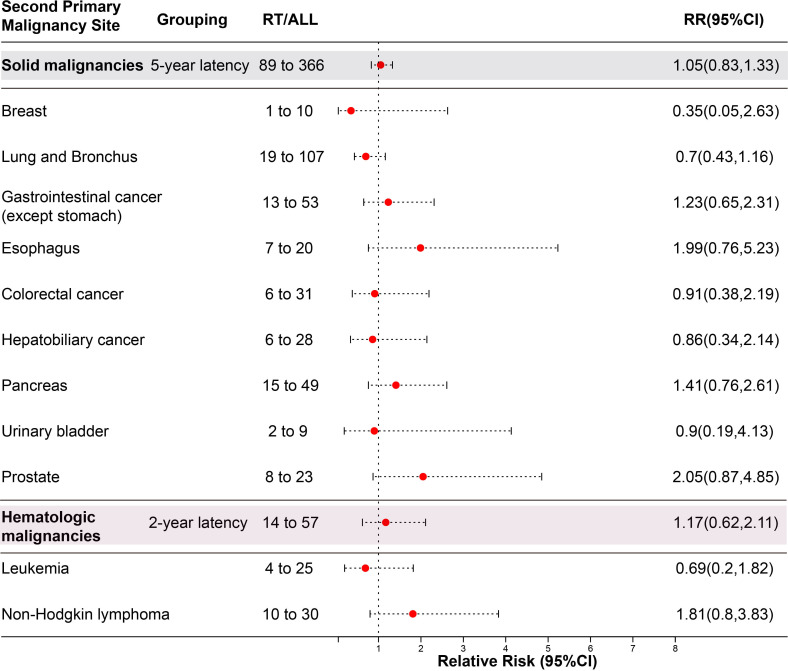
Results: Among patients with sufficient latency, there was no significant association between radiotherapy and the risk of developing second primary solid malignancies (relative risk=1.05, 95% CI 0.83 to 1.33) or haematological malignancies (relative risk=1.17, 95% CI 0.62 to 2.11). Interestingly, radiotherapy was associated with a reduced cumulative incidence of second lung and bronchus cancer compared with no radiotherapy, with a 15-year incidence of 1.4%-3.17% (p<0.05). Radiotherapy was not associated with a significant increase in standardised incidence ratios of SPMs.
Conclusions: Adjuvant radiotherapy was not associated with an increased risk of developing SPMs in surgically treated patients with gastric cancer. Clinical trials are warranted to further verify the findings.
目的:本研究旨在评估辅助放疗与第二原发性恶性肿瘤(SPMs)发展之间的关系,并确定其在接受手术治疗的胃癌患者中的决定因素。设计:采用监测、流行病学和最终结果(SEER)数据库进行回顾性队列研究。背景:对队列(来自SEER的18个注册中心,2000-2018年)进行筛查,以筛查手术治疗的非转移性胃癌诊断后足够潜伏期后发生的任何恶性肿瘤。参与者:24777例手术治疗的胃癌病例纳入队列。其中辅助放疗6128例。结果测量:使用Fine和Gray竞争风险模型估计SPMs的累积发病率,使用泊松回归分析计算放疗相关风险。结果:在足够潜伏期的患者中,放疗与发生第二原发性实体恶性肿瘤的风险(相对风险=1.05,95% CI 0.83至1.33)或血液学恶性肿瘤(相对风险=1.17,95% CI 0.62至2.11)之间没有显著关联。有趣的是,与未放疗相比,放疗与第二肺和支气管癌的累积发病率降低相关,15年发病率为1.4%-3.17%(结论:辅助放疗与手术治疗的胃癌患者发生SPMs的风险增加无关)。临床试验有必要进一步验证这些发现。
期刊介绍:
BMJ Open is an online, open access journal, dedicated to publishing medical research from all disciplines and therapeutic areas. The journal publishes all research study types, from study protocols to phase I trials to meta-analyses, including small or specialist studies. Publishing procedures are built around fully open peer review and continuous publication, publishing research online as soon as the article is ready.




 京公网安备 11010802042870号
京ICP备2023020795号-1
京公网安备 11010802042870号
京ICP备2023020795号-1

 分享
分享
 求助内容:
求助内容: 应助结果提醒方式:
 扫码关注我们
