Trends in the prevalence and factors associated with indoor smoking in 24 countries Party to the WHO FCTC: implications for equitable policy implementation.
{"title":"Trends in the prevalence and factors associated with indoor smoking in 24 countries Party to the WHO FCTC: implications for equitable policy implementation.","authors":"Daniel Bogale Odo, Olalekan Ayo-Yusuf, Yonatan Dinku, Alemayehu Gonie Mekonnen, Raglan Maddox","doi":"10.1136/bmjgh-2024-017110","DOIUrl":null,"url":null,"abstract":"<p><strong>Introduction: </strong>The health consequences of secondhand smoke (SHS) are a long-standing concern. The WHO Framework Convention on Tobacco Control (FCTC) is an evidence-based treaty that aims to protect people from health and environmental harms of commercial tobacco use and exposure to SHS. This study quantified the prevalence of daily smoking inside the house (indoor smoking) and change over time and examined the determinants of indoor smoking in 24 WHO FCTC Parties.</p><p><strong>Methods: </strong>We used data from the 2 most recent Demographic and Health Surveys (DHS) from 24 countries. Counties were selected if they submitted at least one FCTC implementation report and had two DHS surveys conducted after 2010. The weighted prevalence and percentage changes in daily indoor smoking in the two consecutive surveys were calculated, including rate of change, and a two-sample test of proportions was used to assess changes. Multinomial logistic regression model was employed to examine the association between socioeconomic characteristics and indoor smoking. All results were presented by country.</p><p><strong>Results: </strong>A significant decline in the prevalence of daily indoor smoking was detected in 16/24 countries, with the rate of decline ranging from -45.8% in Liberia to -15.2% in India. Jordan reported a significant increase in daily indoor smoking from 57% to 60%; p=0.002. The meta-analytical estimate showed that overall, the relative risk ratio (RRR) of daily indoor smoking was significantly lower for households in the 5th wealth quintile compared with counterparts in the 1st quintile (RRR=0.40; 95% CI: 0.30 to 0.52), and in households where head of the household attended higher education compared with no formal education (RRR=0.60; 95% CI: 0.53 to 0.69).</p><p><strong>Conclusions: </strong>This study demonstrated that prevalence of daily indoor smoking was associated with low socioeconomic status. Reducing SHS exposure is critical, including addressing inequities to help improve health outcomes. Currently, over 2.8 billion people in low-income countries are not protected by smoke-free environment laws, and only 18% of the world's population is covered by strong restrictions on tobacco marketing.</p>","PeriodicalId":9137,"journal":{"name":"BMJ Global Health","volume":"10 2","pages":""},"PeriodicalIF":6.1000,"publicationDate":"2025-02-12","publicationTypes":"Journal Article","fieldsOfStudy":null,"isOpenAccess":false,"openAccessPdf":"https://www.ncbi.nlm.nih.gov/pmc/articles/PMC11822386/pdf/","citationCount":"0","resultStr":null,"platform":"Semanticscholar","paperid":null,"PeriodicalName":"BMJ Global Health","FirstCategoryId":"3","ListUrlMain":"https://doi.org/10.1136/bmjgh-2024-017110","RegionNum":2,"RegionCategory":"医学","ArticlePicture":[],"TitleCN":null,"AbstractTextCN":null,"PMCID":null,"EPubDate":"","PubModel":"","JCR":"Q1","JCRName":"PUBLIC, ENVIRONMENTAL & OCCUPATIONAL HEALTH","Score":null,"Total":0}
引用次数: 0
Abstract
Introduction: The health consequences of secondhand smoke (SHS) are a long-standing concern. The WHO Framework Convention on Tobacco Control (FCTC) is an evidence-based treaty that aims to protect people from health and environmental harms of commercial tobacco use and exposure to SHS. This study quantified the prevalence of daily smoking inside the house (indoor smoking) and change over time and examined the determinants of indoor smoking in 24 WHO FCTC Parties.
Methods: We used data from the 2 most recent Demographic and Health Surveys (DHS) from 24 countries. Counties were selected if they submitted at least one FCTC implementation report and had two DHS surveys conducted after 2010. The weighted prevalence and percentage changes in daily indoor smoking in the two consecutive surveys were calculated, including rate of change, and a two-sample test of proportions was used to assess changes. Multinomial logistic regression model was employed to examine the association between socioeconomic characteristics and indoor smoking. All results were presented by country.
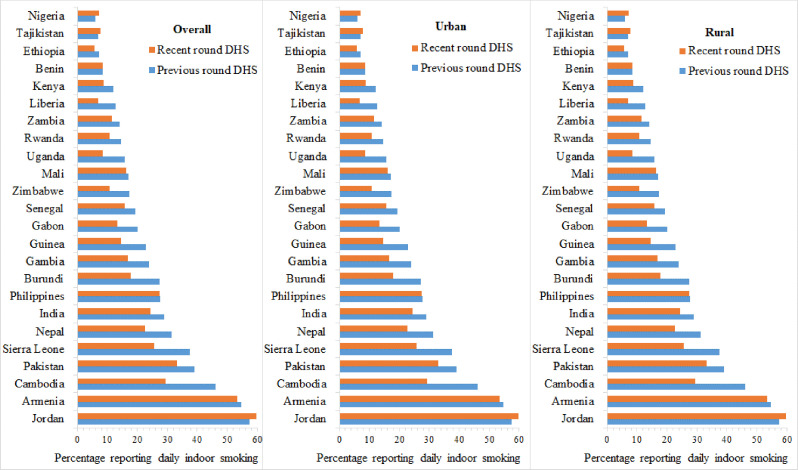
Results: A significant decline in the prevalence of daily indoor smoking was detected in 16/24 countries, with the rate of decline ranging from -45.8% in Liberia to -15.2% in India. Jordan reported a significant increase in daily indoor smoking from 57% to 60%; p=0.002. The meta-analytical estimate showed that overall, the relative risk ratio (RRR) of daily indoor smoking was significantly lower for households in the 5th wealth quintile compared with counterparts in the 1st quintile (RRR=0.40; 95% CI: 0.30 to 0.52), and in households where head of the household attended higher education compared with no formal education (RRR=0.60; 95% CI: 0.53 to 0.69).
Conclusions: This study demonstrated that prevalence of daily indoor smoking was associated with low socioeconomic status. Reducing SHS exposure is critical, including addressing inequities to help improve health outcomes. Currently, over 2.8 billion people in low-income countries are not protected by smoke-free environment laws, and only 18% of the world's population is covered by strong restrictions on tobacco marketing.
期刊介绍:
BMJ Global Health is an online Open Access journal from BMJ that focuses on publishing high-quality peer-reviewed content pertinent to individuals engaged in global health, including policy makers, funders, researchers, clinicians, and frontline healthcare workers. The journal encompasses all facets of global health, with a special emphasis on submissions addressing underfunded areas such as non-communicable diseases (NCDs). It welcomes research across all study phases and designs, from study protocols to phase I trials to meta-analyses, including small or specialized studies. The journal also encourages opinionated discussions on controversial topics.





 京公网安备 11010802042870号
京ICP备2023020795号-1
京公网安备 11010802042870号
京ICP备2023020795号-1

 分享
分享
 求助内容:
求助内容: 应助结果提醒方式:
 扫码关注我们
