{"title":"Constructing a logistic regression-based prediction model for subsequent early pregnancy loss in women with pregnancy loss.","authors":"Nan Ding, Peili Wang, Xiaoping Wang, Fang Wang","doi":"10.1186/s40001-025-02361-5","DOIUrl":null,"url":null,"abstract":"<p><strong>Objectives: </strong>The aim of this study is to construct a nomogram for predicting subsequent early pregnancy loss in women with a history of pregnancy loss, which may increase well-being and the capacity for managing reproductive options.</p><p><strong>Materials and methods: </strong>We conducted a retrospective analysis of medical records from women with a history of pregnancy loss at the Reproductive Medicine Center of Lanzhou University Second Hospital between January 2019 and December 2022. A cohort of 718 patients was selected for the study. We structured our data into a training set of 575 cases (80% of the cohort) and a test set of 143 cases (20%). To identify significant predictors, we applied a stepwise forward algorithm guided by the Akaike Information Criterion (AIC) to the training set. Model validation was conducted using the test set. For the validation process, we employed various methods to assess the predictive power and accuracy of the model. Receiver Operating Characteristic (ROC) curves provided insights into the model's ability to distinguish between outcomes effectively. Calibration curves assessed the accuracy of the probability predictions against actual outcomes. The clinical utility of the model was further evaluated through Decision Curve Analysis, which quantified the net benefits at various threshold probabilities. In addition, a nomogram was developed to visually represent the risk factors.</p><p><strong>Results: </strong>Among the 36 candidate variables initially considered, 10 key predictors were identified through logistic regression analysis and incorporated into the nomogram. These selected variables include age, education, thrombin time (TT), antithrombin III (AT-III), D-dimer levels, 25-hydroxy Vitamin D, immunoglobulin G(IgG), complement components C4, anti-cardiolipin antibody (ACA) and lupus anticoagulant (LA). In addition, based on clinical experience, the number of previous pregnancy losses was also included as a predictive variable. The prediction model revealed an area under the curve (AUC) of approximately 0.717 for the training set and 0.725 for the validation set. Calibration analysis indicated satisfactory goodness-of-fit, with a Hosmer-Lemeshow test yielding a χ2 value of 7.78 (p = 0.55). Decision curve analysis confirmed the clinical utility of the nomogram. Internal validation confirmed the robust performance of the predictive model.</p><p><strong>Conclusions: </strong>The constructed nomogram provides a valuable tool for predicting subsequent early pregnancy loss in women with a history of pregnancy loss. This nomogram can assist clinicians and patients in making informed decisions regarding the management of pregnancy and improving clinical outcomes.</p><p><strong>Trial registration: </strong>This study was registered in the Chinese Clinical Trial Registry under the registration number ChiCTR2000039414 on October 27, 2020. The registration was done retrospectively.</p>","PeriodicalId":11949,"journal":{"name":"European Journal of Medical Research","volume":"30 1","pages":"99"},"PeriodicalIF":3.4000,"publicationDate":"2025-02-12","publicationTypes":"Journal Article","fieldsOfStudy":null,"isOpenAccess":false,"openAccessPdf":"https://www.ncbi.nlm.nih.gov/pmc/articles/PMC11823067/pdf/","citationCount":"0","resultStr":null,"platform":"Semanticscholar","paperid":null,"PeriodicalName":"European Journal of Medical Research","FirstCategoryId":"3","ListUrlMain":"https://doi.org/10.1186/s40001-025-02361-5","RegionNum":3,"RegionCategory":"医学","ArticlePicture":[],"TitleCN":null,"AbstractTextCN":null,"PMCID":null,"EPubDate":"","PubModel":"","JCR":"Q2","JCRName":"MEDICINE, RESEARCH & EXPERIMENTAL","Score":null,"Total":0}
引用次数: 0
Abstract
Objectives: The aim of this study is to construct a nomogram for predicting subsequent early pregnancy loss in women with a history of pregnancy loss, which may increase well-being and the capacity for managing reproductive options.
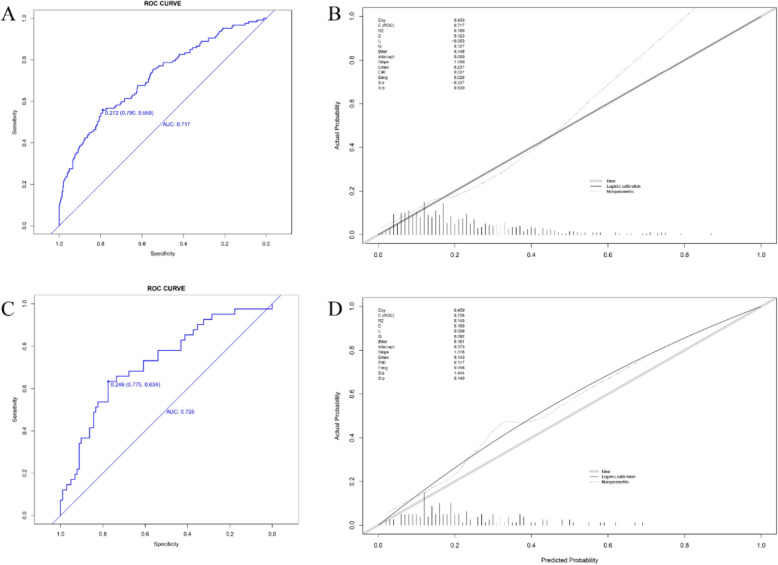
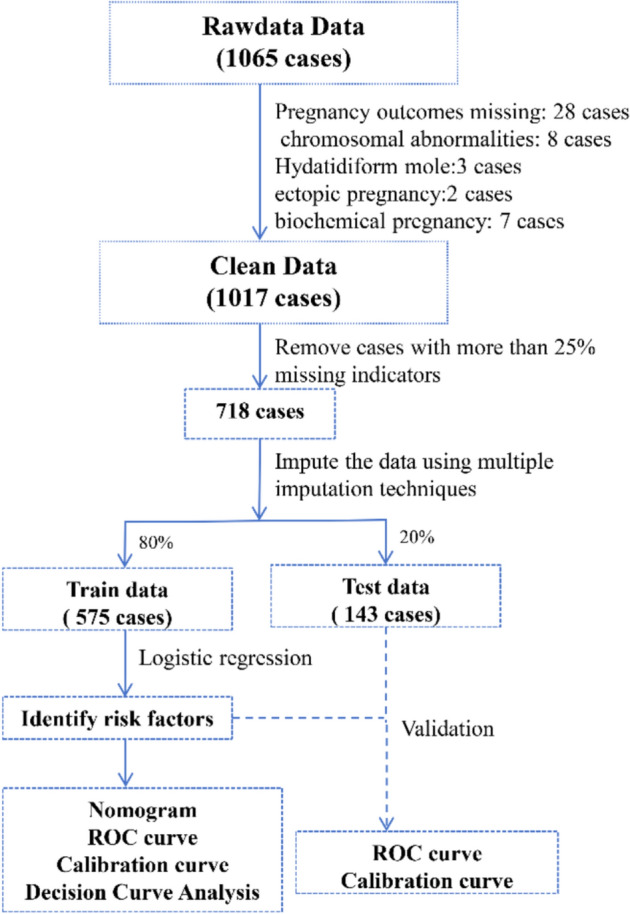
Materials and methods: We conducted a retrospective analysis of medical records from women with a history of pregnancy loss at the Reproductive Medicine Center of Lanzhou University Second Hospital between January 2019 and December 2022. A cohort of 718 patients was selected for the study. We structured our data into a training set of 575 cases (80% of the cohort) and a test set of 143 cases (20%). To identify significant predictors, we applied a stepwise forward algorithm guided by the Akaike Information Criterion (AIC) to the training set. Model validation was conducted using the test set. For the validation process, we employed various methods to assess the predictive power and accuracy of the model. Receiver Operating Characteristic (ROC) curves provided insights into the model's ability to distinguish between outcomes effectively. Calibration curves assessed the accuracy of the probability predictions against actual outcomes. The clinical utility of the model was further evaluated through Decision Curve Analysis, which quantified the net benefits at various threshold probabilities. In addition, a nomogram was developed to visually represent the risk factors.
Results: Among the 36 candidate variables initially considered, 10 key predictors were identified through logistic regression analysis and incorporated into the nomogram. These selected variables include age, education, thrombin time (TT), antithrombin III (AT-III), D-dimer levels, 25-hydroxy Vitamin D, immunoglobulin G(IgG), complement components C4, anti-cardiolipin antibody (ACA) and lupus anticoagulant (LA). In addition, based on clinical experience, the number of previous pregnancy losses was also included as a predictive variable. The prediction model revealed an area under the curve (AUC) of approximately 0.717 for the training set and 0.725 for the validation set. Calibration analysis indicated satisfactory goodness-of-fit, with a Hosmer-Lemeshow test yielding a χ2 value of 7.78 (p = 0.55). Decision curve analysis confirmed the clinical utility of the nomogram. Internal validation confirmed the robust performance of the predictive model.
Conclusions: The constructed nomogram provides a valuable tool for predicting subsequent early pregnancy loss in women with a history of pregnancy loss. This nomogram can assist clinicians and patients in making informed decisions regarding the management of pregnancy and improving clinical outcomes.
Trial registration: This study was registered in the Chinese Clinical Trial Registry under the registration number ChiCTR2000039414 on October 27, 2020. The registration was done retrospectively.
期刊介绍:
European Journal of Medical Research publishes translational and clinical research of international interest across all medical disciplines, enabling clinicians and other researchers to learn about developments and innovations within these disciplines and across the boundaries between disciplines. The journal publishes high quality research and reviews and aims to ensure that the results of all well-conducted research are published, regardless of their outcome.




 京公网安备 11010802042870号
京ICP备2023020795号-1
京公网安备 11010802042870号
京ICP备2023020795号-1

 分享
分享
 求助内容:
求助内容: 应助结果提醒方式:
 扫码关注我们
