L Iván Mayor-Silva, Guillermo Moreno, Alfonso Meneses-Monroy, Patricia Martín-Casas, Marta M Hernández-Martín, Antonio G Moreno-Pimentel, Leyre Rodríguez-Leal
{"title":"Influence of Gender Role on Resilience and Positive Affect in Female Nursing Students: A Cross-Sectional Study.","authors":"L Iván Mayor-Silva, Guillermo Moreno, Alfonso Meneses-Monroy, Patricia Martín-Casas, Marta M Hernández-Martín, Antonio G Moreno-Pimentel, Leyre Rodríguez-Leal","doi":"10.3390/healthcare13030336","DOIUrl":null,"url":null,"abstract":"<p><p><b>Introduction</b>: Women experience more social barriers, gender stereotypes, biases, and discrimination than men, which can increase their vulnerability to mental health problems. Therefore, it is essential to adopt a gender perspective in research on nursing students, examining the impact of these factors on their well-being and psychological resources like resilience. This study aims to analyze the relationship between gender roles in resilience and positive or negative affect among female nursing students. <b>Methods</b>: A cross-sectional study was conducted with first- and fourth-year female nursing students at a public university in Madrid, Spain. Sociodemographic variables, positive and negative affect (PANAS scale), resilience (CD-RISC scale), and gender roles (BRSI inventory) were analyzed. ANOVA, correlation analysis, and linear regression models were used to study the relationships between variables. <b>Results</b>: The study included 338 students with a mean age of 21.43 years, of which 80.2% had a high level of resilience, with a positive affect score of 31.96 (SD: 7.34) and a negative affect score of 22.99 (SD: 7.35). Overall, 48.5% had undifferentiated roles, 23.7% feminine roles, 14.2% androgynous roles, and 13.6% masculine roles. Female students with masculine and androgynous roles showed higher resilience levels (93.48% and 97.92%) compared to those with feminine and undifferentiated roles (81.25% and 70.73%) (<i>p</i> < 0.001). Female students with androgynous and masculine roles showed higher positive affect levels compared to those with feminine and undifferentiated roles (<i>p</i> < 0.001), with no differences in negative affect. These results were observed in both first- and fourth-year students. A high correlation was found between masculine roles and positive affect and resilience in both first- and fourth-year students. <b>Conclusions</b>: Gender roles influence positive affect and resilience in females. Among female nursing students, androgynous and masculine roles are associated with higher levels of resilience and positive affect compared to feminine and undifferentiated roles. Differences in psychological well-being may be related to socially constructed gender roles rather than biological sex, with masculine roles enhancing resilience and feminine roles correlating with greater vulnerability.</p>","PeriodicalId":12977,"journal":{"name":"Healthcare","volume":"13 3","pages":""},"PeriodicalIF":2.7000,"publicationDate":"2025-02-06","publicationTypes":"Journal Article","fieldsOfStudy":null,"isOpenAccess":false,"openAccessPdf":"https://www.ncbi.nlm.nih.gov/pmc/articles/PMC11816593/pdf/","citationCount":"0","resultStr":null,"platform":"Semanticscholar","paperid":null,"PeriodicalName":"Healthcare","FirstCategoryId":"3","ListUrlMain":"https://doi.org/10.3390/healthcare13030336","RegionNum":4,"RegionCategory":"医学","ArticlePicture":[],"TitleCN":null,"AbstractTextCN":null,"PMCID":null,"EPubDate":"","PubModel":"","JCR":"Q2","JCRName":"HEALTH CARE SCIENCES & SERVICES","Score":null,"Total":0}
引用次数: 0
Abstract
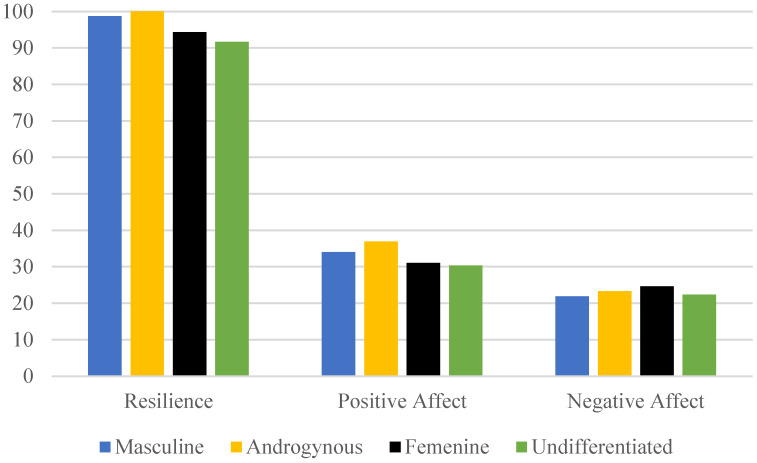
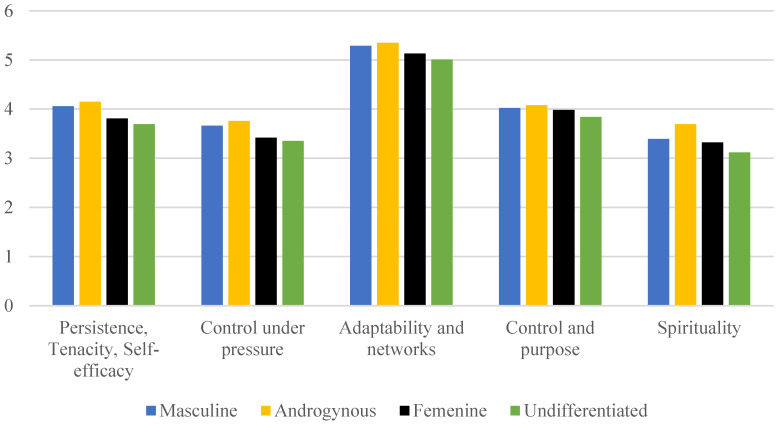
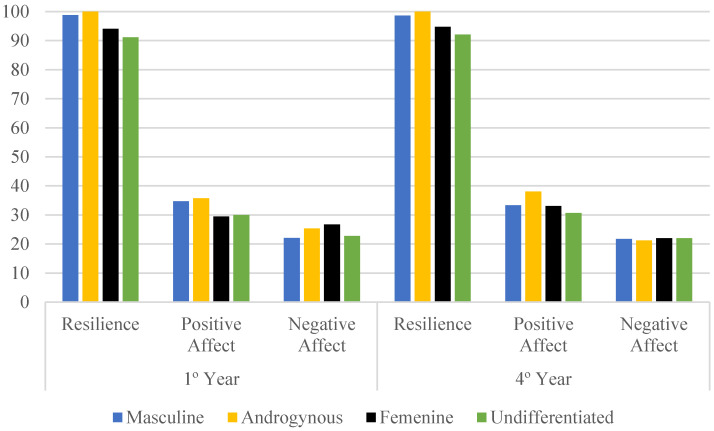
Introduction: Women experience more social barriers, gender stereotypes, biases, and discrimination than men, which can increase their vulnerability to mental health problems. Therefore, it is essential to adopt a gender perspective in research on nursing students, examining the impact of these factors on their well-being and psychological resources like resilience. This study aims to analyze the relationship between gender roles in resilience and positive or negative affect among female nursing students. Methods: A cross-sectional study was conducted with first- and fourth-year female nursing students at a public university in Madrid, Spain. Sociodemographic variables, positive and negative affect (PANAS scale), resilience (CD-RISC scale), and gender roles (BRSI inventory) were analyzed. ANOVA, correlation analysis, and linear regression models were used to study the relationships between variables. Results: The study included 338 students with a mean age of 21.43 years, of which 80.2% had a high level of resilience, with a positive affect score of 31.96 (SD: 7.34) and a negative affect score of 22.99 (SD: 7.35). Overall, 48.5% had undifferentiated roles, 23.7% feminine roles, 14.2% androgynous roles, and 13.6% masculine roles. Female students with masculine and androgynous roles showed higher resilience levels (93.48% and 97.92%) compared to those with feminine and undifferentiated roles (81.25% and 70.73%) (p < 0.001). Female students with androgynous and masculine roles showed higher positive affect levels compared to those with feminine and undifferentiated roles (p < 0.001), with no differences in negative affect. These results were observed in both first- and fourth-year students. A high correlation was found between masculine roles and positive affect and resilience in both first- and fourth-year students. Conclusions: Gender roles influence positive affect and resilience in females. Among female nursing students, androgynous and masculine roles are associated with higher levels of resilience and positive affect compared to feminine and undifferentiated roles. Differences in psychological well-being may be related to socially constructed gender roles rather than biological sex, with masculine roles enhancing resilience and feminine roles correlating with greater vulnerability.
期刊介绍:
Healthcare (ISSN 2227-9032) is an international, peer-reviewed, open access journal (free for readers), which publishes original theoretical and empirical work in the interdisciplinary area of all aspects of medicine and health care research. Healthcare publishes Original Research Articles, Reviews, Case Reports, Research Notes and Short Communications. We encourage researchers to publish their experimental and theoretical results in as much detail as possible. For theoretical papers, full details of proofs must be provided so that the results can be checked; for experimental papers, full experimental details must be provided so that the results can be reproduced. Additionally, electronic files or software regarding the full details of the calculations, experimental procedure, etc., can be deposited along with the publication as “Supplementary Material”.



 京公网安备 11010802042870号
京ICP备2023020795号-1
京公网安备 11010802042870号
京ICP备2023020795号-1

 分享
分享
 求助内容:
求助内容: 应助结果提醒方式:
 扫码关注我们
