Mengde Lyu, Mingyue Yin, Ling Ding, Renhuan Tang, Zhili Chen, Shengji Deng, Yuming Zhong, Zhan Li, George P Nassis, Yongming Li
{"title":"Physiological and Neuromuscular Fatigue after 3-Minute Lateral Shuffle Movement at Different Speeds and Distances.","authors":"Mengde Lyu, Mingyue Yin, Ling Ding, Renhuan Tang, Zhili Chen, Shengji Deng, Yuming Zhong, Zhan Li, George P Nassis, Yongming Li","doi":"10.5114/jhk/190145","DOIUrl":null,"url":null,"abstract":"<p><p>This study aimed to 1) investigate and compare physiological and neuromuscular fatigue after a 3-min lateral shuffle movement (LSM) at different speeds and distances, and 2) examine the relationship between the number of changes of direction (CODs) during LSM and fatigue-related variables. Twenty male college athletes (age: 20.9 ± 1.7 yrs, body mass: 72.8 ± 8.6 kg, body height: 177.9 ± 5.6 cm; mean ± SD) performed six LSM protocols at two speeds (1.8 and 2.0 m/s) and three distances (2.5, 5 and 10 m) in random order and on separate days. The heart rate (HR), blood lactate (BLa) concentration, the rating of perceived exertion (RPE) and the countermovement jump (CMJ) were assessed and recorded before and immediately after exercise. Neuromuscular fatigue was assessed with the decline in CMJ performance (CMJ<sub>decline</sub>). Results showed no interaction effect (speed*distance) for all variables. The distance was a significant factor influencing the HR (F = 12.663, p = 0.000, η<sub>p</sub> <sup>2</sup> = 0.25), BLa concentration (F = 15.357, p = 0.000, η<sub>p</sub> <sup>2</sup> = 0.288), CMJ<sub>decline</sub> (F = 19.496, p = 0.000, η<sub>p</sub> <sup>2</sup> = 0.339), and the RPE (F = 20.149, p = 0.000, η<sub>p</sub> <sup>2</sup> = 0.347). Speed was also a significant factor influencing the HR (F = 6.367, p = 0.016, η<sub>p</sub> <sup>2</sup> = 0.144), BLa concentration (F = 10.292, p = 0.000, η<sub>p</sub> <sup>2</sup> = 0.213), CMJ<sub>decline</sub> (F = 9.014, p = 0.005, η<sub>p</sub> <sup>2</sup> = 0.192), and the RPE (F = 9.539, p = 0.004, η<sub>p</sub> <sup>2</sup> = 0.201). CODs displayed moderate correlations with BLa concentration (r = 0.331, p < 0.001), CMJ<sub>decline</sub> (r = -0.415, p < 0.001), and the RPE (r = 0.318, p < 0.001). These results suggest that physiological and neuromuscular fatigue would be greater with higher speed and shorter distance of LSM.</p>","PeriodicalId":16055,"journal":{"name":"Journal of Human Kinetics","volume":"95 ","pages":"151-159"},"PeriodicalIF":2.8000,"publicationDate":"2024-12-06","publicationTypes":"Journal Article","fieldsOfStudy":null,"isOpenAccess":false,"openAccessPdf":"https://www.ncbi.nlm.nih.gov/pmc/articles/PMC11812171/pdf/","citationCount":"0","resultStr":null,"platform":"Semanticscholar","paperid":null,"PeriodicalName":"Journal of Human Kinetics","FirstCategoryId":"3","ListUrlMain":"https://doi.org/10.5114/jhk/190145","RegionNum":3,"RegionCategory":"医学","ArticlePicture":[],"TitleCN":null,"AbstractTextCN":null,"PMCID":null,"EPubDate":"2025/1/1 0:00:00","PubModel":"eCollection","JCR":"Q2","JCRName":"SPORT SCIENCES","Score":null,"Total":0}
引用次数: 0
Abstract
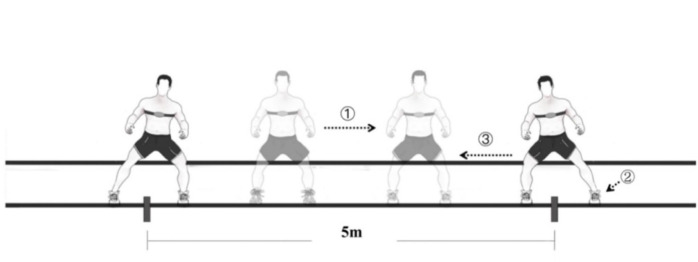
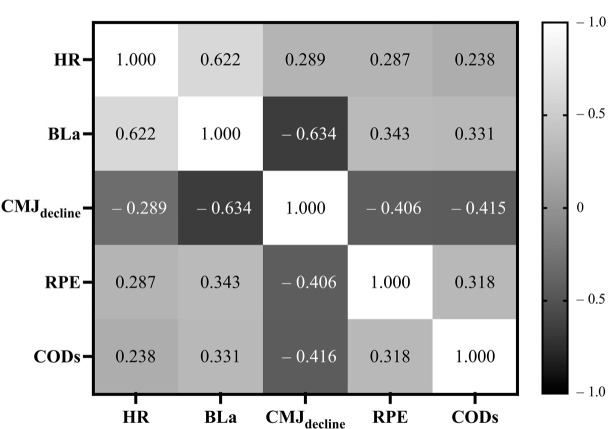
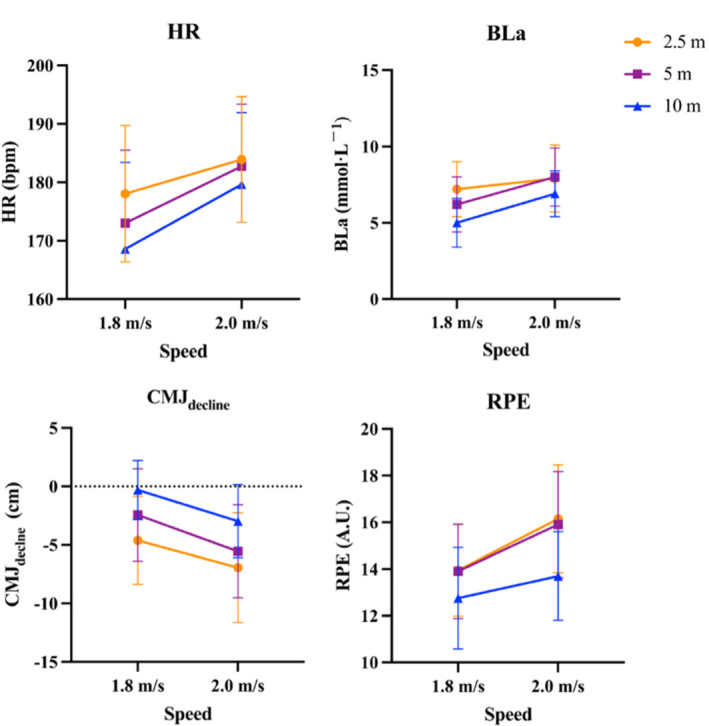
This study aimed to 1) investigate and compare physiological and neuromuscular fatigue after a 3-min lateral shuffle movement (LSM) at different speeds and distances, and 2) examine the relationship between the number of changes of direction (CODs) during LSM and fatigue-related variables. Twenty male college athletes (age: 20.9 ± 1.7 yrs, body mass: 72.8 ± 8.6 kg, body height: 177.9 ± 5.6 cm; mean ± SD) performed six LSM protocols at two speeds (1.8 and 2.0 m/s) and three distances (2.5, 5 and 10 m) in random order and on separate days. The heart rate (HR), blood lactate (BLa) concentration, the rating of perceived exertion (RPE) and the countermovement jump (CMJ) were assessed and recorded before and immediately after exercise. Neuromuscular fatigue was assessed with the decline in CMJ performance (CMJdecline). Results showed no interaction effect (speed*distance) for all variables. The distance was a significant factor influencing the HR (F = 12.663, p = 0.000, ηp2 = 0.25), BLa concentration (F = 15.357, p = 0.000, ηp2 = 0.288), CMJdecline (F = 19.496, p = 0.000, ηp2 = 0.339), and the RPE (F = 20.149, p = 0.000, ηp2 = 0.347). Speed was also a significant factor influencing the HR (F = 6.367, p = 0.016, ηp2 = 0.144), BLa concentration (F = 10.292, p = 0.000, ηp2 = 0.213), CMJdecline (F = 9.014, p = 0.005, ηp2 = 0.192), and the RPE (F = 9.539, p = 0.004, ηp2 = 0.201). CODs displayed moderate correlations with BLa concentration (r = 0.331, p < 0.001), CMJdecline (r = -0.415, p < 0.001), and the RPE (r = 0.318, p < 0.001). These results suggest that physiological and neuromuscular fatigue would be greater with higher speed and shorter distance of LSM.
期刊介绍:
The Journal of Human Kinetics is an open access interdisciplinary periodical offering the latest research in the science of human movement studies. This comprehensive professional journal features articles and research notes encompassing such topic areas as: Kinesiology, Exercise Physiology and Nutrition, Sports Training and Behavioural Sciences in Sport, but especially considering elite and competitive aspects of sport.
The journal publishes original papers, invited reviews, short communications and letters to the Editors. Manuscripts submitted to the journal must contain novel data on theoretical or experimental research or on practical applications in the field of sport sciences.
The Journal of Human Kinetics is published in March, June, September and December.
We encourage scientists from around the world to submit their papers to our periodical.




 京公网安备 11010802042870号
京ICP备2023020795号-1
京公网安备 11010802042870号
京ICP备2023020795号-1

 分享
分享
 求助内容:
求助内容: 应助结果提醒方式:
 扫码关注我们
