Kassahun Demelash, Abdissa Biruksew, Gelila Gashawbeza, Delenasaw Yewhalaw, Ahmed Zeynudin
{"title":"Prevalence of asymptomatic malaria infection and associated risk factors in Mizan-Aman town, Ethiopia: community-based cross-sectional study.","authors":"Kassahun Demelash, Abdissa Biruksew, Gelila Gashawbeza, Delenasaw Yewhalaw, Ahmed Zeynudin","doi":"10.1186/s12936-024-05210-8","DOIUrl":null,"url":null,"abstract":"<p><strong>Background: </strong>Asymptomatic malaria parasitemia patients constitute an effective transmission pool for malaria infection in the community. However, less attention has been given to malaria control and elimination strategies. Therefore, to achieve a malaria elimination strategy, investigating the magnitude of asymptomatic malaria in different settings in Ethiopia is crucial. However, there is not enough information on the prevalence of asymptomatic malaria infection and associated risk factors in the Bench Sheko Zone, southwest Ethiopia. This study, therefore, aimed to provide information and help achieve sustainable malaria elimination.</p><p><strong>Methods: </strong>A community-based cross-sectional study was conducted from February to April 2019 in Mizan-Aman town, southwest Ethiopia. A semi-structured questionnaire was used to collect sociodemographic information. Plasmodium species were screened using microscopy and rapid diagnostic test (RDT). HemoCue was used to measure haemoglobin levels. Statistical Package for the Social Sciences (SPSS) version 20.0 was used for descriptive and logistic regression statistics to risk factors. A P-value of 0.05 was used as a cutoff-value for significance.</p><p><strong>Results: </strong>A total of 353 malaria-like symptom free participants were enrolled in this study. 17 seventeen (4.8%, 95% Confidence interval = 2.57, 7.03) asymptomatic malaria cases were revealed; among these, 12 (70.58%) (95% CI = 65.75, 75.25) were due to Plasmodium vivax and 5 (29.41%) (95% CI = 24.74, 34.25) were due to Plasmodium falciparum. Asymptomatic malaria was significantly associated with the presence of mosquito breeding sites [Adjusted odd ratio (AOR) = 6.06 (1.76-20.82)], insecticide-treated nets (ITN) use [AOR = 3.51 (0.97-12.68)], and indoor residual spraying (IRS) [AOR = 3.95 (1.26-12.37)]. Mild anaemia was found in 20% (3/15) of the asymptomatic malaria patients. Additionally, there was a significant association between malaria and anaemia [OR = 5.786 (1.46-22.85)] in this study.</p><p><strong>Conclusions: </strong>The population of the current study area will be at risk because asymptomatic malaria is present. Low coverage of the IRS, ITN, and proximity of stagnant water in residences had an impact on asymptomatic malaria. Further studies are needed on the burden of asymptomatic malaria via molecular methods, and the Bench Sheko regional health office is better able to scale-up malaria prevention and control tools.</p>","PeriodicalId":18317,"journal":{"name":"Malaria Journal","volume":"24 1","pages":"41"},"PeriodicalIF":3.0000,"publicationDate":"2025-02-12","publicationTypes":"Journal Article","fieldsOfStudy":null,"isOpenAccess":false,"openAccessPdf":"https://www.ncbi.nlm.nih.gov/pmc/articles/PMC11823150/pdf/","citationCount":"0","resultStr":null,"platform":"Semanticscholar","paperid":null,"PeriodicalName":"Malaria Journal","FirstCategoryId":"3","ListUrlMain":"https://doi.org/10.1186/s12936-024-05210-8","RegionNum":3,"RegionCategory":"医学","ArticlePicture":[],"TitleCN":null,"AbstractTextCN":null,"PMCID":null,"EPubDate":"","PubModel":"","JCR":"Q3","JCRName":"INFECTIOUS DISEASES","Score":null,"Total":0}
引用次数: 0
Abstract
Background: Asymptomatic malaria parasitemia patients constitute an effective transmission pool for malaria infection in the community. However, less attention has been given to malaria control and elimination strategies. Therefore, to achieve a malaria elimination strategy, investigating the magnitude of asymptomatic malaria in different settings in Ethiopia is crucial. However, there is not enough information on the prevalence of asymptomatic malaria infection and associated risk factors in the Bench Sheko Zone, southwest Ethiopia. This study, therefore, aimed to provide information and help achieve sustainable malaria elimination.
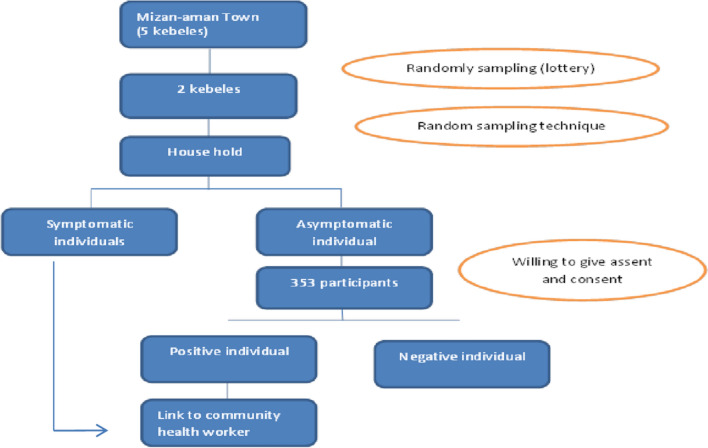
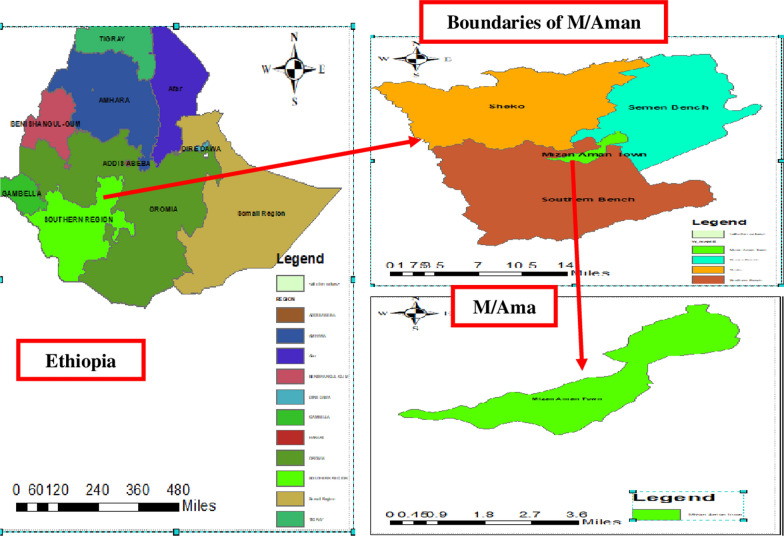
Methods: A community-based cross-sectional study was conducted from February to April 2019 in Mizan-Aman town, southwest Ethiopia. A semi-structured questionnaire was used to collect sociodemographic information. Plasmodium species were screened using microscopy and rapid diagnostic test (RDT). HemoCue was used to measure haemoglobin levels. Statistical Package for the Social Sciences (SPSS) version 20.0 was used for descriptive and logistic regression statistics to risk factors. A P-value of 0.05 was used as a cutoff-value for significance.
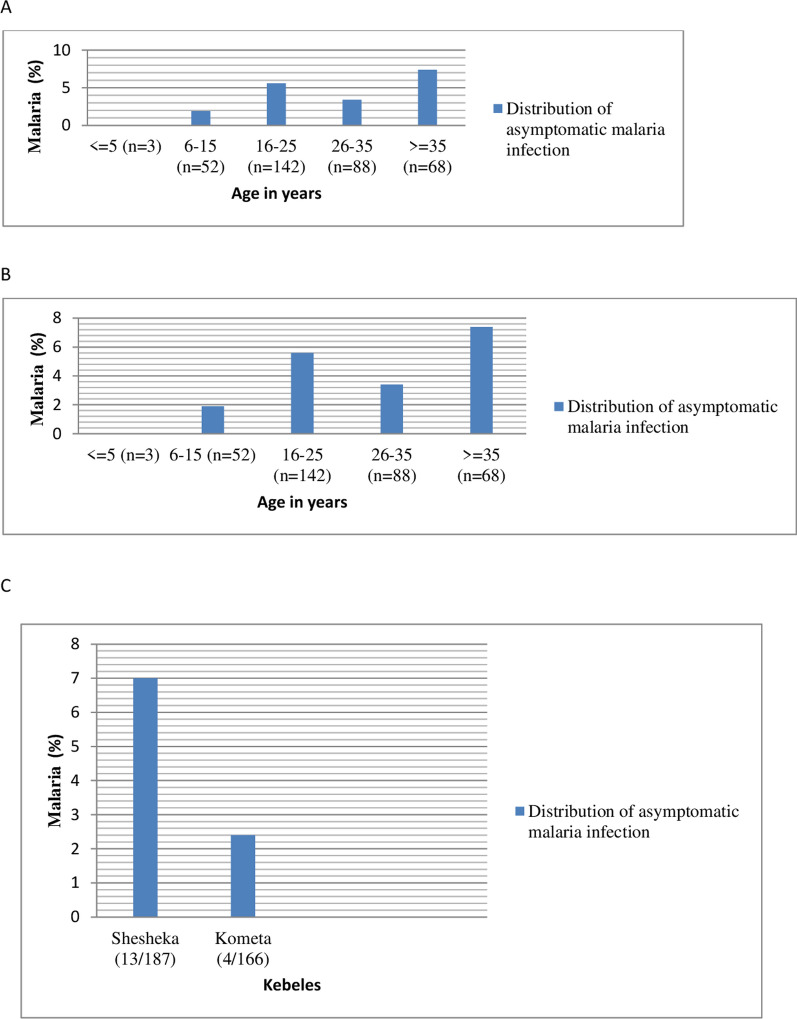
Results: A total of 353 malaria-like symptom free participants were enrolled in this study. 17 seventeen (4.8%, 95% Confidence interval = 2.57, 7.03) asymptomatic malaria cases were revealed; among these, 12 (70.58%) (95% CI = 65.75, 75.25) were due to Plasmodium vivax and 5 (29.41%) (95% CI = 24.74, 34.25) were due to Plasmodium falciparum. Asymptomatic malaria was significantly associated with the presence of mosquito breeding sites [Adjusted odd ratio (AOR) = 6.06 (1.76-20.82)], insecticide-treated nets (ITN) use [AOR = 3.51 (0.97-12.68)], and indoor residual spraying (IRS) [AOR = 3.95 (1.26-12.37)]. Mild anaemia was found in 20% (3/15) of the asymptomatic malaria patients. Additionally, there was a significant association between malaria and anaemia [OR = 5.786 (1.46-22.85)] in this study.
Conclusions: The population of the current study area will be at risk because asymptomatic malaria is present. Low coverage of the IRS, ITN, and proximity of stagnant water in residences had an impact on asymptomatic malaria. Further studies are needed on the burden of asymptomatic malaria via molecular methods, and the Bench Sheko regional health office is better able to scale-up malaria prevention and control tools.
期刊介绍:
Malaria Journal is aimed at the scientific community interested in malaria in its broadest sense. It is the only journal that publishes exclusively articles on malaria and, as such, it aims to bring together knowledge from the different specialities involved in this very broad discipline, from the bench to the bedside and to the field.



 京公网安备 11010802042870号
京ICP备2023020795号-1
京公网安备 11010802042870号
京ICP备2023020795号-1

 分享
分享
 求助内容:
求助内容: 应助结果提醒方式:
 扫码关注我们
