Outperformance of Combined Artificial Anterolateral Ligament and ACL Reconstruction Compared With Isolated Artificial ACL Reconstruction in Knees With Anterolateral Structure and ACL Deficiency: A Biomechanical Analysis.
{"title":"Outperformance of Combined Artificial Anterolateral Ligament and ACL Reconstruction Compared With Isolated Artificial ACL Reconstruction in Knees With Anterolateral Structure and ACL Deficiency: A Biomechanical Analysis.","authors":"Rongshan Cheng, Dimitris Dimitriou, Gai Yao, Xianghui Li, Xiaolong Lv, Yangyang Yang, Hua Ying, Ziming Wang, Tsung-Yuan Tsai","doi":"10.1177/23259671241309270","DOIUrl":null,"url":null,"abstract":"<p><strong>Background: </strong>Despite the promising clinical outcomes of artificial polyethylene terephthalate (PET) ligaments in isolated anterior cruciate ligament reconstruction (ACLR), their biomechanical performance after combined anterolateral ligament reconstruction (ALLR)/ACLR in anterolateral structure (ALS)/anterior cruciate ligament (ACL)-deficient knees has not been investigated.</p><p><strong>Purpose/hypothesis: </strong>The purpose of this study was to compare biomechanical performance in cadaveric knees between combined artificial ALLR/ACLR and isolated artificial ACLR using PET ligaments. It was hypothesized that combined artificial ALLR/ACLR would restore native knee stability and outperform isolated artificial ACLR in ALS/ACL-deficient knees.</p><p><strong>Study design: </strong>Controlled laboratory study.</p><p><strong>Methods: </strong>Eight fresh-frozen cadaveric knees were tested using a robotic manipulator. Each knee was tested in 4 states: (1) ALS/ACL intact, (2) ALS/ACL deficient, (3) ACLR, and (4) ALLR/ACLR. The anterior tibial translation (ATT) and tibial internal rotation (IR) in each knee condition were measured under 3 loads: (1) 89 N of anterior tibial loading, (2) 5 N·m of IR torque, and (3) simulated pivot shift (combined 5 N·m of IR torque and 7 N·m of valgus load).</p><p><strong>Results: </strong>During 89 N of anterior tibial loading, there were no significant differences in ATT between the isolated ACLR and ALLR/ACLR knees. During 5 N·m of IR torque, the mean tibial IR at 45° of flexion was significantly higher in the ACLR knees (32.49°± 7.96°) than in the ALLR/ACLR knees (21.78°± 3.03°) (<i>P</i> < .05). During the simulated pivot shift, the mean ATT and tibial IR at 30° and 45° of flexion were significantly higher in the ACLR knees (ATT: 5.09 ± 2.74 mm at 30°, 5.43 ± 2.79 mm at 45°; IR: 30.08°± 7.31° at 30°, 32.55°± 6.48° at 45°) than in the ALLR/ACLR knees (ATT: 1.93 ± 2.71 mm at 30°, 1.17 ± 2.26 mm at 45°; IR: 22.12°± 4.05° at 30°, 22.18°± 3.37° at 45°) (<i>P</i> < .05).</p><p><strong>Conclusion: </strong>Combined artificial ALLR/ACLR restored native knee stability across multiple flexion angles and outperformed isolated artificial ACLR in ALS/ACL-deficient knees, particularly with respect to ATT and tibial IR during the pivot-shift test.</p><p><strong>Clinical relevance: </strong>The indications of the artificial PET ligament may be expanded to include combined ALLR/ACLR to restore knee stability better than isolated artificial ACLR in ALS/ACL-deficient knees.</p>","PeriodicalId":19646,"journal":{"name":"Orthopaedic Journal of Sports Medicine","volume":"13 2","pages":"23259671241309270"},"PeriodicalIF":2.5000,"publicationDate":"2025-02-06","publicationTypes":"Journal Article","fieldsOfStudy":null,"isOpenAccess":false,"openAccessPdf":"https://www.ncbi.nlm.nih.gov/pmc/articles/PMC11815784/pdf/","citationCount":"0","resultStr":null,"platform":"Semanticscholar","paperid":null,"PeriodicalName":"Orthopaedic Journal of Sports Medicine","FirstCategoryId":"3","ListUrlMain":"https://doi.org/10.1177/23259671241309270","RegionNum":3,"RegionCategory":"医学","ArticlePicture":[],"TitleCN":null,"AbstractTextCN":null,"PMCID":null,"EPubDate":"2025/2/1 0:00:00","PubModel":"eCollection","JCR":"Q2","JCRName":"ORTHOPEDICS","Score":null,"Total":0}
引用次数: 0
Abstract
Background: Despite the promising clinical outcomes of artificial polyethylene terephthalate (PET) ligaments in isolated anterior cruciate ligament reconstruction (ACLR), their biomechanical performance after combined anterolateral ligament reconstruction (ALLR)/ACLR in anterolateral structure (ALS)/anterior cruciate ligament (ACL)-deficient knees has not been investigated.
Purpose/hypothesis: The purpose of this study was to compare biomechanical performance in cadaveric knees between combined artificial ALLR/ACLR and isolated artificial ACLR using PET ligaments. It was hypothesized that combined artificial ALLR/ACLR would restore native knee stability and outperform isolated artificial ACLR in ALS/ACL-deficient knees.
Study design: Controlled laboratory study.
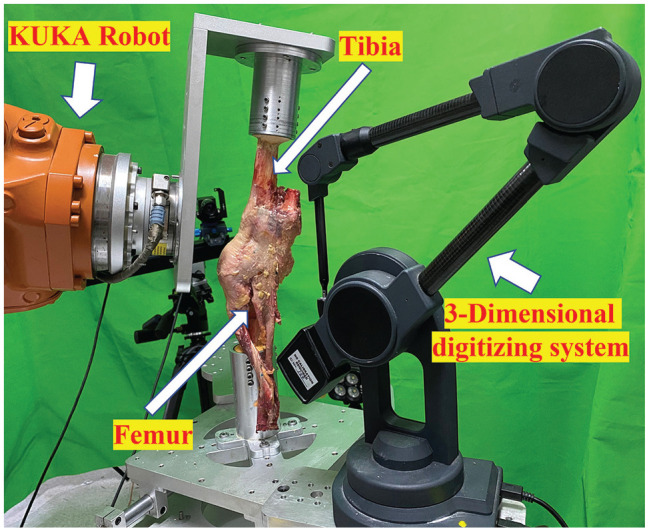
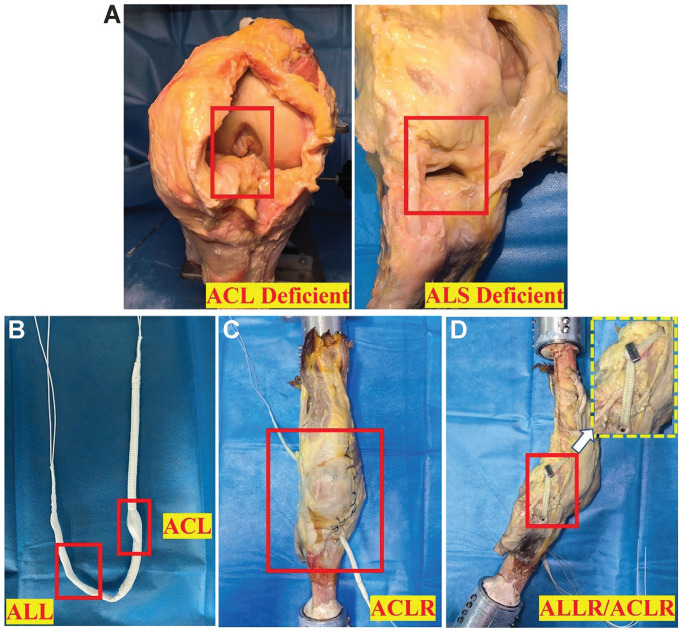
Methods: Eight fresh-frozen cadaveric knees were tested using a robotic manipulator. Each knee was tested in 4 states: (1) ALS/ACL intact, (2) ALS/ACL deficient, (3) ACLR, and (4) ALLR/ACLR. The anterior tibial translation (ATT) and tibial internal rotation (IR) in each knee condition were measured under 3 loads: (1) 89 N of anterior tibial loading, (2) 5 N·m of IR torque, and (3) simulated pivot shift (combined 5 N·m of IR torque and 7 N·m of valgus load).
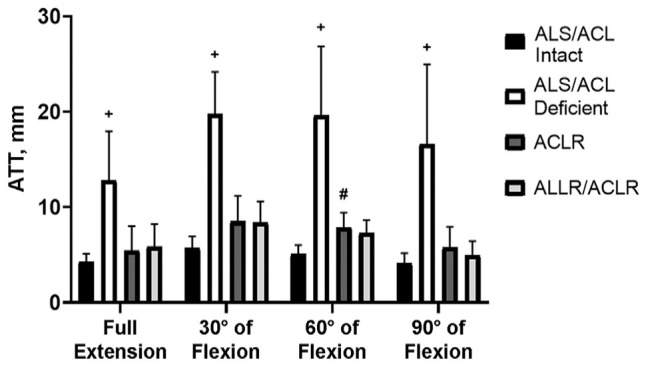
Results: During 89 N of anterior tibial loading, there were no significant differences in ATT between the isolated ACLR and ALLR/ACLR knees. During 5 N·m of IR torque, the mean tibial IR at 45° of flexion was significantly higher in the ACLR knees (32.49°± 7.96°) than in the ALLR/ACLR knees (21.78°± 3.03°) (P < .05). During the simulated pivot shift, the mean ATT and tibial IR at 30° and 45° of flexion were significantly higher in the ACLR knees (ATT: 5.09 ± 2.74 mm at 30°, 5.43 ± 2.79 mm at 45°; IR: 30.08°± 7.31° at 30°, 32.55°± 6.48° at 45°) than in the ALLR/ACLR knees (ATT: 1.93 ± 2.71 mm at 30°, 1.17 ± 2.26 mm at 45°; IR: 22.12°± 4.05° at 30°, 22.18°± 3.37° at 45°) (P < .05).
Conclusion: Combined artificial ALLR/ACLR restored native knee stability across multiple flexion angles and outperformed isolated artificial ACLR in ALS/ACL-deficient knees, particularly with respect to ATT and tibial IR during the pivot-shift test.
Clinical relevance: The indications of the artificial PET ligament may be expanded to include combined ALLR/ACLR to restore knee stability better than isolated artificial ACLR in ALS/ACL-deficient knees.
期刊介绍:
The Orthopaedic Journal of Sports Medicine (OJSM), developed by the American Orthopaedic Society for Sports Medicine (AOSSM), is a global, peer-reviewed, open access journal that combines the interests of researchers and clinical practitioners across orthopaedic sports medicine, arthroscopy, and knee arthroplasty.
Topics include original research in the areas of:
-Orthopaedic Sports Medicine, including surgical and nonsurgical treatment of orthopaedic sports injuries
-Arthroscopic Surgery (Shoulder/Elbow/Wrist/Hip/Knee/Ankle/Foot)
-Relevant translational research
-Sports traumatology/epidemiology
-Knee and shoulder arthroplasty
The OJSM also publishes relevant systematic reviews and meta-analyses.
This journal is a member of the Committee on Publication Ethics (COPE).



 京公网安备 11010802042870号
京ICP备2023020795号-1
京公网安备 11010802042870号
京ICP备2023020795号-1

 分享
分享
 求助内容:
求助内容: 应助结果提醒方式:
 扫码关注我们
