Karin Kjellenberg, Björg Helgadóttir, Örjan Ekblom, Gisela Nyberg
{"title":"Fitness and Screen Time at Age 13 Relates to Academic Performance at Age 16","authors":"Karin Kjellenberg, Björg Helgadóttir, Örjan Ekblom, Gisela Nyberg","doi":"10.1111/apa.70024","DOIUrl":null,"url":null,"abstract":"<div>\n \n \n <section>\n \n <h3> Aim</h3>\n \n <p>Investigate the longitudinal relationship between physical activity, organised physical activity, fitness, screen time and academic performance among Swedish adolescents.</p>\n </section>\n \n <section>\n \n <h3> Methods</h3>\n \n <p>Data from 1139 adolescents at age 13, included vigorous physical activity (accelerometry), fitness (submaximal ergometer test), screen time and organised physical activity participation (self-reported) and academic performance (math and Swedish grades at ages 13 and 16 from registry). Academic performance at age 16 was categorised as A–D (higher grades or pass) or E, F (fail or at-risk of failing). Multilevel logistic regression models were used to examine the relationships while adjusting for gender, parental education, parental country of birth and academic performance at age 13.</p>\n </section>\n \n <section>\n \n <h3> Results</h3>\n \n <p>Higher fitness at age 13 was associated with increased odds of receiving A–D at age 16 (OR: 1.04 per mL, 99% CI 1.00, 1.07, <i>p</i> = 0.003). High screen time during weekdays was associated with reduced odds (OR: 0.40, 99% CI 0.20, 0.81, <i>p</i> = 0.001) compared to low screen time.</p>\n </section>\n \n <section>\n \n <h3> Conclusion</h3>\n \n <p>Academic performance at the end of compulsory school (age 16) was related to fitness and screen time 3 years earlier. These findings create a paradigm for future randomised controlled trials to explore how influencing these factors might affect academic performance.</p>\n </section>\n </div>","PeriodicalId":55562,"journal":{"name":"Acta Paediatrica","volume":"114 7","pages":"1691-1701"},"PeriodicalIF":2.1000,"publicationDate":"2025-02-13","publicationTypes":"Journal Article","fieldsOfStudy":null,"isOpenAccess":false,"openAccessPdf":"https://onlinelibrary.wiley.com/doi/epdf/10.1111/apa.70024","citationCount":"0","resultStr":null,"platform":"Semanticscholar","paperid":null,"PeriodicalName":"Acta Paediatrica","FirstCategoryId":"3","ListUrlMain":"https://onlinelibrary.wiley.com/doi/10.1111/apa.70024","RegionNum":4,"RegionCategory":"医学","ArticlePicture":[],"TitleCN":null,"AbstractTextCN":null,"PMCID":null,"EPubDate":"","PubModel":"","JCR":"Q1","JCRName":"PEDIATRICS","Score":null,"Total":0}
引用次数: 0
Abstract
Aim
Investigate the longitudinal relationship between physical activity, organised physical activity, fitness, screen time and academic performance among Swedish adolescents.
Methods
Data from 1139 adolescents at age 13, included vigorous physical activity (accelerometry), fitness (submaximal ergometer test), screen time and organised physical activity participation (self-reported) and academic performance (math and Swedish grades at ages 13 and 16 from registry). Academic performance at age 16 was categorised as A–D (higher grades or pass) or E, F (fail or at-risk of failing). Multilevel logistic regression models were used to examine the relationships while adjusting for gender, parental education, parental country of birth and academic performance at age 13.
Results
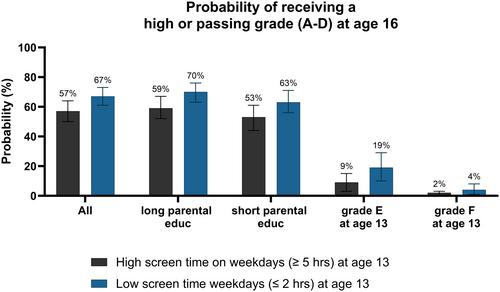
Higher fitness at age 13 was associated with increased odds of receiving A–D at age 16 (OR: 1.04 per mL, 99% CI 1.00, 1.07, p = 0.003). High screen time during weekdays was associated with reduced odds (OR: 0.40, 99% CI 0.20, 0.81, p = 0.001) compared to low screen time.
Conclusion
Academic performance at the end of compulsory school (age 16) was related to fitness and screen time 3 years earlier. These findings create a paradigm for future randomised controlled trials to explore how influencing these factors might affect academic performance.
目的:探讨瑞典青少年身体活动、有组织的身体活动、健康、屏幕时间与学习成绩之间的纵向关系。方法:来自1139名13岁青少年的数据,包括剧烈体育活动(加速度计)、健身(次极限测力仪测试)、屏幕时间和有组织的体育活动参与(自我报告)以及学习成绩(13岁和16岁时的数学和瑞典成绩)。16岁时的学习成绩分为A-D(较高的成绩或及格)或E、F(不及格或可能不及格)。在调整性别、父母受教育程度、父母出生国家和13岁时的学习成绩后,使用多水平逻辑回归模型来检验这些关系。结果:13岁时较高的健康水平与16岁时接受A-D的几率增加相关(OR: 1.04 / mL, 99% CI 1.00, 1.07, p = 0.003)。与低屏幕时间相比,工作日高屏幕时间与低屏幕时间相关(OR: 0.40, 99% CI 0.20, 0.81, p = 0.001)。结论:义务教育结束时(16岁)的学习成绩与3年前的健康和屏幕时间有关。这些发现为未来的随机对照试验创造了一个范例,以探索影响这些因素如何影响学习成绩。
期刊介绍:
Acta Paediatrica is a peer-reviewed monthly journal at the forefront of international pediatric research. It covers both clinical and experimental research in all areas of pediatrics including:
neonatal medicine
developmental medicine
adolescent medicine
child health and environment
psychosomatic pediatrics
child health in developing countries




 京公网安备 11010802042870号
京ICP备2023020795号-1
京公网安备 11010802042870号
京ICP备2023020795号-1

 分享
分享
 求助内容:
求助内容: 应助结果提醒方式:
 扫码关注我们
