Kamsheung Chan, Lapkin Chiang, Ken Kaming Ho, Yimchu Li, S H Ko, Catherine Xiaorui Chen
{"title":"Management of gout in primary care of Hong Kong in accordance with international guidelines: any gaps to bridge?","authors":"Kamsheung Chan, Lapkin Chiang, Ken Kaming Ho, Yimchu Li, S H Ko, Catherine Xiaorui Chen","doi":"10.1186/s12875-024-02664-2","DOIUrl":null,"url":null,"abstract":"<p><strong>Background: </strong>The global prevalence of gout ranges from 1 to 6.8% in different countries, while around 3% in Hong Kong. Sudden elevated serum urate level (SUA) will result in acute arthritis and repeated flare-ups. If not properly managed, tophi formation and joint damage will occur, leading to disabilities. Gout is one of the most common conditions encountered in primary care. This study aims to assess urate control among gout patients managed in primary care settings of Hong Kong and to evaluate its associated risk factors.</p><p><strong>Method: </strong>This was retrospective cross-sectional study. Adult Chinese gout patients who had been followed up in public primary care clinics of Hong Kong from 1 January 2021 to 31 December 2021 were included. Patient demographics, clinical and biochemical parameters were retrieved from the clinical management computer system. Student's t-test was used for analyzing continuous variables and Chi-square test was used for categorical data. Multivariate stepwise logistic regression was used to determine the associated risk factors for poor urate control.</p><p><strong>Results: </strong>Among the 385 gout patients included, 115 (29.9%) met the target serum urate level (TSUL). 4.4% of gout patients developed tophaceous gout, while none of them could achieve the TSUL. 60.3% of gout patients were put on urate-lowering agents (ULT), while allopurinol was the most commonly used, i.e. 95.7%. In multivariate studies, patients who are male (OR 2.59, 95% CI: 1.37-4.87), active smokers (OR 3.17, 95% CI: 1.08-9.33), with chronic kidney disease (CKD) with stage 3a, 3b and 4, (OR 3.24, 3.12 and 10.25 respectively; 95% CI: 1.56-6.73, 1.11-8.76 and 1.08-97.48 respectively) were less likely to meet TSUL whereas those on urate-lowering agents (OR 0.23, 95% CI: 0.13-0.40) were more likely to achieve satisfactory urate control.</p><p><strong>Conclusion: </strong>60.3% of gout patients were treated with urate-lowering agents in public primary care settings in Hong Kong, while only 29.9% of gout patients and none of tophaceous gout patients were adequately treated. Male patients, active smokers or comorbid with CKD stage 3a, 3b and 4 were less likely to achieve target urate control.</p>","PeriodicalId":72428,"journal":{"name":"BMC primary care","volume":"26 1","pages":"38"},"PeriodicalIF":2.6000,"publicationDate":"2025-02-12","publicationTypes":"Journal Article","fieldsOfStudy":null,"isOpenAccess":false,"openAccessPdf":"https://www.ncbi.nlm.nih.gov/pmc/articles/PMC11817381/pdf/","citationCount":"0","resultStr":null,"platform":"Semanticscholar","paperid":null,"PeriodicalName":"BMC primary care","FirstCategoryId":"1085","ListUrlMain":"https://doi.org/10.1186/s12875-024-02664-2","RegionNum":0,"RegionCategory":null,"ArticlePicture":[],"TitleCN":null,"AbstractTextCN":null,"PMCID":null,"EPubDate":"","PubModel":"","JCR":"Q2","JCRName":"MEDICINE, GENERAL & INTERNAL","Score":null,"Total":0}
引用次数: 0
Abstract
Background: The global prevalence of gout ranges from 1 to 6.8% in different countries, while around 3% in Hong Kong. Sudden elevated serum urate level (SUA) will result in acute arthritis and repeated flare-ups. If not properly managed, tophi formation and joint damage will occur, leading to disabilities. Gout is one of the most common conditions encountered in primary care. This study aims to assess urate control among gout patients managed in primary care settings of Hong Kong and to evaluate its associated risk factors.
Method: This was retrospective cross-sectional study. Adult Chinese gout patients who had been followed up in public primary care clinics of Hong Kong from 1 January 2021 to 31 December 2021 were included. Patient demographics, clinical and biochemical parameters were retrieved from the clinical management computer system. Student's t-test was used for analyzing continuous variables and Chi-square test was used for categorical data. Multivariate stepwise logistic regression was used to determine the associated risk factors for poor urate control.
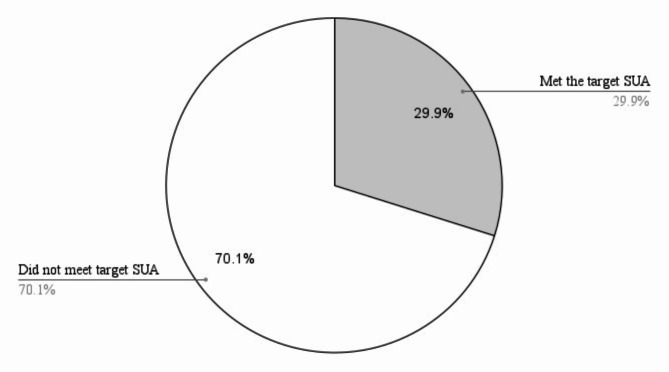
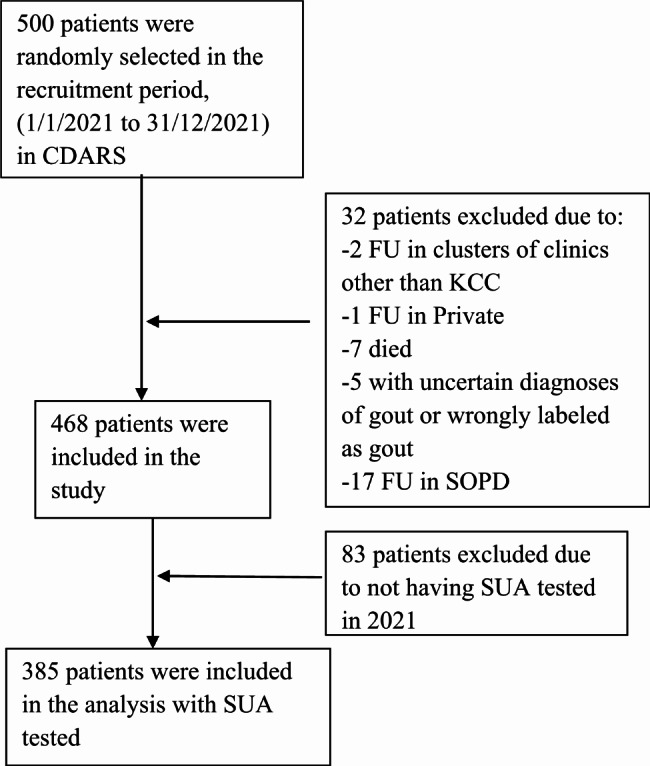
Results: Among the 385 gout patients included, 115 (29.9%) met the target serum urate level (TSUL). 4.4% of gout patients developed tophaceous gout, while none of them could achieve the TSUL. 60.3% of gout patients were put on urate-lowering agents (ULT), while allopurinol was the most commonly used, i.e. 95.7%. In multivariate studies, patients who are male (OR 2.59, 95% CI: 1.37-4.87), active smokers (OR 3.17, 95% CI: 1.08-9.33), with chronic kidney disease (CKD) with stage 3a, 3b and 4, (OR 3.24, 3.12 and 10.25 respectively; 95% CI: 1.56-6.73, 1.11-8.76 and 1.08-97.48 respectively) were less likely to meet TSUL whereas those on urate-lowering agents (OR 0.23, 95% CI: 0.13-0.40) were more likely to achieve satisfactory urate control.
Conclusion: 60.3% of gout patients were treated with urate-lowering agents in public primary care settings in Hong Kong, while only 29.9% of gout patients and none of tophaceous gout patients were adequately treated. Male patients, active smokers or comorbid with CKD stage 3a, 3b and 4 were less likely to achieve target urate control.




 京公网安备 11010802042870号
京ICP备2023020795号-1
京公网安备 11010802042870号
京ICP备2023020795号-1

 分享
分享

 求助内容:
求助内容: 应助结果提醒方式:
 扫码关注我们
