Georgios Antoniadis, Ioannis Tsikopoulos, Aikaterini Tsionga, Konstantinos Galanoulis, Nikolaos Bousdroukis, Michael Samarinas
{"title":"Urethral bulking agents and pelvic floor muscle training for the treatment of stress urinary incontinence in female patients with multiple sclerosis.","authors":"Georgios Antoniadis, Ioannis Tsikopoulos, Aikaterini Tsionga, Konstantinos Galanoulis, Nikolaos Bousdroukis, Michael Samarinas","doi":"10.14440/bladder.2024.0049","DOIUrl":null,"url":null,"abstract":"<p><strong>Background: </strong>Stress urinary incontinence (SUI), characterized by involuntary urine leakage during increased abdominal pressure, is prevalent among women with multiple sclerosis (MS), significantly impacting their quality of life (QoL). Traditional treatments are less suitable for MS patients due to potential complications, highlighting the need for less invasive alternatives, <i>that is</i>, urethral bulking agents (UBAs) and pelvic floor muscle training (PFMT). UBAs increase urethral tissue volume, while PFMT strengthens pelvic muscles. Despite promising outcomes, their efficacy in MS-related SUI is under-researched.</p><p><strong>Objective: </strong>This study assessed the effectiveness of UBAs and PFMT in managing SUI among female patients with MS.</p><p><strong>Methods: </strong>This nine-month study involved 14 female MS patients with moderate SUI, who were equally divided into two groups to evaluate the effectiveness of UBAs and PFMT. UBAs were administered through injections to enhance urethral resistance, while PFMT used guided exercises to improve pelvic control. Outcomes were assessed in terms of urinary pad usage, scores of International Consultation on Incontinence Questionnaire-Short Form, and QoL metrics to evaluate reductions in incontinence and symptom severity.</p><p><strong>Results: </strong>Both treatment groups showed significant improvement with SUI management. Daily pad usage decreased to 0-1 in both groups, with reductions in symptom severity and improvements in QoL scores. UBAs provided quicker symptomatic relief, while PFMT supported long-term management. However, two participants in the PFMT group discontinued follow-up due to MS-related complications, highlighting the challenges of maintaining adherence in progressive conditions.</p><p><strong>Conclusion: </strong>UBAs and PFMT are effective management options for SUI in MS patients, improving symptom control and QoL. This study underscored the importance of individualized, multimodal approaches to optimize outcomes for women with MS-related SUI. Nevertheless, further research is needed for long-term validation.</p>","PeriodicalId":72421,"journal":{"name":"Bladder (San Francisco, Calif.)","volume":"11 4","pages":"e21200028"},"PeriodicalIF":0.0000,"publicationDate":"2025-01-17","publicationTypes":"Journal Article","fieldsOfStudy":null,"isOpenAccess":false,"openAccessPdf":"https://www.ncbi.nlm.nih.gov/pmc/articles/PMC11810683/pdf/","citationCount":"0","resultStr":null,"platform":"Semanticscholar","paperid":null,"PeriodicalName":"Bladder (San Francisco, Calif.)","FirstCategoryId":"1085","ListUrlMain":"https://doi.org/10.14440/bladder.2024.0049","RegionNum":0,"RegionCategory":null,"ArticlePicture":[],"TitleCN":null,"AbstractTextCN":null,"PMCID":null,"EPubDate":"2024/1/1 0:00:00","PubModel":"eCollection","JCR":"","JCRName":"","Score":null,"Total":0}
引用次数: 0
Abstract
Background: Stress urinary incontinence (SUI), characterized by involuntary urine leakage during increased abdominal pressure, is prevalent among women with multiple sclerosis (MS), significantly impacting their quality of life (QoL). Traditional treatments are less suitable for MS patients due to potential complications, highlighting the need for less invasive alternatives, that is, urethral bulking agents (UBAs) and pelvic floor muscle training (PFMT). UBAs increase urethral tissue volume, while PFMT strengthens pelvic muscles. Despite promising outcomes, their efficacy in MS-related SUI is under-researched.
Objective: This study assessed the effectiveness of UBAs and PFMT in managing SUI among female patients with MS.
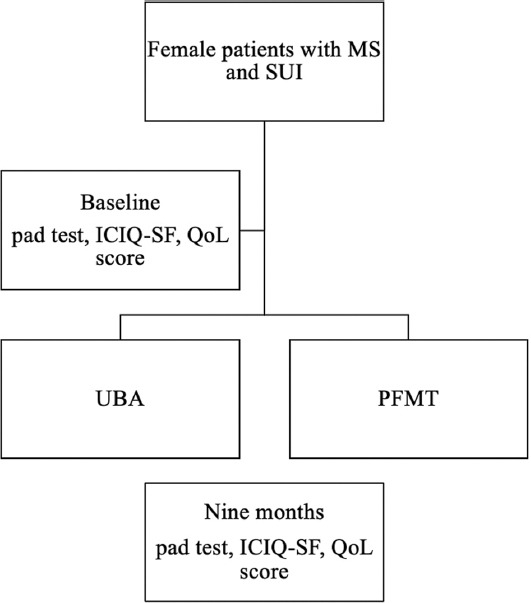
Methods: This nine-month study involved 14 female MS patients with moderate SUI, who were equally divided into two groups to evaluate the effectiveness of UBAs and PFMT. UBAs were administered through injections to enhance urethral resistance, while PFMT used guided exercises to improve pelvic control. Outcomes were assessed in terms of urinary pad usage, scores of International Consultation on Incontinence Questionnaire-Short Form, and QoL metrics to evaluate reductions in incontinence and symptom severity.
Results: Both treatment groups showed significant improvement with SUI management. Daily pad usage decreased to 0-1 in both groups, with reductions in symptom severity and improvements in QoL scores. UBAs provided quicker symptomatic relief, while PFMT supported long-term management. However, two participants in the PFMT group discontinued follow-up due to MS-related complications, highlighting the challenges of maintaining adherence in progressive conditions.
Conclusion: UBAs and PFMT are effective management options for SUI in MS patients, improving symptom control and QoL. This study underscored the importance of individualized, multimodal approaches to optimize outcomes for women with MS-related SUI. Nevertheless, further research is needed for long-term validation.



 京公网安备 11010802042870号
京ICP备2023020795号-1
京公网安备 11010802042870号
京ICP备2023020795号-1

 分享
分享

 求助内容:
求助内容: 应助结果提醒方式:
 扫码关注我们
