{"title":"The Turing heritage for plant biology: all spots and stripes?","authors":"Eric Siero, Eva E Deinum","doi":"10.1017/qpb.2024.16","DOIUrl":null,"url":null,"abstract":"<p><p>In 'The chemical basis of morphogenesis' (1952), Alan Turing introduced an idea that revolutionised our thinking about pattern formation. He proposed that diffusion could lead to the spontaneous formation of regular patterns. Here, we discuss the impact of Turing's idea on plant science using three well-established examples at different scales: ROP patterning inside single cells, epidermal patterning across several cells and whole vegetation patterns. Also at intermediate levels, e.g., organ spacing, plants look surprisingly regular. But not all regular patterns are Turing patterns, careful observation and prediction of the patterning process-not just the final pattern-is critical to distinguish between mechanisms.</p>","PeriodicalId":101358,"journal":{"name":"Quantitative plant biology","volume":"6 ","pages":"e1"},"PeriodicalIF":2.5000,"publicationDate":"2025-01-13","publicationTypes":"Journal Article","fieldsOfStudy":null,"isOpenAccess":false,"openAccessPdf":"https://www.ncbi.nlm.nih.gov/pmc/articles/PMC11811860/pdf/","citationCount":"0","resultStr":null,"platform":"Semanticscholar","paperid":null,"PeriodicalName":"Quantitative plant biology","FirstCategoryId":"1085","ListUrlMain":"https://doi.org/10.1017/qpb.2024.16","RegionNum":0,"RegionCategory":null,"ArticlePicture":[],"TitleCN":null,"AbstractTextCN":null,"PMCID":null,"EPubDate":"2025/1/1 0:00:00","PubModel":"eCollection","JCR":"","JCRName":"","Score":null,"Total":0}
引用次数: 0
Abstract
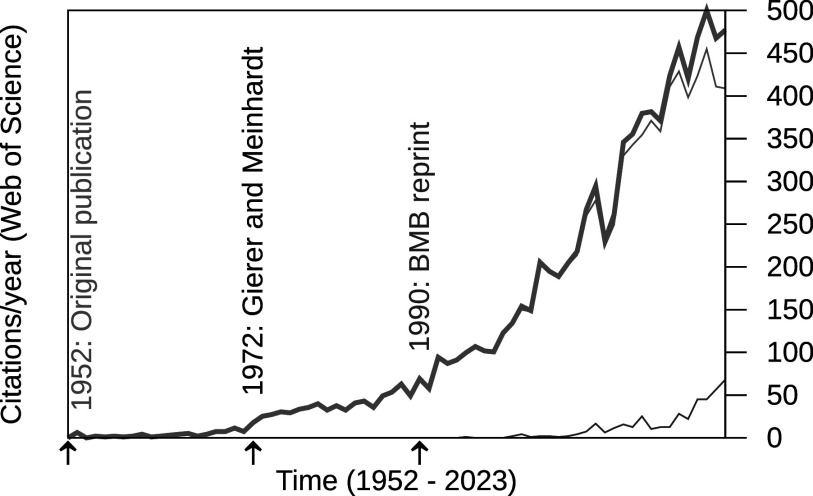
In 'The chemical basis of morphogenesis' (1952), Alan Turing introduced an idea that revolutionised our thinking about pattern formation. He proposed that diffusion could lead to the spontaneous formation of regular patterns. Here, we discuss the impact of Turing's idea on plant science using three well-established examples at different scales: ROP patterning inside single cells, epidermal patterning across several cells and whole vegetation patterns. Also at intermediate levels, e.g., organ spacing, plants look surprisingly regular. But not all regular patterns are Turing patterns, careful observation and prediction of the patterning process-not just the final pattern-is critical to distinguish between mechanisms.




 京公网安备 11010802042870号
京ICP备2023020795号-1
京公网安备 11010802042870号
京ICP备2023020795号-1

 分享
分享

 求助内容:
求助内容: 应助结果提醒方式:
 扫码关注我们
