Joseph S Brown, Michael A Lee, Wayne Vuong, Andrei Loas, Bradley L Pentelute
{"title":"pyBinder: Quantitation to Advance Affinity Selection-Mass Spectrometry.","authors":"Joseph S Brown, Michael A Lee, Wayne Vuong, Andrei Loas, Bradley L Pentelute","doi":"10.1021/acs.analchem.4c04445","DOIUrl":null,"url":null,"abstract":"<p><p>Affinity selection-mass spectrometry (AS-MS) is a ligand discovery platform that relies upon mass spectrometry to identify molecules bound to a biomolecular target. When utilized with large peptide libraries (10<sup>8</sup> members), AS-MS sample complexity can surpass the sequencing capacity of modern mass spectrometers, resulting in incomplete data, identification of few target-specific ligands, and/or incomplete sequencing. To address this challenge, we introduce pyBinder to perform quantitation on AS-MS data to process primary MS<sup>1</sup> data and develop two scores to rank the peptides from the integration of their peak area: target selectivity and concentration-dependent enrichment. We benchmark pyBinder utilizing AS-MS data developed against antihemagglutinin antibody 12ca5, revealing that peptides that contain a motif known for target-specific high-affinity binding are well characterized by these two scores. AS-MS data from a second protein target, WD Repeat Domain 5 (WDR5), is analyzed to confirm the two pyBinder scores reliably capture the target-specific motif-containing peptides. From the results delivered by pyBinder, a list of target-selective features is developed and fed back into subsequent MS experiments to facilitate expanded data generation and the targeted discovery of selective ligands. pyBinder analysis resulted in a 4-fold increase in motif-containing sequence identification for WDR5 (from 3 to 14 ligands discovered), showing the utility of the two scores. This work establishes an improved approach for AS-MS to enable discovery outcomes (i.e., more ligands identified), but also a way to compare AS-MS data across samples, protocols, and conditions broadly.</p>","PeriodicalId":27,"journal":{"name":"Analytical Chemistry","volume":" ","pages":"3855-3863"},"PeriodicalIF":6.7000,"publicationDate":"2025-02-25","publicationTypes":"Journal Article","fieldsOfStudy":null,"isOpenAccess":false,"openAccessPdf":"","citationCount":"0","resultStr":null,"platform":"Semanticscholar","paperid":null,"PeriodicalName":"Analytical Chemistry","FirstCategoryId":"92","ListUrlMain":"https://doi.org/10.1021/acs.analchem.4c04445","RegionNum":1,"RegionCategory":"化学","ArticlePicture":[],"TitleCN":null,"AbstractTextCN":null,"PMCID":null,"EPubDate":"2025/2/14 0:00:00","PubModel":"Epub","JCR":"Q1","JCRName":"CHEMISTRY, ANALYTICAL","Score":null,"Total":0}
引用次数: 0
Abstract
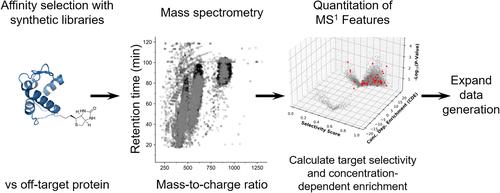
Affinity selection-mass spectrometry (AS-MS) is a ligand discovery platform that relies upon mass spectrometry to identify molecules bound to a biomolecular target. When utilized with large peptide libraries (108 members), AS-MS sample complexity can surpass the sequencing capacity of modern mass spectrometers, resulting in incomplete data, identification of few target-specific ligands, and/or incomplete sequencing. To address this challenge, we introduce pyBinder to perform quantitation on AS-MS data to process primary MS1 data and develop two scores to rank the peptides from the integration of their peak area: target selectivity and concentration-dependent enrichment. We benchmark pyBinder utilizing AS-MS data developed against antihemagglutinin antibody 12ca5, revealing that peptides that contain a motif known for target-specific high-affinity binding are well characterized by these two scores. AS-MS data from a second protein target, WD Repeat Domain 5 (WDR5), is analyzed to confirm the two pyBinder scores reliably capture the target-specific motif-containing peptides. From the results delivered by pyBinder, a list of target-selective features is developed and fed back into subsequent MS experiments to facilitate expanded data generation and the targeted discovery of selective ligands. pyBinder analysis resulted in a 4-fold increase in motif-containing sequence identification for WDR5 (from 3 to 14 ligands discovered), showing the utility of the two scores. This work establishes an improved approach for AS-MS to enable discovery outcomes (i.e., more ligands identified), but also a way to compare AS-MS data across samples, protocols, and conditions broadly.
期刊介绍:
Analytical Chemistry, a peer-reviewed research journal, focuses on disseminating new and original knowledge across all branches of analytical chemistry. Fundamental articles may explore general principles of chemical measurement science and need not directly address existing or potential analytical methodology. They can be entirely theoretical or report experimental results. Contributions may cover various phases of analytical operations, including sampling, bioanalysis, electrochemistry, mass spectrometry, microscale and nanoscale systems, environmental analysis, separations, spectroscopy, chemical reactions and selectivity, instrumentation, imaging, surface analysis, and data processing. Papers discussing known analytical methods should present a significant, original application of the method, a notable improvement, or results on an important analyte.



 京公网安备 11010802042870号
京ICP备2023020795号-1
京公网安备 11010802042870号
京ICP备2023020795号-1

 分享
分享
 求助内容:
求助内容: 应助结果提醒方式:
 扫码关注我们
