Shreyas Malpathak, Sangeeth Das Kallullathil, Artur F Izmaylov
{"title":"Simulating Vibrational Dynamics on Bosonic Quantum Devices.","authors":"Shreyas Malpathak, Sangeeth Das Kallullathil, Artur F Izmaylov","doi":"10.1021/acs.jpclett.4c03480","DOIUrl":null,"url":null,"abstract":"<p><p>Bosonic quantum devices, which utilize harmonic oscillator modes to encode information, are emerging as a promising alternative to conventional qubit-based quantum devices, especially for the simulation of vibrational dynamics and spectroscopy. We present a framework for digital quantum simulation of vibrational dynamics under anharmonic potentials on these bosonic devices. In our approach, the vibrational Hamiltonian is decomposed into solvable fragments that can be used for Hamiltonian simulation on currently available bosonic hardware. Specifically, we have extended the Cartan subalgebra approach [Yen, T.C.; Izmaylov, A. F. <i>PRX Quantum 2</i>, 2021; 040320]- a method for decomposing quantum Hamiltonians into solvable parts- to bosonic operators, enabling us to construct anharmonic Hamiltonian fragments that can be efficiently diagonalized using Bogoliubov transforms. The approach is tested using a simulation of tunneling dynamics in a model two-dimensional double-well potential and calculations of vibrational eigenenergies for small molecules. Our fragmentation scheme provides a new approach for digital quantum simulations on bosonic quantum hardware for multimode anharmonic vibrational dynamics.</p>","PeriodicalId":62,"journal":{"name":"The Journal of Physical Chemistry Letters","volume":" ","pages":"1855-1864"},"PeriodicalIF":4.6000,"publicationDate":"2025-02-27","publicationTypes":"Journal Article","fieldsOfStudy":null,"isOpenAccess":false,"openAccessPdf":"","citationCount":"0","resultStr":null,"platform":"Semanticscholar","paperid":null,"PeriodicalName":"The Journal of Physical Chemistry Letters","FirstCategoryId":"1","ListUrlMain":"https://doi.org/10.1021/acs.jpclett.4c03480","RegionNum":2,"RegionCategory":"化学","ArticlePicture":[],"TitleCN":null,"AbstractTextCN":null,"PMCID":null,"EPubDate":"2025/2/14 0:00:00","PubModel":"Epub","JCR":"Q2","JCRName":"CHEMISTRY, PHYSICAL","Score":null,"Total":0}
引用次数: 0
Abstract
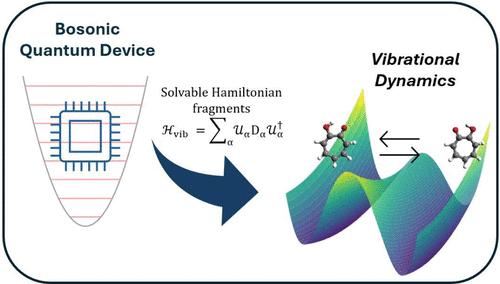
Bosonic quantum devices, which utilize harmonic oscillator modes to encode information, are emerging as a promising alternative to conventional qubit-based quantum devices, especially for the simulation of vibrational dynamics and spectroscopy. We present a framework for digital quantum simulation of vibrational dynamics under anharmonic potentials on these bosonic devices. In our approach, the vibrational Hamiltonian is decomposed into solvable fragments that can be used for Hamiltonian simulation on currently available bosonic hardware. Specifically, we have extended the Cartan subalgebra approach [Yen, T.C.; Izmaylov, A. F. PRX Quantum 2, 2021; 040320]- a method for decomposing quantum Hamiltonians into solvable parts- to bosonic operators, enabling us to construct anharmonic Hamiltonian fragments that can be efficiently diagonalized using Bogoliubov transforms. The approach is tested using a simulation of tunneling dynamics in a model two-dimensional double-well potential and calculations of vibrational eigenenergies for small molecules. Our fragmentation scheme provides a new approach for digital quantum simulations on bosonic quantum hardware for multimode anharmonic vibrational dynamics.
玻色子量子器件,利用谐振子模式来编码信息,正在成为传统的基于量子比特的量子器件的一个有前途的替代品,特别是在振动动力学和光谱学的模拟方面。我们提出了一个数字量子模拟这些玻色子器件在非调和势下振动动力学的框架。在我们的方法中,振动哈密顿量被分解成可解的碎片,这些碎片可以用于目前可用的玻色子硬件上的哈密顿模拟。具体来说,我们扩展了Cartan子代数方法[Yen, T.C.;Izmaylov, A. F. PRX Quantum 2, 2021;[40320]-一种将量子哈密顿分解为可解部分的方法-到玻色子算子,使我们能够构建可以使用Bogoliubov变换有效对角化的非调和哈密顿片段。利用二维双阱势模型的隧道动力学模拟和小分子的振动本征能计算对该方法进行了验证。我们的碎片化方案为玻色子量子硬件的多模非调和振动动力学的数字量子模拟提供了新的方法。
期刊介绍:
The Journal of Physical Chemistry (JPC) Letters is devoted to reporting new and original experimental and theoretical basic research of interest to physical chemists, biophysical chemists, chemical physicists, physicists, material scientists, and engineers. An important criterion for acceptance is that the paper reports a significant scientific advance and/or physical insight such that rapid publication is essential. Two issues of JPC Letters are published each month.



 京公网安备 11010802042870号
京ICP备2023020795号-1
京公网安备 11010802042870号
京ICP备2023020795号-1

 分享
分享
 求助内容:
求助内容: 应助结果提醒方式:
 扫码关注我们
