{"title":"Psychological impact of the 2023 Kahramanmaraş earthquakes on non-victims: a cross-sectional study.","authors":"Metin Çınaroğlu, Eda Yılmazer, Gökben Hızlı Sayar","doi":"10.1186/s12889-025-21901-6","DOIUrl":null,"url":null,"abstract":"<p><p>The 2023 Kahramanmaraş earthquakes, with magnitudes of 7.7 and 7.6, caused extensive destruction and psychological distress across southeastern Turkey. This study explores the psychological impact on non-victims, particularly Istanbul residents, focusing on mental health outcomes and coping mechanisms. A cross-sectional survey was conducted from March to May 2024 with 721 participants from various Turkish cities, including a significant portion from Istanbul. Validated psychological scales such as the Beck Depression Inventory-II (BDI-II), Beck Anxiety Inventory (BAI), Warwick-Edinburgh Mental Well-being Scale (WEMWBS), and PTSD Checklist for DSM-5 (PCL-5) measured depression, anxiety, well-being, and PTSD symptoms. Sociodemographic factors like age, gender, occupation, income, education level, and previous earthquake experience were also analyzed.Results showed significant psychological distress among non-victims: 51.9% reported high levels of distress, with 24% meeting PTSD criteria, 30% exhibiting moderate to severe depression, and 28% experiencing significant anxiety. Higher income and education levels correlated with better mental health outcomes. Higher education levels were linked to lower PTSD risk (β = -0.20, p < 0.01) and fewer depression symptoms (β = -0.15, p < 0.05). Higher income was associated with lower depression scores (β = -0.20, p < 0.01) and fewer PTSD symptoms (β = -0.15, p < 0.05). Age positively correlated with well-being (r = 0.68, p < 0.001) and negatively with PTSD symptoms (r = -0.15, p < 0.05).Comparisons with victim studies of major earthquakes, such as the 1995 Great Hanshin-Awaji earthquake, the 1999 Marmara earthquake, the 2008 Wenchuan earthquake, and the 2000 Iceland earthquakes, revealed similar profound psychological impacts. This highlights the need for comprehensive mental health interventions for both direct and indirect exposures. This study underscores the necessity for inclusive mental health strategies to enhance resilience and well-being, ensuring robust recovery after catastrophic events.</p>","PeriodicalId":9039,"journal":{"name":"BMC Public Health","volume":"25 1","pages":"597"},"PeriodicalIF":3.6000,"publicationDate":"2025-02-13","publicationTypes":"Journal Article","fieldsOfStudy":null,"isOpenAccess":false,"openAccessPdf":"https://www.ncbi.nlm.nih.gov/pmc/articles/PMC11827230/pdf/","citationCount":"0","resultStr":null,"platform":"Semanticscholar","paperid":null,"PeriodicalName":"BMC Public Health","FirstCategoryId":"3","ListUrlMain":"https://doi.org/10.1186/s12889-025-21901-6","RegionNum":2,"RegionCategory":"医学","ArticlePicture":[],"TitleCN":null,"AbstractTextCN":null,"PMCID":null,"EPubDate":"","PubModel":"","JCR":"Q1","JCRName":"PUBLIC, ENVIRONMENTAL & OCCUPATIONAL HEALTH","Score":null,"Total":0}
引用次数: 0
Abstract
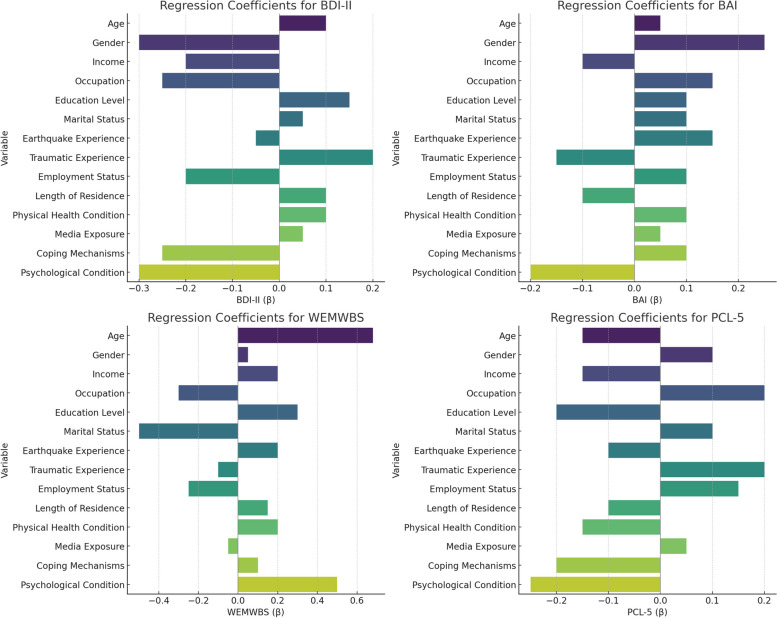
The 2023 Kahramanmaraş earthquakes, with magnitudes of 7.7 and 7.6, caused extensive destruction and psychological distress across southeastern Turkey. This study explores the psychological impact on non-victims, particularly Istanbul residents, focusing on mental health outcomes and coping mechanisms. A cross-sectional survey was conducted from March to May 2024 with 721 participants from various Turkish cities, including a significant portion from Istanbul. Validated psychological scales such as the Beck Depression Inventory-II (BDI-II), Beck Anxiety Inventory (BAI), Warwick-Edinburgh Mental Well-being Scale (WEMWBS), and PTSD Checklist for DSM-5 (PCL-5) measured depression, anxiety, well-being, and PTSD symptoms. Sociodemographic factors like age, gender, occupation, income, education level, and previous earthquake experience were also analyzed.Results showed significant psychological distress among non-victims: 51.9% reported high levels of distress, with 24% meeting PTSD criteria, 30% exhibiting moderate to severe depression, and 28% experiencing significant anxiety. Higher income and education levels correlated with better mental health outcomes. Higher education levels were linked to lower PTSD risk (β = -0.20, p < 0.01) and fewer depression symptoms (β = -0.15, p < 0.05). Higher income was associated with lower depression scores (β = -0.20, p < 0.01) and fewer PTSD symptoms (β = -0.15, p < 0.05). Age positively correlated with well-being (r = 0.68, p < 0.001) and negatively with PTSD symptoms (r = -0.15, p < 0.05).Comparisons with victim studies of major earthquakes, such as the 1995 Great Hanshin-Awaji earthquake, the 1999 Marmara earthquake, the 2008 Wenchuan earthquake, and the 2000 Iceland earthquakes, revealed similar profound psychological impacts. This highlights the need for comprehensive mental health interventions for both direct and indirect exposures. This study underscores the necessity for inclusive mental health strategies to enhance resilience and well-being, ensuring robust recovery after catastrophic events.
2023年的kahramanmaraku地震,震级为7.7级和7.6级,在土耳其东南部造成了广泛的破坏和心理上的痛苦。本研究探讨了对非受害者,特别是伊斯坦布尔居民的心理影响,重点是心理健康结果和应对机制。2024年3月至5月进行了一项横断面调查,共有来自土耳其各个城市的721名参与者,其中很大一部分来自伊斯坦布尔。经验证的心理量表,如贝克抑郁量表- ii (BDI-II)、贝克焦虑量表(BAI)、沃里克-爱丁堡心理健康量表(WEMWBS)和DSM-5的创伤后应激障碍检查表(PCL-5)测量抑郁、焦虑、幸福感和创伤后应激障碍症状。社会人口学因素如年龄、性别、职业、收入、教育程度和以前的地震经历也进行了分析。结果显示,非受害者中有明显的心理困扰:51.9%的人报告了高度的痛苦,24%的人符合PTSD标准,30%的人表现出中度至重度抑郁,28%的人表现出明显的焦虑。较高的收入和教育水平与较好的心理健康结果相关。高等教育水平与较低的PTSD风险相关(β = -0.20, p
期刊介绍:
BMC Public Health is an open access, peer-reviewed journal that considers articles on the epidemiology of disease and the understanding of all aspects of public health. The journal has a special focus on the social determinants of health, the environmental, behavioral, and occupational correlates of health and disease, and the impact of health policies, practices and interventions on the community.



 京公网安备 11010802042870号
京ICP备2023020795号-1
京公网安备 11010802042870号
京ICP备2023020795号-1

 分享
分享
 求助内容:
求助内容: 应助结果提醒方式:
 扫码关注我们
