Tobacco and household expenditure in Egypt: insights into socioeconomic inequalities and spending profiles from the Household Income, Expenditure and Consumption Survey.
{"title":"Tobacco and household expenditure in Egypt: insights into socioeconomic inequalities and spending profiles from the Household Income, Expenditure and Consumption Survey.","authors":"Aya Mostafa, Rasha Saad Hussein","doi":"10.1186/s12889-025-21676-w","DOIUrl":null,"url":null,"abstract":"<p><strong>Background: </strong>Tobacco use deepens poverty. Egypt, a lower-middle income country, is one of the few countries worldwide where tobacco use is rising. However, no published study examined the adverse impacts of tobacco on the Egyptian household welfare, specifically after the first Egyptian Pound (EGP) devaluation by 80% in 2016. To address this gap and inform tobacco taxation policymaking, we aimed to provide evidence characterizing national household tobacco expenditure in Egypt.</p><p><strong>Methods: </strong>We conducted a secondary analysis of the 2017/2018 Household Income, Expenditure and Consumption Survey, focusing on the most used tobacco products in Egypt: cigarette and waterpipe tobacco. We identified the proportion and background characteristics of cigarette and waterpipe tobacco smoker households. We calculated household tobacco expenditure share as a proportion of total household expenditure. We compared mean household expenditure shares of 12 expenditure groups among smoker and nonsmoker households and examined the differences by income quintiles. We determined the factors associated with household tobacco expenditure. Descriptive, bivariable, and multivariable analyses were performed.</p><p><strong>Results: </strong>Cigarette and waterpipe tobacco smokers were present in 41.1% and 7.0% of 12,845 households, respectively. Annual household expenditure on cigarettes (10.7%) was triple that of waterpipe tobacco (3.4%) (p < 0.001). Smoker households spent less than nonsmoker households on virtually all expenditure groups (p < 0.001). The poorest income quintile spent 11.1% of its total expenditure on tobacco (1.26 times higher than the richest, p = 0.006). More waterpipe tobacco than cigarette smoker households lived below the poverty line (40.6% versus 24.4%, p < 0.001). Cigarette smoker households spent less on food and housing but more on tobacco than waterpipe tobacco smoker households. The poorest cigarette and waterpipe tobacco smoker households spent 7.0-9.7 times as much on tobacco as on education. Common independent factors associated with higher household expenditure on cigarettes and waterpipe tobacco were urban residence (p = 0.011 and p = 0.015, respectively), and lower income (p < 0.001).</p><p><strong>Conclusion: </strong>In 2017/2018, one-tenth of Egyptian smoker household's expenditure was allocated to tobacco, disproportionately concentrated among the poorest. Our results preliminarily indicate that tobacco expenditure is associated with potential compromises of varying extent in almost all other expenditures in smoker households. This baseline profiling of household tobacco expenditure can potentially inform an evidence-based tobacco taxation policy, supporting the reduction of tobacco-associated socioeconomic inequalities.</p>","PeriodicalId":9039,"journal":{"name":"BMC Public Health","volume":"25 1","pages":"598"},"PeriodicalIF":3.6000,"publicationDate":"2025-02-13","publicationTypes":"Journal Article","fieldsOfStudy":null,"isOpenAccess":false,"openAccessPdf":"https://www.ncbi.nlm.nih.gov/pmc/articles/PMC11827235/pdf/","citationCount":"0","resultStr":null,"platform":"Semanticscholar","paperid":null,"PeriodicalName":"BMC Public Health","FirstCategoryId":"3","ListUrlMain":"https://doi.org/10.1186/s12889-025-21676-w","RegionNum":2,"RegionCategory":"医学","ArticlePicture":[],"TitleCN":null,"AbstractTextCN":null,"PMCID":null,"EPubDate":"","PubModel":"","JCR":"Q1","JCRName":"PUBLIC, ENVIRONMENTAL & OCCUPATIONAL HEALTH","Score":null,"Total":0}
引用次数: 0
Abstract
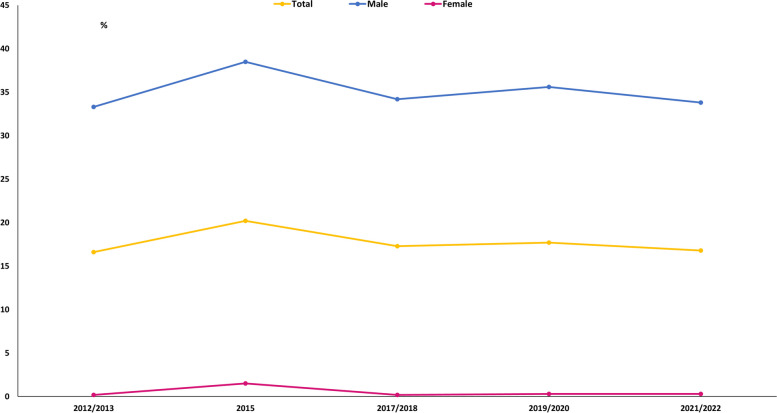
Background: Tobacco use deepens poverty. Egypt, a lower-middle income country, is one of the few countries worldwide where tobacco use is rising. However, no published study examined the adverse impacts of tobacco on the Egyptian household welfare, specifically after the first Egyptian Pound (EGP) devaluation by 80% in 2016. To address this gap and inform tobacco taxation policymaking, we aimed to provide evidence characterizing national household tobacco expenditure in Egypt.
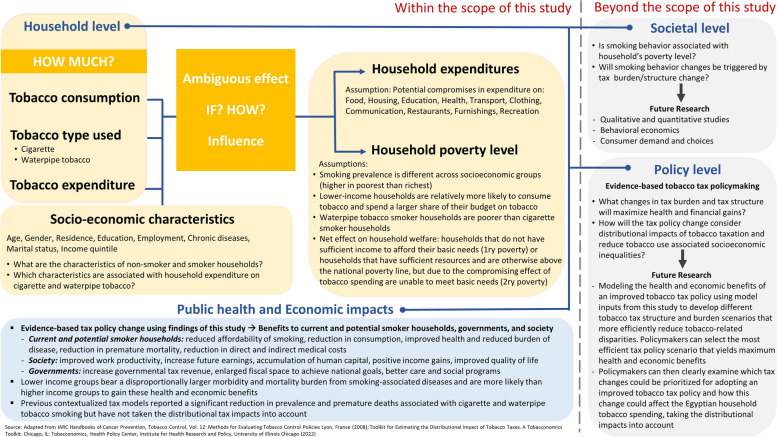
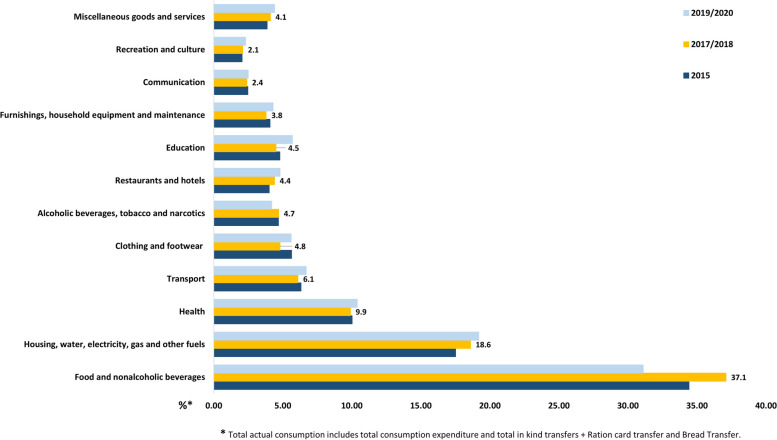
Methods: We conducted a secondary analysis of the 2017/2018 Household Income, Expenditure and Consumption Survey, focusing on the most used tobacco products in Egypt: cigarette and waterpipe tobacco. We identified the proportion and background characteristics of cigarette and waterpipe tobacco smoker households. We calculated household tobacco expenditure share as a proportion of total household expenditure. We compared mean household expenditure shares of 12 expenditure groups among smoker and nonsmoker households and examined the differences by income quintiles. We determined the factors associated with household tobacco expenditure. Descriptive, bivariable, and multivariable analyses were performed.
Results: Cigarette and waterpipe tobacco smokers were present in 41.1% and 7.0% of 12,845 households, respectively. Annual household expenditure on cigarettes (10.7%) was triple that of waterpipe tobacco (3.4%) (p < 0.001). Smoker households spent less than nonsmoker households on virtually all expenditure groups (p < 0.001). The poorest income quintile spent 11.1% of its total expenditure on tobacco (1.26 times higher than the richest, p = 0.006). More waterpipe tobacco than cigarette smoker households lived below the poverty line (40.6% versus 24.4%, p < 0.001). Cigarette smoker households spent less on food and housing but more on tobacco than waterpipe tobacco smoker households. The poorest cigarette and waterpipe tobacco smoker households spent 7.0-9.7 times as much on tobacco as on education. Common independent factors associated with higher household expenditure on cigarettes and waterpipe tobacco were urban residence (p = 0.011 and p = 0.015, respectively), and lower income (p < 0.001).
Conclusion: In 2017/2018, one-tenth of Egyptian smoker household's expenditure was allocated to tobacco, disproportionately concentrated among the poorest. Our results preliminarily indicate that tobacco expenditure is associated with potential compromises of varying extent in almost all other expenditures in smoker households. This baseline profiling of household tobacco expenditure can potentially inform an evidence-based tobacco taxation policy, supporting the reduction of tobacco-associated socioeconomic inequalities.
期刊介绍:
BMC Public Health is an open access, peer-reviewed journal that considers articles on the epidemiology of disease and the understanding of all aspects of public health. The journal has a special focus on the social determinants of health, the environmental, behavioral, and occupational correlates of health and disease, and the impact of health policies, practices and interventions on the community.



 京公网安备 11010802042870号
京ICP备2023020795号-1
京公网安备 11010802042870号
京ICP备2023020795号-1

 分享
分享
 求助内容:
求助内容: 应助结果提醒方式:
 扫码关注我们
