Michela Alfe, Valentina Gargiulo, Giovanna Ruoppolo, Francesco Cammarota, Pietro Calandra, Cesare Oliviero Rossi, Valeria Loise, Michele Porto, Roberto Di Capua, Paolino Caputo
{"title":"Microstructural modifications in bitumens rejuvenated by oil from pyrolysis of waste tires.","authors":"Michela Alfe, Valentina Gargiulo, Giovanna Ruoppolo, Francesco Cammarota, Pietro Calandra, Cesare Oliviero Rossi, Valeria Loise, Michele Porto, Roberto Di Capua, Paolino Caputo","doi":"10.3389/fchem.2024.1512905","DOIUrl":null,"url":null,"abstract":"<p><strong>Introduction: </strong>Bitumen is the viscoelastic fluid binding the crushed stones and mineral aggregates in the asphalt material used to pave roads around the world. During the paving procedure, the volatile compounds are lost and oxidization occurs with variation of the mechanical characteristics (aging); thus, the material becomes rigid and brittle over time and may need replacement. Instead of being landfilled, aged asphalts can be reused in new pavements after pretreatment with specific additives to restore their original properties.</p><p><strong>Methods: </strong>By considering conscious utilization of natural resources, we propose using the condensable fraction (oil) obtained from the pyrolysis of waste tires (WTs) as the agent to rejuvenate aged bitumen. The pyrolysis oil from WTs was produced and characterized using elemental analysis, gas chromatography coupled with mass spectrometry (GCMS), and thermogravimetry. Bitumen was aged by the rolling thin-film oven test procedure and blended with the WT pyrolysis oil at three different concentrations (1%, 3%, and 6% w/w) to evaluate the rheological behaviors. The blends were also investigated using atomic force microscopy, and the asphaltenic fraction was assessed via optical microscopy.</p><p><strong>Results and discussion: </strong>All the data consistently indicate that oil addition not only reduces the viscosity of bitumen and restores it to values close to the original unaged bitumen but also changes the intermolecular structure to recover the self-assembly pattern typical of the unaged sample. The physicochemical mechanisms of this phenomenon are proposed in light of the oil characteristics. Hence, it is concluded that the pyrolysis oil from WTs can be used to rejuvenate asphalts, which can then be used in reclaimed asphalt pavement technology. The impacts of our findings are expected to be extensive because bitumens are globally used for paving roads. In addition, since the proposed method couples/fuses urban waste treatment with asphalt maintenance processes, two types of wastes (oil from pyrolysis of WTs and aged bitumens) can be simultaneously recovered and reused to produce new and performing asphalts.</p>","PeriodicalId":12421,"journal":{"name":"Frontiers in Chemistry","volume":"12 ","pages":"1512905"},"PeriodicalIF":4.2000,"publicationDate":"2025-01-30","publicationTypes":"Journal Article","fieldsOfStudy":null,"isOpenAccess":false,"openAccessPdf":"https://www.ncbi.nlm.nih.gov/pmc/articles/PMC11821977/pdf/","citationCount":"0","resultStr":null,"platform":"Semanticscholar","paperid":null,"PeriodicalName":"Frontiers in Chemistry","FirstCategoryId":"92","ListUrlMain":"https://doi.org/10.3389/fchem.2024.1512905","RegionNum":3,"RegionCategory":"化学","ArticlePicture":[],"TitleCN":null,"AbstractTextCN":null,"PMCID":null,"EPubDate":"2024/1/1 0:00:00","PubModel":"eCollection","JCR":"Q2","JCRName":"CHEMISTRY, MULTIDISCIPLINARY","Score":null,"Total":0}
引用次数: 0
Abstract
Introduction: Bitumen is the viscoelastic fluid binding the crushed stones and mineral aggregates in the asphalt material used to pave roads around the world. During the paving procedure, the volatile compounds are lost and oxidization occurs with variation of the mechanical characteristics (aging); thus, the material becomes rigid and brittle over time and may need replacement. Instead of being landfilled, aged asphalts can be reused in new pavements after pretreatment with specific additives to restore their original properties.
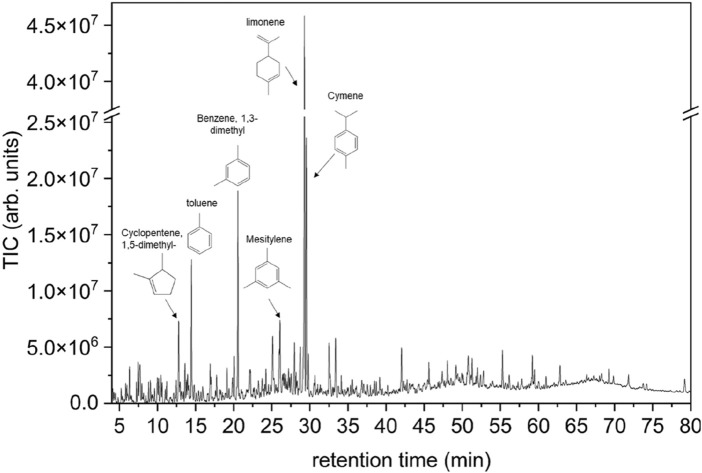
Methods: By considering conscious utilization of natural resources, we propose using the condensable fraction (oil) obtained from the pyrolysis of waste tires (WTs) as the agent to rejuvenate aged bitumen. The pyrolysis oil from WTs was produced and characterized using elemental analysis, gas chromatography coupled with mass spectrometry (GCMS), and thermogravimetry. Bitumen was aged by the rolling thin-film oven test procedure and blended with the WT pyrolysis oil at three different concentrations (1%, 3%, and 6% w/w) to evaluate the rheological behaviors. The blends were also investigated using atomic force microscopy, and the asphaltenic fraction was assessed via optical microscopy.
Results and discussion: All the data consistently indicate that oil addition not only reduces the viscosity of bitumen and restores it to values close to the original unaged bitumen but also changes the intermolecular structure to recover the self-assembly pattern typical of the unaged sample. The physicochemical mechanisms of this phenomenon are proposed in light of the oil characteristics. Hence, it is concluded that the pyrolysis oil from WTs can be used to rejuvenate asphalts, which can then be used in reclaimed asphalt pavement technology. The impacts of our findings are expected to be extensive because bitumens are globally used for paving roads. In addition, since the proposed method couples/fuses urban waste treatment with asphalt maintenance processes, two types of wastes (oil from pyrolysis of WTs and aged bitumens) can be simultaneously recovered and reused to produce new and performing asphalts.
期刊介绍:
Frontiers in Chemistry is a high visiblity and quality journal, publishing rigorously peer-reviewed research across the chemical sciences. Field Chief Editor Steve Suib at the University of Connecticut is supported by an outstanding Editorial Board of international researchers. This multidisciplinary open-access journal is at the forefront of disseminating and communicating scientific knowledge and impactful discoveries to academics, industry leaders and the public worldwide.
Chemistry is a branch of science that is linked to all other main fields of research. The omnipresence of Chemistry is apparent in our everyday lives from the electronic devices that we all use to communicate, to foods we eat, to our health and well-being, to the different forms of energy that we use. While there are many subtopics and specialties of Chemistry, the fundamental link in all these areas is how atoms, ions, and molecules come together and come apart in what some have come to call the “dance of life”.
All specialty sections of Frontiers in Chemistry are open-access with the goal of publishing outstanding research publications, review articles, commentaries, and ideas about various aspects of Chemistry. The past forms of publication often have specific subdisciplines, most commonly of analytical, inorganic, organic and physical chemistries, but these days those lines and boxes are quite blurry and the silos of those disciplines appear to be eroding. Chemistry is important to both fundamental and applied areas of research and manufacturing, and indeed the outlines of academic versus industrial research are also often artificial. Collaborative research across all specialty areas of Chemistry is highly encouraged and supported as we move forward. These are exciting times and the field of Chemistry is an important and significant contributor to our collective knowledge.




 京公网安备 11010802042870号
京ICP备2023020795号-1
京公网安备 11010802042870号
京ICP备2023020795号-1

 分享
分享
 求助内容:
求助内容: 应助结果提醒方式:
 扫码关注我们
