{"title":"Pathophysiological mechanisms of ARDS: a narrative review from molecular to organ-level perspectives.","authors":"Kaihuan Zhou, Qianqian Qin, Junyu Lu","doi":"10.1186/s12931-025-03137-5","DOIUrl":null,"url":null,"abstract":"<p><strong>Background: </strong>Acute respiratory distress syndrome (ARDS) remains a life-threatening pulmonary condition with persistently high mortality rates despite significant advancements in supportive care. Its complex pathophysiology involves an intricate interplay of molecular and cellular processes, including cytokine storms, oxidative stress, programmed cell death, and disruption of the alveolar-capillary barrier. These mechanisms drive localized lung injury and contribute to systemic inflammatory response syndrome and multiple organ dysfunction syndrome. Unlike prior reviews that primarily focus on isolated mechanisms, this narrative review synthesizes the key pathophysiological processes of ARDS across molecular, cellular, tissue, and organ levels.</p><p><strong>Main body: </strong>By integrating classical theories with recent research advancements, we provide a comprehensive analysis of how inflammatory mediators, metabolic reprogramming, oxidative stress, and immune dysregulation synergistically drive ARDS onset and progression. Furthermore, we critically evaluate current evidence-based therapeutic strategies, such as lung-protective ventilation and prone positioning, while exploring innovative therapies, including stem cell therapy, gene therapy, and immunotherapy. We emphasize the significance of ARDS subtypes and their inherent heterogeneity in guiding the development of personalized treatment strategies.</p><p><strong>Conclusions: </strong>This narrative review provides fresh perspectives for future research, ultimately enhancing patient outcomes and optimizing management approaches in ARDS.</p>","PeriodicalId":49131,"journal":{"name":"Respiratory Research","volume":"26 1","pages":"54"},"PeriodicalIF":5.8000,"publicationDate":"2025-02-13","publicationTypes":"Journal Article","fieldsOfStudy":null,"isOpenAccess":false,"openAccessPdf":"https://www.ncbi.nlm.nih.gov/pmc/articles/PMC11827456/pdf/","citationCount":"0","resultStr":null,"platform":"Semanticscholar","paperid":null,"PeriodicalName":"Respiratory Research","FirstCategoryId":"3","ListUrlMain":"https://doi.org/10.1186/s12931-025-03137-5","RegionNum":2,"RegionCategory":"医学","ArticlePicture":[],"TitleCN":null,"AbstractTextCN":null,"PMCID":null,"EPubDate":"","PubModel":"","JCR":"Q1","JCRName":"Medicine","Score":null,"Total":0}
引用次数: 0
Abstract
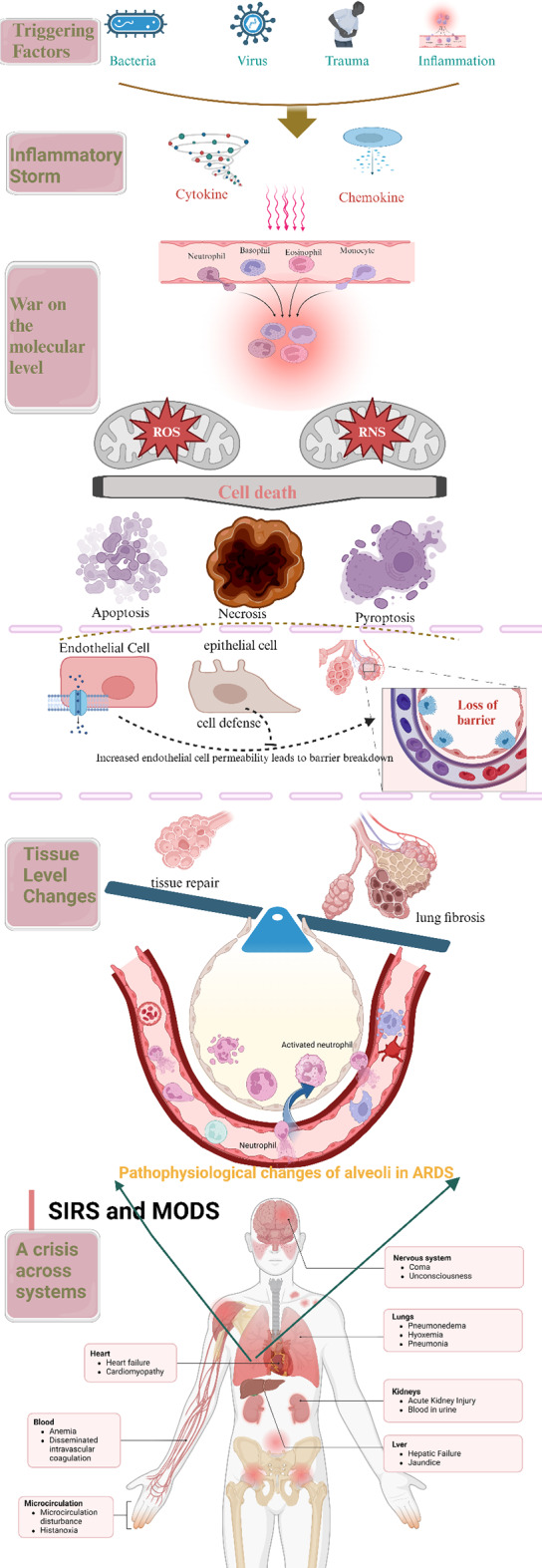
Background: Acute respiratory distress syndrome (ARDS) remains a life-threatening pulmonary condition with persistently high mortality rates despite significant advancements in supportive care. Its complex pathophysiology involves an intricate interplay of molecular and cellular processes, including cytokine storms, oxidative stress, programmed cell death, and disruption of the alveolar-capillary barrier. These mechanisms drive localized lung injury and contribute to systemic inflammatory response syndrome and multiple organ dysfunction syndrome. Unlike prior reviews that primarily focus on isolated mechanisms, this narrative review synthesizes the key pathophysiological processes of ARDS across molecular, cellular, tissue, and organ levels.
Main body: By integrating classical theories with recent research advancements, we provide a comprehensive analysis of how inflammatory mediators, metabolic reprogramming, oxidative stress, and immune dysregulation synergistically drive ARDS onset and progression. Furthermore, we critically evaluate current evidence-based therapeutic strategies, such as lung-protective ventilation and prone positioning, while exploring innovative therapies, including stem cell therapy, gene therapy, and immunotherapy. We emphasize the significance of ARDS subtypes and their inherent heterogeneity in guiding the development of personalized treatment strategies.
Conclusions: This narrative review provides fresh perspectives for future research, ultimately enhancing patient outcomes and optimizing management approaches in ARDS.
期刊介绍:
Respiratory Research publishes high-quality clinical and basic research, review and commentary articles on all aspects of respiratory medicine and related diseases.
As the leading fully open access journal in the field, Respiratory Research provides an essential resource for pulmonologists, allergists, immunologists and other physicians, researchers, healthcare workers and medical students with worldwide dissemination of articles resulting in high visibility and generating international discussion.
Topics of specific interest include asthma, chronic obstructive pulmonary disease, cystic fibrosis, genetics, infectious diseases, interstitial lung diseases, lung development, lung tumors, occupational and environmental factors, pulmonary circulation, pulmonary pharmacology and therapeutics, respiratory immunology, respiratory physiology, and sleep-related respiratory problems.




 京公网安备 11010802042870号
京ICP备2023020795号-1
京公网安备 11010802042870号
京ICP备2023020795号-1

 分享
分享
 求助内容:
求助内容: 应助结果提醒方式:
 扫码关注我们
