Tom Nadarzynski, Nicky Knights, Deborah Husbands, Cynthia Graham, Carrie D Llewellyn, Tom Buchanan, Ian Montgomery, Alejandra Soruco Rodriguez, Chimeremumma Ogueri, Nidhi Singh, Evan Rouse, Olabisi Oyebode, Ankit Das, Grace Paydon, Gurpreet Lall, Anathoth Bulukungu, Nur Yanyali, Alexandra Stefan, Damien Ridge
{"title":"Chatbot -assisted self-assessment (CASA): Co-designing an AI -powered behaviour change intervention for ethnic minorities.","authors":"Tom Nadarzynski, Nicky Knights, Deborah Husbands, Cynthia Graham, Carrie D Llewellyn, Tom Buchanan, Ian Montgomery, Alejandra Soruco Rodriguez, Chimeremumma Ogueri, Nidhi Singh, Evan Rouse, Olabisi Oyebode, Ankit Das, Grace Paydon, Gurpreet Lall, Anathoth Bulukungu, Nur Yanyali, Alexandra Stefan, Damien Ridge","doi":"10.1371/journal.pdig.0000724","DOIUrl":null,"url":null,"abstract":"<p><strong>Background: </strong>The digitalisation of healthcare has provided new ways to address disparities in sexual health outcomes that particularly affect ethnic and sexual minorities. Conversational artificial intelligence (AI) chatbots can provide personalised health education and refer users for appropriate medical consultations. We aimed to explore design principles of a chatbot-assisted culturally sensitive self-assessment intervention based on the disclosure of health-related information.</p><p><strong>Methods: </strong>In 2022, an online survey was conducted among an ethnically diverse UK sample (N = 1,287) to identify the level and type of health-related information disclosure to sexual health chatbots, and reactions to chatbots' risk appraisal. Follow-up interviews (N = 41) further explored perceptions of chatbot-led health assessment to identify aspects related to acceptability and utilisation. Datasets were analysed using one-way ANOVAs, linear regression, and thematic analysis.</p><p><strong>Results: </strong>Participants had neutral-to-positive attitudes towards chatbots and were comfortable disclosing demographic and sensitive health information. Chatbot awareness, previous experience and positive attitudes towards chatbots predicted information disclosure. Qualitatively, four main themes were identified: \"Chatbot as an artificial health advisor\", \"Disclosing information to a chatbot\", \"Ways to facilitate trust and disclosure\", and \"Acting on self-assessment\".</p><p><strong>Conclusion: </strong>Chatbots were acceptable for health self-assessment among this sample of ethnically diverse individuals. Most users reported being comfortable disclosing sensitive and personal information, but user anonymity is key to engagement with chatbots. As this technology becomes more advanced and widely available, chatbots could potentially become supplementary tools for health education and screening eligibility assessment. Future research is needed to establish their impact on screening uptake and access to health services among minoritised communities.</p>","PeriodicalId":74465,"journal":{"name":"PLOS digital health","volume":"4 2","pages":"e0000724"},"PeriodicalIF":7.7000,"publicationDate":"2025-02-13","publicationTypes":"Journal Article","fieldsOfStudy":null,"isOpenAccess":false,"openAccessPdf":"https://www.ncbi.nlm.nih.gov/pmc/articles/PMC11824973/pdf/","citationCount":"0","resultStr":null,"platform":"Semanticscholar","paperid":null,"PeriodicalName":"PLOS digital health","FirstCategoryId":"1085","ListUrlMain":"https://doi.org/10.1371/journal.pdig.0000724","RegionNum":0,"RegionCategory":null,"ArticlePicture":[],"TitleCN":null,"AbstractTextCN":null,"PMCID":null,"EPubDate":"2025/2/1 0:00:00","PubModel":"eCollection","JCR":"","JCRName":"","Score":null,"Total":0}
引用次数: 0
Abstract
Background: The digitalisation of healthcare has provided new ways to address disparities in sexual health outcomes that particularly affect ethnic and sexual minorities. Conversational artificial intelligence (AI) chatbots can provide personalised health education and refer users for appropriate medical consultations. We aimed to explore design principles of a chatbot-assisted culturally sensitive self-assessment intervention based on the disclosure of health-related information.
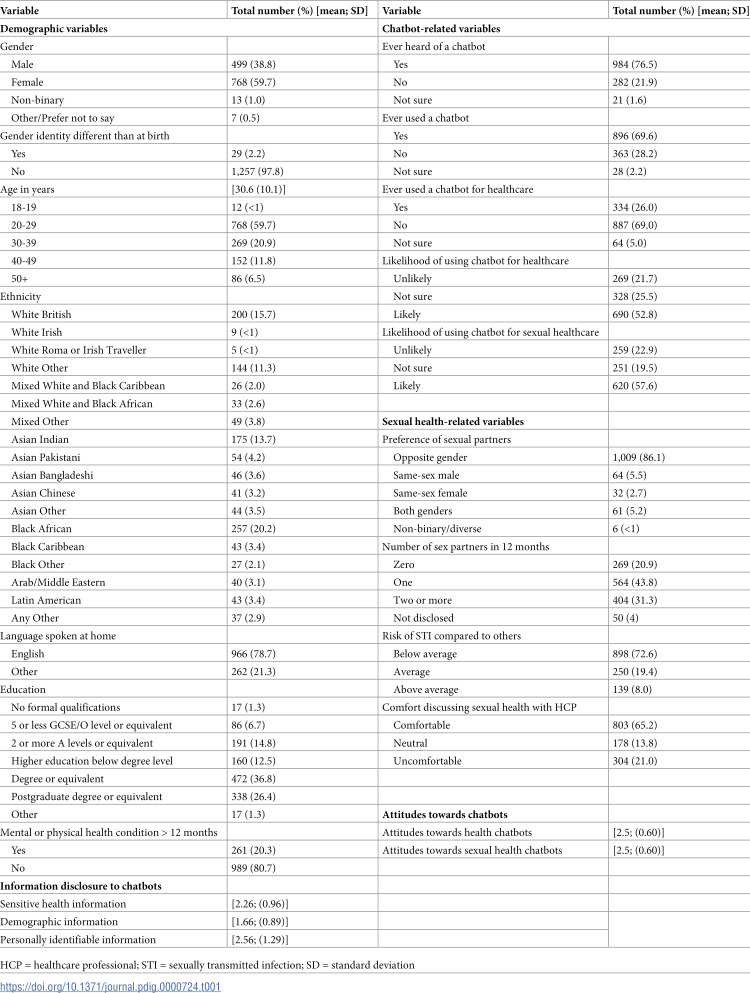
Methods: In 2022, an online survey was conducted among an ethnically diverse UK sample (N = 1,287) to identify the level and type of health-related information disclosure to sexual health chatbots, and reactions to chatbots' risk appraisal. Follow-up interviews (N = 41) further explored perceptions of chatbot-led health assessment to identify aspects related to acceptability and utilisation. Datasets were analysed using one-way ANOVAs, linear regression, and thematic analysis.
Results: Participants had neutral-to-positive attitudes towards chatbots and were comfortable disclosing demographic and sensitive health information. Chatbot awareness, previous experience and positive attitudes towards chatbots predicted information disclosure. Qualitatively, four main themes were identified: "Chatbot as an artificial health advisor", "Disclosing information to a chatbot", "Ways to facilitate trust and disclosure", and "Acting on self-assessment".
Conclusion: Chatbots were acceptable for health self-assessment among this sample of ethnically diverse individuals. Most users reported being comfortable disclosing sensitive and personal information, but user anonymity is key to engagement with chatbots. As this technology becomes more advanced and widely available, chatbots could potentially become supplementary tools for health education and screening eligibility assessment. Future research is needed to establish their impact on screening uptake and access to health services among minoritised communities.





 京公网安备 11010802042870号
京ICP备2023020795号-1
京公网安备 11010802042870号
京ICP备2023020795号-1

 分享
分享

 求助内容:
求助内容: 应助结果提醒方式:
 扫码关注我们
