Seoa Kim, Won-Gwang Lim, Hyeonjung Jung, Yo Chan Jeong, Cheol-Young Park, Seung Bo Yang, Chang Hoon Lee, Donghai Wang, Kwonnam Sohn, Jeong Woo Han, Jinwoo Lee
{"title":"Protective catalytic layer powering activity and stability of electrocatalyst for high-energy lithium-sulfur pouch cell","authors":"Seoa Kim, Won-Gwang Lim, Hyeonjung Jung, Yo Chan Jeong, Cheol-Young Park, Seung Bo Yang, Chang Hoon Lee, Donghai Wang, Kwonnam Sohn, Jeong Woo Han, Jinwoo Lee","doi":"10.1038/s41467-025-56606-2","DOIUrl":null,"url":null,"abstract":"<p>Designing an electrocatalyst that simultaneously satisfies high catalytic activity and surface stability is essential for realizing high-performance lithium-sulfur (Li||S) batteries. Here, we propose an advanced electrocatalyst by constructing a thin protective catalytic layer (PCL) on the surface of metal nanoparticle catalysts. This few atomic layer thicknesses of the PCL composed of pyridinic N embedded graphitic carbon allows electrons to transfer from a metal nanoparticle to pyridinic N, resulting in an optimized <i>p</i>-orbital level of pyridinic N of PCL favorable for highly active conversion reaction of lithium sulfide. Further, PCL suppresses the direct contact of sulfur species with metal electrocatalysts. This surface protection effect inhibits the phase change of metal electrocatalysts to metal sulfide impurities, which maintains a highly active Li||S electrocatalysis for long-term cycling. Consequently, A h-level Li||S pouch cell with >500 W h kg<sup>−1</sup> (specific energy based on current collector, anode, separator, electrolyte, and cathode), Coulombic efficiency (>95%), and stable life of 20 cycles was successfully realized.</p>","PeriodicalId":19066,"journal":{"name":"Nature Communications","volume":"1 1","pages":""},"PeriodicalIF":15.7000,"publicationDate":"2025-02-14","publicationTypes":"Journal Article","fieldsOfStudy":null,"isOpenAccess":false,"openAccessPdf":"","citationCount":"0","resultStr":null,"platform":"Semanticscholar","paperid":null,"PeriodicalName":"Nature Communications","FirstCategoryId":"103","ListUrlMain":"https://doi.org/10.1038/s41467-025-56606-2","RegionNum":1,"RegionCategory":"综合性期刊","ArticlePicture":[],"TitleCN":null,"AbstractTextCN":null,"PMCID":null,"EPubDate":"","PubModel":"","JCR":"Q1","JCRName":"MULTIDISCIPLINARY SCIENCES","Score":null,"Total":0}
引用次数: 0
Abstract
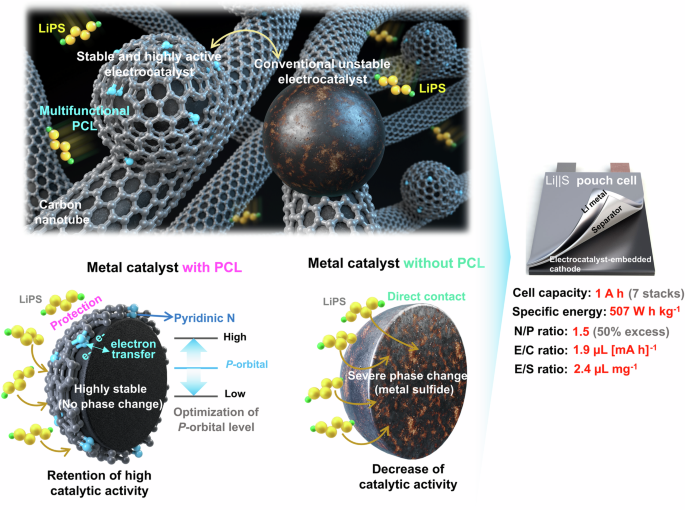
Designing an electrocatalyst that simultaneously satisfies high catalytic activity and surface stability is essential for realizing high-performance lithium-sulfur (Li||S) batteries. Here, we propose an advanced electrocatalyst by constructing a thin protective catalytic layer (PCL) on the surface of metal nanoparticle catalysts. This few atomic layer thicknesses of the PCL composed of pyridinic N embedded graphitic carbon allows electrons to transfer from a metal nanoparticle to pyridinic N, resulting in an optimized p-orbital level of pyridinic N of PCL favorable for highly active conversion reaction of lithium sulfide. Further, PCL suppresses the direct contact of sulfur species with metal electrocatalysts. This surface protection effect inhibits the phase change of metal electrocatalysts to metal sulfide impurities, which maintains a highly active Li||S electrocatalysis for long-term cycling. Consequently, A h-level Li||S pouch cell with >500 W h kg−1 (specific energy based on current collector, anode, separator, electrolyte, and cathode), Coulombic efficiency (>95%), and stable life of 20 cycles was successfully realized.
设计一种同时满足高催化活性和表面稳定性的电催化剂是实现高性能锂硫(Li||S)电池的关键。本文提出了一种新型的电催化剂,即在金属纳米颗粒催化剂表面构建一层薄薄的保护催化层(PCL)。这种由吡啶N嵌入石墨碳组成的PCL原子层厚度较小,使得电子可以从金属纳米颗粒转移到吡啶N上,从而使PCL的吡啶N的p轨道水平优化,有利于硫化锂的高活性转化反应。此外,PCL抑制了硫与金属电催化剂的直接接触。这种表面保护作用抑制了金属电催化剂向金属硫化物杂质的相变,保持了Li||S电催化长期循环的高活性。因此,成功地实现了具有500 W h kg−1(基于集流器、阳极、分离器、电解质和阴极的比能)、95%的库仑效率和20次循环稳定寿命的h级Li||S袋电池。
期刊介绍:
Nature Communications, an open-access journal, publishes high-quality research spanning all areas of the natural sciences. Papers featured in the journal showcase significant advances relevant to specialists in each respective field. With a 2-year impact factor of 16.6 (2022) and a median time of 8 days from submission to the first editorial decision, Nature Communications is committed to rapid dissemination of research findings. As a multidisciplinary journal, it welcomes contributions from biological, health, physical, chemical, Earth, social, mathematical, applied, and engineering sciences, aiming to highlight important breakthroughs within each domain.



 京公网安备 11010802042870号
京ICP备2023020795号-1
京公网安备 11010802042870号
京ICP备2023020795号-1

 分享
分享
 求助内容:
求助内容: 应助结果提醒方式:
 扫码关注我们
