Mahsa Amiri , Majid Ahmadi , Nabil Khossossi , Prasad Gonugunta , Khatereh Roohi , Bart Kooi , Mahinder Ramdin , Prasaanth Ravi Anusuyadevi , Tanel Tätte , Nadezda Kongi , Alexander Vanetsev , Poulumi Dey , Peyman Taheri
{"title":"Ultra-thin defective TiO2 films as photocathodes for selective CO2 reduction to formate","authors":"Mahsa Amiri , Majid Ahmadi , Nabil Khossossi , Prasad Gonugunta , Khatereh Roohi , Bart Kooi , Mahinder Ramdin , Prasaanth Ravi Anusuyadevi , Tanel Tätte , Nadezda Kongi , Alexander Vanetsev , Poulumi Dey , Peyman Taheri","doi":"10.1016/j.jcat.2025.116022","DOIUrl":null,"url":null,"abstract":"<div><div>Titanium dioxide (TiO<sub>2</sub>) has been widely used as a photocatalyst in CO<sub>2</sub> reduction reaction (CO<sub>2</sub>RR) due to its low cost, high stability, and strong absorption in the close-to-visible ultra-violet (UV) range. However, TiO<sub>2</sub> films suffer from poor selectivity in CO<sub>2</sub> reduction due to their unfavorable electronic properties. In this work, we address this challenge by fabricating ultra-thin (14 nm) defective TiO<sub>2</sub> films (TiO<sub>2</sub>-DTF) to enhance the selectivity of CO<sub>2</sub>RR towards formate.</div><div>TiO<sub>2</sub> sol was prepared using a facile and reproducible sol-gel method and directly deposited onto the surface of the electrode, forming a uniform, ultra-thin TiO<sub>2</sub> layers with a high number of defects. The activity of the TiO<sub>2</sub>-DTF catalyst was studied in both photochemical and photoelectrochemical CO<sub>2</sub>RR, indicating that the applied potential increases both the yield and selectivity of CO<sub>2</sub>RR to formate. The TiO<sub>2</sub>-DTF photocathode exhibited remarkable formate production during CO<sub>2</sub> reduction, achieving exceptional Faradaic efficiencies of up to 45 %. To elucidate the mechanism of photoelectrochemical CO<sub>2</sub>RR on TiO<sub>2</sub>-DTF, an <em>in-situ</em> attenuated total reflection Fourier-transform infrared spectroscopy (<em>in-situ</em> ATR-FTIR) was used and experimental results were supported by density functional theory (DFT) calculations. This study demonstrates that ultra-thin highly defective TiO<sub>2</sub> film, prepared using the cost-effective and environmentally friendly sol-gel method, can be used as photoelectrocatalyst for CO<sub>2</sub> reduction.</div></div>","PeriodicalId":346,"journal":{"name":"Journal of Catalysis","volume":"445 ","pages":"Article 116022"},"PeriodicalIF":6.5000,"publicationDate":"2025-05-01","publicationTypes":"Journal Article","fieldsOfStudy":null,"isOpenAccess":false,"openAccessPdf":"","citationCount":"0","resultStr":null,"platform":"Semanticscholar","paperid":null,"PeriodicalName":"Journal of Catalysis","FirstCategoryId":"92","ListUrlMain":"https://www.sciencedirect.com/science/article/pii/S0021951725000879","RegionNum":1,"RegionCategory":"化学","ArticlePicture":[],"TitleCN":null,"AbstractTextCN":null,"PMCID":null,"EPubDate":"2025/2/15 0:00:00","PubModel":"Epub","JCR":"Q2","JCRName":"CHEMISTRY, PHYSICAL","Score":null,"Total":0}
引用次数: 0
Abstract
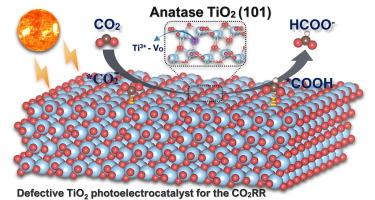
Titanium dioxide (TiO2) has been widely used as a photocatalyst in CO2 reduction reaction (CO2RR) due to its low cost, high stability, and strong absorption in the close-to-visible ultra-violet (UV) range. However, TiO2 films suffer from poor selectivity in CO2 reduction due to their unfavorable electronic properties. In this work, we address this challenge by fabricating ultra-thin (14 nm) defective TiO2 films (TiO2-DTF) to enhance the selectivity of CO2RR towards formate.
TiO2 sol was prepared using a facile and reproducible sol-gel method and directly deposited onto the surface of the electrode, forming a uniform, ultra-thin TiO2 layers with a high number of defects. The activity of the TiO2-DTF catalyst was studied in both photochemical and photoelectrochemical CO2RR, indicating that the applied potential increases both the yield and selectivity of CO2RR to formate. The TiO2-DTF photocathode exhibited remarkable formate production during CO2 reduction, achieving exceptional Faradaic efficiencies of up to 45 %. To elucidate the mechanism of photoelectrochemical CO2RR on TiO2-DTF, an in-situ attenuated total reflection Fourier-transform infrared spectroscopy (in-situ ATR-FTIR) was used and experimental results were supported by density functional theory (DFT) calculations. This study demonstrates that ultra-thin highly defective TiO2 film, prepared using the cost-effective and environmentally friendly sol-gel method, can be used as photoelectrocatalyst for CO2 reduction.
期刊介绍:
The Journal of Catalysis publishes scholarly articles on both heterogeneous and homogeneous catalysis, covering a wide range of chemical transformations. These include various types of catalysis, such as those mediated by photons, plasmons, and electrons. The focus of the studies is to understand the relationship between catalytic function and the underlying chemical properties of surfaces and metal complexes.
The articles in the journal offer innovative concepts and explore the synthesis and kinetics of inorganic solids and homogeneous complexes. Furthermore, they discuss spectroscopic techniques for characterizing catalysts, investigate the interaction of probes and reacting species with catalysts, and employ theoretical methods.
The research presented in the journal should have direct relevance to the field of catalytic processes, addressing either fundamental aspects or applications of catalysis.




 京公网安备 11010802042870号
京ICP备2023020795号-1
京公网安备 11010802042870号
京ICP备2023020795号-1

 分享
分享
 求助内容:
求助内容: 应助结果提醒方式:
 扫码关注我们
