{"title":"General surgeon workforce density is not associated with treatment-incidence ratios at the county or hospital service area level in North Carolina","authors":"Mustafa Abid , Mark Holmes , Anthony Charles","doi":"10.1016/j.amjsurg.2025.116231","DOIUrl":null,"url":null,"abstract":"<div><h3>Background</h3><div>General Surgeon Workforce Density (WFD) is used to approximate surgical access. Treatment-incidence ratios (TIR) provide a novel measure of care access. TIR's association with General Surgeon WFD has not been evaluated.</div></div><div><h3>Study design</h3><div>Retrospective cohort study of North Carolina inpatient discharges (2016–2019). The association between county and Hospital Service Area (HSA) TIRs for general surgical diseases was analyzed using adjusted linear and logistic regression.</div></div><div><h3>Results</h3><div>When adjusting for pertinent covariates, county General Surgeon WFD and TIR (−0.0009, 95 % CI -0.028,0.026; p 0.95) and HSA General Surgeon WFD and TIR (0.008, 95 % CI -0.021,0.037; p 0.58) were not statistically significantly associated. The odds of a county 0.91 (95 % CI 0.42,1.97; p 0.82) or HSA (OR 0.93, 95 % CI 0.43,2.04; p 0.86) having a high TIR was not associated with WFD.</div></div><div><h3>Conclusion</h3><div>General Surgeon WFD is not associated with disease-specific procedural rates of common surgical conditions at the county or HSA level.</div></div>","PeriodicalId":7771,"journal":{"name":"American journal of surgery","volume":"242 ","pages":"Article 116231"},"PeriodicalIF":2.7000,"publicationDate":"2025-04-01","publicationTypes":"Journal Article","fieldsOfStudy":null,"isOpenAccess":false,"openAccessPdf":"","citationCount":"0","resultStr":null,"platform":"Semanticscholar","paperid":null,"PeriodicalName":"American journal of surgery","FirstCategoryId":"3","ListUrlMain":"https://www.sciencedirect.com/science/article/pii/S0002961025000534","RegionNum":3,"RegionCategory":"医学","ArticlePicture":[],"TitleCN":null,"AbstractTextCN":null,"PMCID":null,"EPubDate":"2025/2/3 0:00:00","PubModel":"Epub","JCR":"Q1","JCRName":"SURGERY","Score":null,"Total":0}
引用次数: 0
Abstract
Background
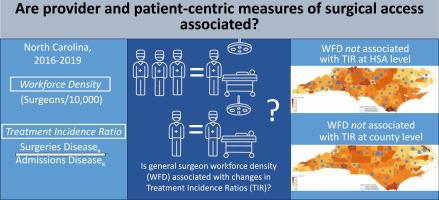
General Surgeon Workforce Density (WFD) is used to approximate surgical access. Treatment-incidence ratios (TIR) provide a novel measure of care access. TIR's association with General Surgeon WFD has not been evaluated.
Study design
Retrospective cohort study of North Carolina inpatient discharges (2016–2019). The association between county and Hospital Service Area (HSA) TIRs for general surgical diseases was analyzed using adjusted linear and logistic regression.
Results
When adjusting for pertinent covariates, county General Surgeon WFD and TIR (−0.0009, 95 % CI -0.028,0.026; p 0.95) and HSA General Surgeon WFD and TIR (0.008, 95 % CI -0.021,0.037; p 0.58) were not statistically significantly associated. The odds of a county 0.91 (95 % CI 0.42,1.97; p 0.82) or HSA (OR 0.93, 95 % CI 0.43,2.04; p 0.86) having a high TIR was not associated with WFD.
Conclusion
General Surgeon WFD is not associated with disease-specific procedural rates of common surgical conditions at the county or HSA level.
期刊介绍:
The American Journal of Surgery® is a peer-reviewed journal designed for the general surgeon who performs abdominal, cancer, vascular, head and neck, breast, colorectal, and other forms of surgery. AJS is the official journal of 7 major surgical societies* and publishes their official papers as well as independently submitted clinical studies, editorials, reviews, brief reports, correspondence and book reviews.



 京公网安备 11010802042870号
京ICP备2023020795号-1
京公网安备 11010802042870号
京ICP备2023020795号-1

 分享
分享
 求助内容:
求助内容: 应助结果提醒方式:
 扫码关注我们
