{"title":"Experimental Study on the Permeability of Mixed Granular Proppants in the Process of Compression","authors":"C. Liu, Z. Y. Man","doi":"10.1134/S0015462824603280","DOIUrl":null,"url":null,"abstract":"<p>Variations in the permeability during compression across various materials, the particle sizes, and the material combinations are investigated. The study focused on three typical materials: expanded polystyrene (EPS), polyurethane (PU), and expanded polypropylene (EPP), selected based on the particle size and the strength. The key findings are as follows: (1) The permeability of polyurethane decreases from 1121.2 Darcy (D) to 767.6 D, marking a reduction of approximately 31.5% post-compression. (2) Expanded polystyrene exhibited a significant decrease in the permeability from 547.6 to 195.2 D, a decline of 64.3%. (3) The highest permeability is observed in expanded polypropylene with a 30-fold expansion ratio demonstrating the most stable permeability. The permeability of expanded polypropylene with a 45-fold expansion ratio reduces from 695.8 to 226.4D, a decrease of roughly 67.4%. These results suggest that expanded polypropylene with a 30-fold expansion ratio and expanded polypropylene are the most effective supporting materials. Additionally, the study revealed that the particle size profoundly impacts the permeability of proppants. For both expanded polypropylene and polyurethane, the permeability and the conductivity initially increase and then decrease with enlargement of the particle sizes. Conversely, expanded polystyrene behaves differently, showing a relatively low permeability and conductivity at a 2 cm particle size. Furthermore, the permeability of material combinations with various particle sizes displays a distinct pattern as compared to single-particle-size materials. The permeability of expanded polystyrene and expanded polypropylene tend to decrease with addition of 1 cm particle size materials to other diameters. In contrast, the permeability of polyurethane increases being mixed with materials of various particle sizes. This research provides valuable insights for selecting appropriate materials in practical applications, emphasizing the nuanced considerations necessary for optimal material choice.</p>","PeriodicalId":560,"journal":{"name":"Fluid Dynamics","volume":"59 6","pages":"1944 - 1960"},"PeriodicalIF":0.6000,"publicationDate":"2025-02-16","publicationTypes":"Journal Article","fieldsOfStudy":null,"isOpenAccess":false,"openAccessPdf":"","citationCount":"0","resultStr":null,"platform":"Semanticscholar","paperid":null,"PeriodicalName":"Fluid Dynamics","FirstCategoryId":"5","ListUrlMain":"https://link.springer.com/article/10.1134/S0015462824603280","RegionNum":4,"RegionCategory":"工程技术","ArticlePicture":[],"TitleCN":null,"AbstractTextCN":null,"PMCID":null,"EPubDate":"","PubModel":"","JCR":"Q4","JCRName":"MECHANICS","Score":null,"Total":0}
引用次数: 0
Abstract
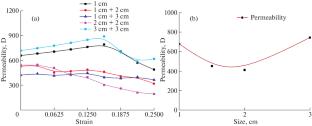
Variations in the permeability during compression across various materials, the particle sizes, and the material combinations are investigated. The study focused on three typical materials: expanded polystyrene (EPS), polyurethane (PU), and expanded polypropylene (EPP), selected based on the particle size and the strength. The key findings are as follows: (1) The permeability of polyurethane decreases from 1121.2 Darcy (D) to 767.6 D, marking a reduction of approximately 31.5% post-compression. (2) Expanded polystyrene exhibited a significant decrease in the permeability from 547.6 to 195.2 D, a decline of 64.3%. (3) The highest permeability is observed in expanded polypropylene with a 30-fold expansion ratio demonstrating the most stable permeability. The permeability of expanded polypropylene with a 45-fold expansion ratio reduces from 695.8 to 226.4D, a decrease of roughly 67.4%. These results suggest that expanded polypropylene with a 30-fold expansion ratio and expanded polypropylene are the most effective supporting materials. Additionally, the study revealed that the particle size profoundly impacts the permeability of proppants. For both expanded polypropylene and polyurethane, the permeability and the conductivity initially increase and then decrease with enlargement of the particle sizes. Conversely, expanded polystyrene behaves differently, showing a relatively low permeability and conductivity at a 2 cm particle size. Furthermore, the permeability of material combinations with various particle sizes displays a distinct pattern as compared to single-particle-size materials. The permeability of expanded polystyrene and expanded polypropylene tend to decrease with addition of 1 cm particle size materials to other diameters. In contrast, the permeability of polyurethane increases being mixed with materials of various particle sizes. This research provides valuable insights for selecting appropriate materials in practical applications, emphasizing the nuanced considerations necessary for optimal material choice.
期刊介绍:
Fluid Dynamics is an international peer reviewed journal that publishes theoretical, computational, and experimental research on aeromechanics, hydrodynamics, plasma dynamics, underground hydrodynamics, and biomechanics of continuous media. Special attention is given to new trends developing at the leading edge of science, such as theory and application of multi-phase flows, chemically reactive flows, liquid and gas flows in electromagnetic fields, new hydrodynamical methods of increasing oil output, new approaches to the description of turbulent flows, etc.



 京公网安备 11010802042870号
京ICP备2023020795号-1
京公网安备 11010802042870号
京ICP备2023020795号-1

 分享
分享
 求助内容:
求助内容: 应助结果提醒方式:
 扫码关注我们
