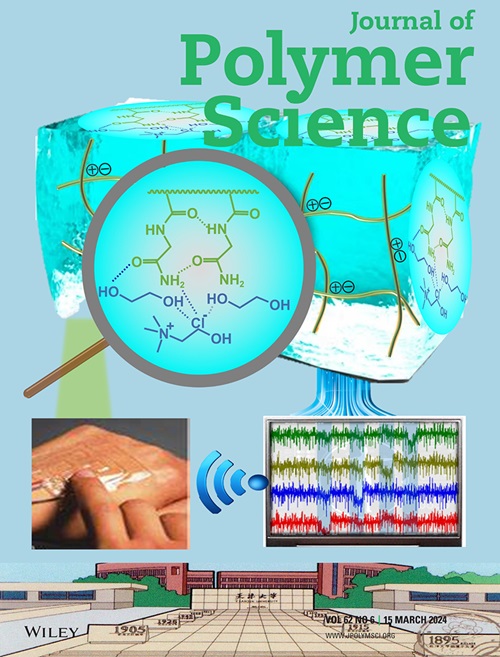
{"title":"DLP Printing Eutectic Gels Crosslinked by Dopamine-Grafted Nano-Cellulose for Flexible Wearable Devices","authors":"Xia Du, Xiaomin Zhang, Zhuang Zhao, Youjie Rong, Pengdi Cui, Xiaobo Huang","doi":"10.1002/pol.20240962","DOIUrl":null,"url":null,"abstract":"<div>\n \n <p>Eutectic gels have great advantages in the application of flexible wearable electronic devices due to their good stability and flexibility. However, the adhesion properties of current eutectic gels are poor and the processing process is complicated. Based on this, this study proposed a eutectic gel with excellent adhesion properties that can be photocurable for 3D printing. We designed a polymerizable deep eutectic solvent (PDES) using acrylic acid as the main monomer, acrylic acid/choline chloride (AA/ChCl) as the eutectic solvent, and dopamine-grafted cellulose nanocrystals (DC) as the nanoscale crosslinking agent. The introduction of DC endows the gel with a denser hydrogen bond network, which can effectively provide energy dissipation and improve the mechanical properties of the gel. The introduction of mussel-inspired dopamine into the gel network gives the gel good adhesion. The low freezing point and low volatility of PDES give the gel excellent freezing resistance and long-term storage stability. Furthermore, the gel has a sensitivity factor of up to 9.5 (at 0%–900% strain), showing excellent strain sensing performance. In addition, the gel can not only realize the customization of various complex structures through digital light processing (DLP) 3D printing technology, but also the manufactured wearable devices can complete the accurate sensing of various strain signals of the human body. Therefore, the combination of multi-performance compatible eutectic gel materials and photocurable 3D printing technology will provide a new idea for the design and manufacture of flexible wearable devices.</p>\n </div>","PeriodicalId":16888,"journal":{"name":"Journal of Polymer Science","volume":"63 4","pages":"998-1009"},"PeriodicalIF":3.6000,"publicationDate":"2024-12-24","publicationTypes":"Journal Article","fieldsOfStudy":null,"isOpenAccess":false,"openAccessPdf":"","citationCount":"0","resultStr":null,"platform":"Semanticscholar","paperid":null,"PeriodicalName":"Journal of Polymer Science","FirstCategoryId":"92","ListUrlMain":"https://onlinelibrary.wiley.com/doi/10.1002/pol.20240962","RegionNum":3,"RegionCategory":"化学","ArticlePicture":[],"TitleCN":null,"AbstractTextCN":null,"PMCID":null,"EPubDate":"","PubModel":"","JCR":"Q2","JCRName":"POLYMER SCIENCE","Score":null,"Total":0}
引用次数: 0
Abstract
Eutectic gels have great advantages in the application of flexible wearable electronic devices due to their good stability and flexibility. However, the adhesion properties of current eutectic gels are poor and the processing process is complicated. Based on this, this study proposed a eutectic gel with excellent adhesion properties that can be photocurable for 3D printing. We designed a polymerizable deep eutectic solvent (PDES) using acrylic acid as the main monomer, acrylic acid/choline chloride (AA/ChCl) as the eutectic solvent, and dopamine-grafted cellulose nanocrystals (DC) as the nanoscale crosslinking agent. The introduction of DC endows the gel with a denser hydrogen bond network, which can effectively provide energy dissipation and improve the mechanical properties of the gel. The introduction of mussel-inspired dopamine into the gel network gives the gel good adhesion. The low freezing point and low volatility of PDES give the gel excellent freezing resistance and long-term storage stability. Furthermore, the gel has a sensitivity factor of up to 9.5 (at 0%–900% strain), showing excellent strain sensing performance. In addition, the gel can not only realize the customization of various complex structures through digital light processing (DLP) 3D printing technology, but also the manufactured wearable devices can complete the accurate sensing of various strain signals of the human body. Therefore, the combination of multi-performance compatible eutectic gel materials and photocurable 3D printing technology will provide a new idea for the design and manufacture of flexible wearable devices.
期刊介绍:
Journal of Polymer Research provides a forum for the prompt publication of articles concerning the fundamental and applied research of polymers. Its great feature lies in the diversity of content which it encompasses, drawing together results from all aspects of polymer science and technology.
As polymer research is rapidly growing around the globe, the aim of this journal is to establish itself as a significant information tool not only for the international polymer researchers in academia but also for those working in industry. The scope of the journal covers a wide range of the highly interdisciplinary field of polymer science and technology.




 京公网安备 11010802042870号
京ICP备2023020795号-1
京公网安备 11010802042870号
京ICP备2023020795号-1

 分享
分享
 求助内容:
求助内容: 应助结果提醒方式:
 扫码关注我们
