{"title":"Sequential changes in conditional survival of patients undergoing curative gastrectomy for gastric cancer","authors":"Hiromitsu Imataki , Hideo Miyake , Hidemasa Nagai , Yuichiro Yoshioka , Junichi Takamizawa , Norihiro Yuasa","doi":"10.1016/j.gassur.2025.101987","DOIUrl":null,"url":null,"abstract":"<div><h3>Background</h3><div>Long-term data on the prognosis of patients who survived >5 years after gastrectomy for gastric cancer (GC) remain scarce. This study aimed to investigate sequential changes in conditional survival (CS) in patients with stage I–III GC who underwent R0 gastrectomy.</div></div><div><h3>Methods</h3><div>Of 1129 patients with stage I to III GC who underwent R0 gastrectomy, the causes of death were assessed, and sequential changes in conditional overall survival (cOS), conditional disease-specific survival (cDSS), and conditional non–disease-specific survival (cNDSS) were calculated and compared. In a subgroup of 709 patients who survived >5 years, the associations between cOS, cDSS, cNDSS, and clinicopathologic factors were analyzed.</div></div><div><h3>Results</h3><div>Over a median follow-up of 63 months, 203 patients (18.0%) died of GC, and 132 patients (11.7%) died of non-GC causes. The 5-year cDSS consistently increased over 10 years after gastrectomy for stage II and III GC. The cDSS and cNDSS intersected at 7 years after gastrectomy for stage II GC, whereas these measures crossed at 8 years after gastrectomy for stage III GC. In the 709 5-year survivors, multivariate analysis identified disease stage as being significantly associated with cOS and cDSS. Moreover, age ≥ 75 years, male sex, and preoperative comorbidities were associated with lower cNDSS.</div></div><div><h3>Conclusion</h3><div>Surveillance for GC relapse was crucial during the first 7 and 8 years after gastrectomy for stages II and III, respectively. Conversely, surveillance for second primary cancers and benign diseases became relatively more important 0, 7, and 8 years after gastrectomy for stages I, II, and III, respectively. In 5-year survivors, age ≥ 75 years, male sex, and preoperative comorbidities were associated with mortality unrelated to GC.</div></div>","PeriodicalId":15893,"journal":{"name":"Journal of Gastrointestinal Surgery","volume":"29 4","pages":"Article 101987"},"PeriodicalIF":2.4000,"publicationDate":"2025-02-12","publicationTypes":"Journal Article","fieldsOfStudy":null,"isOpenAccess":false,"openAccessPdf":"","citationCount":"0","resultStr":null,"platform":"Semanticscholar","paperid":null,"PeriodicalName":"Journal of Gastrointestinal Surgery","FirstCategoryId":"3","ListUrlMain":"https://www.sciencedirect.com/science/article/pii/S1091255X25000460","RegionNum":3,"RegionCategory":"医学","ArticlePicture":[],"TitleCN":null,"AbstractTextCN":null,"PMCID":null,"EPubDate":"","PubModel":"","JCR":"Q3","JCRName":"GASTROENTEROLOGY & HEPATOLOGY","Score":null,"Total":0}
引用次数: 0
Abstract
Background
Long-term data on the prognosis of patients who survived >5 years after gastrectomy for gastric cancer (GC) remain scarce. This study aimed to investigate sequential changes in conditional survival (CS) in patients with stage I–III GC who underwent R0 gastrectomy.
Methods
Of 1129 patients with stage I to III GC who underwent R0 gastrectomy, the causes of death were assessed, and sequential changes in conditional overall survival (cOS), conditional disease-specific survival (cDSS), and conditional non–disease-specific survival (cNDSS) were calculated and compared. In a subgroup of 709 patients who survived >5 years, the associations between cOS, cDSS, cNDSS, and clinicopathologic factors were analyzed.
Results
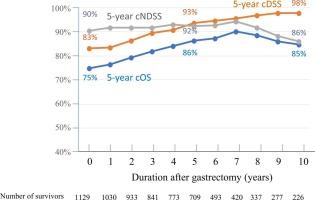
Over a median follow-up of 63 months, 203 patients (18.0%) died of GC, and 132 patients (11.7%) died of non-GC causes. The 5-year cDSS consistently increased over 10 years after gastrectomy for stage II and III GC. The cDSS and cNDSS intersected at 7 years after gastrectomy for stage II GC, whereas these measures crossed at 8 years after gastrectomy for stage III GC. In the 709 5-year survivors, multivariate analysis identified disease stage as being significantly associated with cOS and cDSS. Moreover, age ≥ 75 years, male sex, and preoperative comorbidities were associated with lower cNDSS.
Conclusion
Surveillance for GC relapse was crucial during the first 7 and 8 years after gastrectomy for stages II and III, respectively. Conversely, surveillance for second primary cancers and benign diseases became relatively more important 0, 7, and 8 years after gastrectomy for stages I, II, and III, respectively. In 5-year survivors, age ≥ 75 years, male sex, and preoperative comorbidities were associated with mortality unrelated to GC.
期刊介绍:
The Journal of Gastrointestinal Surgery is a scholarly, peer-reviewed journal that updates the surgeon on the latest developments in gastrointestinal surgery. The journal includes original articles on surgery of the digestive tract; gastrointestinal images; "How I Do It" articles, subject reviews, book reports, editorial columns, the SSAT Presidential Address, articles by a guest orator, symposia, letters, results of conferences and more. This is the official publication of the Society for Surgery of the Alimentary Tract. The journal functions as an outstanding forum for continuing education in surgery and diseases of the gastrointestinal tract.



 京公网安备 11010802042870号
京ICP备2023020795号-1
京公网安备 11010802042870号
京ICP备2023020795号-1

 分享
分享
 求助内容:
求助内容: 应助结果提醒方式:
 扫码关注我们
