Zhihui Li , Lanbo Liu , Wan Li , Xueqing Song , Zheng Wang , Longfei Li
{"title":"Nature of sulfonyl deactivation/activation by metal catalysts†","authors":"Zhihui Li , Lanbo Liu , Wan Li , Xueqing Song , Zheng Wang , Longfei Li","doi":"10.1039/d4cy01350f","DOIUrl":null,"url":null,"abstract":"<div><div>Molecule activation theories are important in catalytic reactions, but sulfonyl activation remains unclear despite the fact that sulfonyl is a widely used leaving group in chemical synthesis. To unveil the nature of sulfonyl deactivation/activation by metal catalysts, the mechanisms of the competitive metal-catalyzed α-alkylation of sulfones and sulfonyl dissociation (Julia olefination) reactions are comprehensively investigated. A favorable metal-catalyzed mechanism is first proposed for the sulfonyl dissociation reaction. The sulfonyl dissociation and chemoselectivity are revealed to originate from hydride addition into the CC bond of the vinyl sulfone intermediate. Through natural localized molecular orbital analysis, a sulfonyl deactivation model with a π<sub>C(α)C(β)</sub> → σ*<sub>S–O</sub> hyperconjugation effect and a sulfonyl activation model with π<sub>C(α)C(β)</sub> → π*<sub>Ph</sub> conjugation effect are proposed. Guided by the sulfonyl activation model, switchable chemoselectivity strategies are provided to control these reactions.</div></div>","PeriodicalId":66,"journal":{"name":"Catalysis Science & Technology","volume":"15 4","pages":"Pages 1016-1027"},"PeriodicalIF":4.2000,"publicationDate":"2025-01-20","publicationTypes":"Journal Article","fieldsOfStudy":null,"isOpenAccess":false,"openAccessPdf":"","citationCount":"0","resultStr":null,"platform":"Semanticscholar","paperid":null,"PeriodicalName":"Catalysis Science & Technology","FirstCategoryId":"92","ListUrlMain":"https://www.sciencedirect.com/org/science/article/pii/S2044475324006865","RegionNum":3,"RegionCategory":"化学","ArticlePicture":[],"TitleCN":null,"AbstractTextCN":null,"PMCID":null,"EPubDate":"2024/12/31 0:00:00","PubModel":"Epub","JCR":"Q2","JCRName":"CHEMISTRY, PHYSICAL","Score":null,"Total":0}
引用次数: 0
Abstract
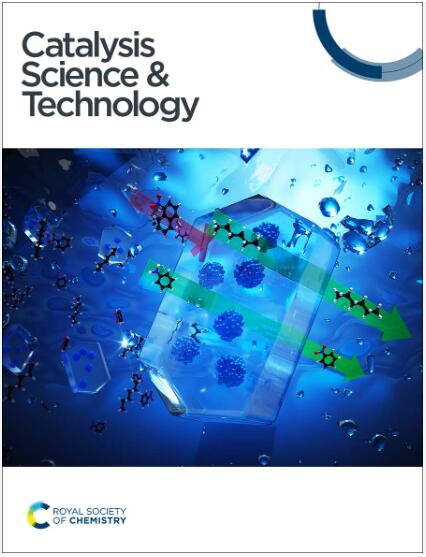
Molecule activation theories are important in catalytic reactions, but sulfonyl activation remains unclear despite the fact that sulfonyl is a widely used leaving group in chemical synthesis. To unveil the nature of sulfonyl deactivation/activation by metal catalysts, the mechanisms of the competitive metal-catalyzed α-alkylation of sulfones and sulfonyl dissociation (Julia olefination) reactions are comprehensively investigated. A favorable metal-catalyzed mechanism is first proposed for the sulfonyl dissociation reaction. The sulfonyl dissociation and chemoselectivity are revealed to originate from hydride addition into the CC bond of the vinyl sulfone intermediate. Through natural localized molecular orbital analysis, a sulfonyl deactivation model with a πC(α)C(β) → σ*S–O hyperconjugation effect and a sulfonyl activation model with πC(α)C(β) → π*Ph conjugation effect are proposed. Guided by the sulfonyl activation model, switchable chemoselectivity strategies are provided to control these reactions.
期刊介绍:
A multidisciplinary journal focusing on cutting edge research across all fundamental science and technological aspects of catalysis.
Editor-in-chief: Bert Weckhuysen
Impact factor: 5.0
Time to first decision (peer reviewed only): 31 days




 京公网安备 11010802042870号
京ICP备2023020795号-1
京公网安备 11010802042870号
京ICP备2023020795号-1

 分享
分享
 求助内容:
求助内容: 应助结果提醒方式:
 扫码关注我们
