Ashwin Khadka, Edmund Samuel, Bhavana Joshi, Shrayas Pradhan, Woojin Lim, Ali Aldalbahi, Govindasami Periyasami, Sam S. Yoon
{"title":"Supersonic solution blowing of polyvinylidene fluoride/cellulose nanofibers for high-performance piezoelectric nanogenerators","authors":"Ashwin Khadka, Edmund Samuel, Bhavana Joshi, Shrayas Pradhan, Woojin Lim, Ali Aldalbahi, Govindasami Periyasami, Sam S. Yoon","doi":"10.1007/s10570-025-06371-8","DOIUrl":null,"url":null,"abstract":"<div><p>Highly viscoelastic polyvinylidene fluoride (PVDF) nanofibers were prepared by supersonic solution blowing, resulting in the formation of nanoscale pseudo-grain boundaries that enhanced the interfacial polarization and facilitated mechanical energy harvesting in piezoelectric nanogenerators (PENGs). The addition of cellulose acetate (CA) or sodium carboxymethylcellulose (CMCNa) to the PVDF solution increased the content of electroactive γ and β phases in the PVDF/CA and PVDF/CMCNa nanofibers by factors of 2 and 3.3, respectively, and the corresponding piezoelectric potentials by factors of 3 and 6, respectively. The PVDF/CA-based PENG generated a piezopotential output of 12.5 V at a tapping force and frequency of 5 N and 5 Hz, respectively, and the PVDF/CMCNa-based PENG produced a piezopotential output of 28.6 V at a tapping force and frequency of 10 N and 7 Hz, respectively, along with a power density of 31 µW·cm<sup>−2</sup>. The versatility of the prepared PENGs was demonstrated for a diverse range of body movements, including walking, running, writing, and finger bending. The optimal PENG can be seamlessly integrated with energy storage systems, thereby supplying power to wearable electronic instruments, such as smart sensors and health-monitoring devices.</p></div>","PeriodicalId":511,"journal":{"name":"Cellulose","volume":"32 3","pages":"1667 - 1683"},"PeriodicalIF":4.8000,"publicationDate":"2025-01-08","publicationTypes":"Journal Article","fieldsOfStudy":null,"isOpenAccess":false,"openAccessPdf":"","citationCount":"0","resultStr":null,"platform":"Semanticscholar","paperid":null,"PeriodicalName":"Cellulose","FirstCategoryId":"88","ListUrlMain":"https://link.springer.com/article/10.1007/s10570-025-06371-8","RegionNum":2,"RegionCategory":"工程技术","ArticlePicture":[],"TitleCN":null,"AbstractTextCN":null,"PMCID":null,"EPubDate":"","PubModel":"","JCR":"Q1","JCRName":"MATERIALS SCIENCE, PAPER & WOOD","Score":null,"Total":0}
引用次数: 0
Abstract
Highly viscoelastic polyvinylidene fluoride (PVDF) nanofibers were prepared by supersonic solution blowing, resulting in the formation of nanoscale pseudo-grain boundaries that enhanced the interfacial polarization and facilitated mechanical energy harvesting in piezoelectric nanogenerators (PENGs). The addition of cellulose acetate (CA) or sodium carboxymethylcellulose (CMCNa) to the PVDF solution increased the content of electroactive γ and β phases in the PVDF/CA and PVDF/CMCNa nanofibers by factors of 2 and 3.3, respectively, and the corresponding piezoelectric potentials by factors of 3 and 6, respectively. The PVDF/CA-based PENG generated a piezopotential output of 12.5 V at a tapping force and frequency of 5 N and 5 Hz, respectively, and the PVDF/CMCNa-based PENG produced a piezopotential output of 28.6 V at a tapping force and frequency of 10 N and 7 Hz, respectively, along with a power density of 31 µW·cm−2. The versatility of the prepared PENGs was demonstrated for a diverse range of body movements, including walking, running, writing, and finger bending. The optimal PENG can be seamlessly integrated with energy storage systems, thereby supplying power to wearable electronic instruments, such as smart sensors and health-monitoring devices.
期刊介绍:
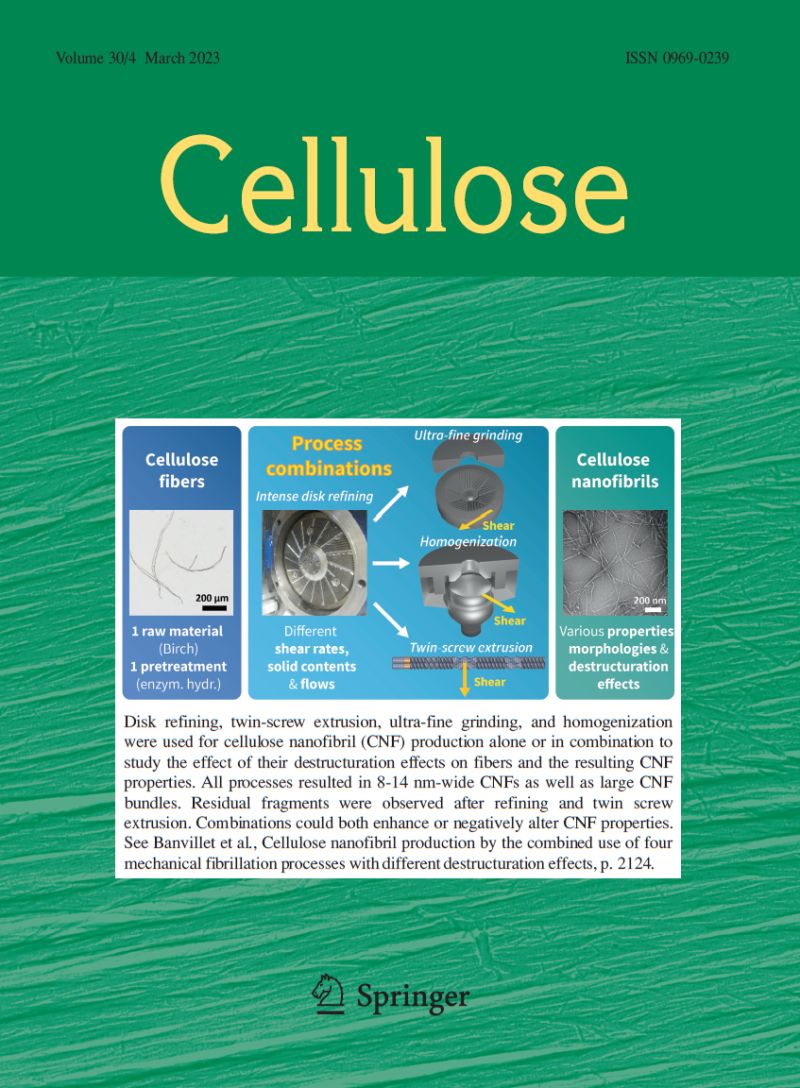
Cellulose is an international journal devoted to the dissemination of research and scientific and technological progress in the field of cellulose and related naturally occurring polymers. The journal is concerned with the pure and applied science of cellulose and related materials, and also with the development of relevant new technologies. This includes the chemistry, biochemistry, physics and materials science of cellulose and its sources, including wood and other biomass resources, and their derivatives. Coverage extends to the conversion of these polymers and resources into manufactured goods, such as pulp, paper, textiles, and manufactured as well natural fibers, and to the chemistry of materials used in their processing. Cellulose publishes review articles, research papers, and technical notes.



 京公网安备 11010802042870号
京ICP备2023020795号-1
京公网安备 11010802042870号
京ICP备2023020795号-1

 分享
分享
 求助内容:
求助内容: 应助结果提醒方式:
 扫码关注我们
