{"title":"Tailoring Electrocarboxylation Pathways on Lead Cathodes: Insights into Electrolysis Mode","authors":"D. F. Bruggeman, M. Zwart, A. C. Garcia","doi":"10.1002/celc.202400580","DOIUrl":null,"url":null,"abstract":"<p>Electrocarboxylation, the electrochemical addition of CO<sub>2</sub> to organic substrates using renewable energy, offers a promising approach for carbon capture and utilization. However, commercial viability remains limited due to poor product selectivity and yields. In this work, we investigate how the electrolysis mode – chronoamperometry (CA) versus chronopotentiometry (CP) – influences the electrocarboxylation mechanisms of phenyl-activated substrates, Benzaldehyde, Styrene, and Benzylbromide, on Lead electrodes. By employing cyclic voltammetry (CV), in situ FTIR, and bulk electrolysis, we explore how these modes affect product selectivity and reaction efficiency. Our results show that substrate-activated mechanisms, such as those observed for Benzaldehyde and Benzylbromide, achieve higher selectivity and reduced side-product formation under CA conditions, while CP leads to increased side reactions. In contrast, Styrene exhibits more complex behavior, with CP favoring di-carboxylation, while CA enhances mono-carboxylation. These findings highlight the significant impact of electrolysis mode on controlling electrocarboxylation pathways, providing valuable insights for optimizing selective and efficient synthesis processes.</p>","PeriodicalId":142,"journal":{"name":"ChemElectroChem","volume":"12 4","pages":""},"PeriodicalIF":5.2000,"publicationDate":"2025-01-27","publicationTypes":"Journal Article","fieldsOfStudy":null,"isOpenAccess":false,"openAccessPdf":"https://onlinelibrary.wiley.com/doi/epdf/10.1002/celc.202400580","citationCount":"0","resultStr":null,"platform":"Semanticscholar","paperid":null,"PeriodicalName":"ChemElectroChem","FirstCategoryId":"92","ListUrlMain":"https://chemistry-europe.onlinelibrary.wiley.com/doi/10.1002/celc.202400580","RegionNum":4,"RegionCategory":"化学","ArticlePicture":[],"TitleCN":null,"AbstractTextCN":null,"PMCID":null,"EPubDate":"","PubModel":"","JCR":"Q2","JCRName":"ELECTROCHEMISTRY","Score":null,"Total":0}
引用次数: 0
Abstract
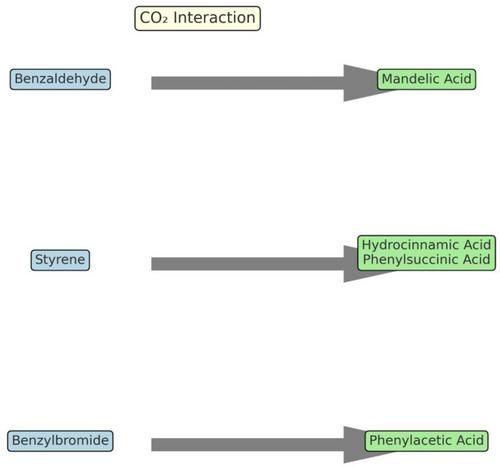
Electrocarboxylation, the electrochemical addition of CO2 to organic substrates using renewable energy, offers a promising approach for carbon capture and utilization. However, commercial viability remains limited due to poor product selectivity and yields. In this work, we investigate how the electrolysis mode – chronoamperometry (CA) versus chronopotentiometry (CP) – influences the electrocarboxylation mechanisms of phenyl-activated substrates, Benzaldehyde, Styrene, and Benzylbromide, on Lead electrodes. By employing cyclic voltammetry (CV), in situ FTIR, and bulk electrolysis, we explore how these modes affect product selectivity and reaction efficiency. Our results show that substrate-activated mechanisms, such as those observed for Benzaldehyde and Benzylbromide, achieve higher selectivity and reduced side-product formation under CA conditions, while CP leads to increased side reactions. In contrast, Styrene exhibits more complex behavior, with CP favoring di-carboxylation, while CA enhances mono-carboxylation. These findings highlight the significant impact of electrolysis mode on controlling electrocarboxylation pathways, providing valuable insights for optimizing selective and efficient synthesis processes.
期刊介绍:
ChemElectroChem is aimed to become a top-ranking electrochemistry journal for primary research papers and critical secondary information from authors across the world. The journal covers the entire scope of pure and applied electrochemistry, the latter encompassing (among others) energy applications, electrochemistry at interfaces (including surfaces), photoelectrochemistry and bioelectrochemistry.






 京公网安备 11010802042870号
京ICP备2023020795号-1
京公网安备 11010802042870号
京ICP备2023020795号-1

 分享
分享
 求助内容:
求助内容: 应助结果提醒方式:
 扫码关注我们
