Qaisar Maqbool , Hamilton Uchenna Aharanwa , Michael Stöger-Pollach , Günther Rupprechter
{"title":"Upcycling hazardous waste into high-performance Ni/η-Al2O3 catalysts for CO2 methanation†","authors":"Qaisar Maqbool , Hamilton Uchenna Aharanwa , Michael Stöger-Pollach , Günther Rupprechter","doi":"10.1039/d4gc05217j","DOIUrl":null,"url":null,"abstract":"<div><div>Transforming hazardous and difficult-to-process waste materials, like spent Ni-MH batteries and aluminium foil, into nanocatalysts (NCts) provides a sustainable solution for resource management and reducing environmental impact. This study demonstrates a novel approach by extracting nickel sulfate (NiSO<sub>4</sub>·<em>x</em>H<sub>2</sub>O) from battery waste and subsequently converting it into Ni(OH)<sub>2</sub> hydrogel precursors using <span>l</span>-glutamic acid. Waste aluminium foil was processed into alumina (Al<sub>2</sub>O<sub>3</sub>), and combined with Ni(OH)<sub>2</sub> to synthesize Ni/η-Al<sub>2</sub>O<sub>3</sub> NCts with 4% and 8% Ni loading. Characterization through XRD/SAED, STEM/EFTEM, and EELS revealed a disordered cubic structure of η-Al<sub>2</sub>O<sub>3</sub>, with well-dispersed Ni particles, making it effective for CO<sub>2</sub> hydrogenation. The 8-Ni/η-Al<sub>2</sub>O<sub>3</sub> exhibited the best catalytic performance, with CH<sub>4</sub> selectivity of 99.8% and space time yield (STY) of 80.3 mmol<sub>CH<sub>4</sub></sub> g<sub>cat</sub><sup>−1</sup> h<sup>−1</sup> at 400 °C. The CO<sub>2</sub> methanation mechanism over Ni/η-Al<sub>2</sub>O<sub>3</sub> NCts was further explored using <em>operando</em> DRIFTS aligned with GC + MS. The <em>operando</em> investigation suggested a preferential associative CO<sub>2</sub> methanation pathway, involving sequential adsorption and hydrogenation of CO<sub>2</sub> to hydrogen carbonates on Ni/η-Al<sub>2</sub>O<sub>3</sub>, and their transformation into formate and methoxy intermediates leading to methane. Finally, to complete the upcycling/recycling loop, the spent Ni/η-Al<sub>2</sub>O<sub>3</sub> NCts were recycled into Ni and Al precursors. These findings underscore the potential of upcycling waste materials for synthesizing sustainable, high-performance NCts, and offer insights into the CO<sub>2</sub> methanation mechanism.</div></div>","PeriodicalId":78,"journal":{"name":"Green Chemistry","volume":"27 10","pages":"Pages 2706-2722"},"PeriodicalIF":9.2000,"publicationDate":"2025-02-05","publicationTypes":"Journal Article","fieldsOfStudy":null,"isOpenAccess":false,"openAccessPdf":"https://www.ncbi.nlm.nih.gov/pmc/articles/PMC11826383/pdf/","citationCount":"0","resultStr":null,"platform":"Semanticscholar","paperid":null,"PeriodicalName":"Green Chemistry","FirstCategoryId":"92","ListUrlMain":"https://www.sciencedirect.com/org/science/article/pii/S1463926225001001","RegionNum":1,"RegionCategory":"化学","ArticlePicture":[],"TitleCN":null,"AbstractTextCN":null,"PMCID":null,"EPubDate":"2025/2/7 0:00:00","PubModel":"Epub","JCR":"Q1","JCRName":"CHEMISTRY, MULTIDISCIPLINARY","Score":null,"Total":0}
引用次数: 0
Abstract
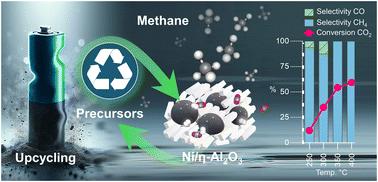
Transforming hazardous and difficult-to-process waste materials, like spent Ni-MH batteries and aluminium foil, into nanocatalysts (NCts) provides a sustainable solution for resource management and reducing environmental impact. This study demonstrates a novel approach by extracting nickel sulfate (NiSO4·xH2O) from battery waste and subsequently converting it into Ni(OH)2 hydrogel precursors using l-glutamic acid. Waste aluminium foil was processed into alumina (Al2O3), and combined with Ni(OH)2 to synthesize Ni/η-Al2O3 NCts with 4% and 8% Ni loading. Characterization through XRD/SAED, STEM/EFTEM, and EELS revealed a disordered cubic structure of η-Al2O3, with well-dispersed Ni particles, making it effective for CO2 hydrogenation. The 8-Ni/η-Al2O3 exhibited the best catalytic performance, with CH4 selectivity of 99.8% and space time yield (STY) of 80.3 mmolCH4 gcat−1 h−1 at 400 °C. The CO2 methanation mechanism over Ni/η-Al2O3 NCts was further explored using operando DRIFTS aligned with GC + MS. The operando investigation suggested a preferential associative CO2 methanation pathway, involving sequential adsorption and hydrogenation of CO2 to hydrogen carbonates on Ni/η-Al2O3, and their transformation into formate and methoxy intermediates leading to methane. Finally, to complete the upcycling/recycling loop, the spent Ni/η-Al2O3 NCts were recycled into Ni and Al precursors. These findings underscore the potential of upcycling waste materials for synthesizing sustainable, high-performance NCts, and offer insights into the CO2 methanation mechanism.
期刊介绍:
Green Chemistry is a journal that provides a unique forum for the publication of innovative research on the development of alternative green and sustainable technologies. The scope of Green Chemistry is based on the definition proposed by Anastas and Warner (Green Chemistry: Theory and Practice, P T Anastas and J C Warner, Oxford University Press, Oxford, 1998), which defines green chemistry as the utilisation of a set of principles that reduces or eliminates the use or generation of hazardous substances in the design, manufacture and application of chemical products. Green Chemistry aims to reduce the environmental impact of the chemical enterprise by developing a technology base that is inherently non-toxic to living things and the environment. The journal welcomes submissions on all aspects of research relating to this endeavor and publishes original and significant cutting-edge research that is likely to be of wide general appeal. For a work to be published, it must present a significant advance in green chemistry, including a comparison with existing methods and a demonstration of advantages over those methods.



 京公网安备 11010802042870号
京ICP备2023020795号-1
京公网安备 11010802042870号
京ICP备2023020795号-1

 分享
分享
 求助内容:
求助内容: 应助结果提醒方式:
 扫码关注我们
