Aleksandar Kostić, Jovan Ilić, Nikola Stojanović, Radmilo Janković, Vesna Nikolov, Slavko Živković
{"title":"ELEVATED SERUM C-REACTIVE PROTEIN LEVELS IN COVID-19 PATIENTS WITH SCIATICA: IMPLICATIONS FOR PROGNOSIS AND TREATMENT STRATEGIES.","authors":"Aleksandar Kostić, Jovan Ilić, Nikola Stojanović, Radmilo Janković, Vesna Nikolov, Slavko Živković","doi":"10.20471/acc.2024.63.01.18","DOIUrl":null,"url":null,"abstract":"<p><p>To the best of our knowledge, no previous study has reported characteristics of C-reactive protein (CRP) levels in COVID-19 patients with comorbidities such as sciatica and lumbar syndrome. The objective of this study was to examine whether CRP levels rose significantly in COVID-19 patients with acute sciatica as compared to COVID-19 patients without it. This prospective study was performed on 147 patients previously diagnosed with COVID-19 infection who were admitted to the COVID hospital. Myalgia (p=0.00008) and lower back pain (p=0.00001) occurred much more frequently in the study group than in the control group. There was a high probability that patients with a previous history of sciatica may experience it again during their stay in COVID-19 hospital and that patients without it would not (p=0.00001). There was a significant correlation between the severity of sciatica and CRP levels (r=0.19, p=0.0174). Our results suggest that serum CRP levels are significantly higher in COVID-19 patients with concomitant sciatica in comparison to patients without sciatic pain, indicating a connection between the increased systemic inflammation in COVID-19 and sciatica. Given that the occurrence of COVID-19 in patients with sciatica is not rare, the knowledge about this matter is of high medical relevance.</p>","PeriodicalId":7072,"journal":{"name":"Acta clinica Croatica","volume":"63 1","pages":"149-156"},"PeriodicalIF":0.8000,"publicationDate":"2024-04-01","publicationTypes":"Journal Article","fieldsOfStudy":null,"isOpenAccess":false,"openAccessPdf":"https://www.ncbi.nlm.nih.gov/pmc/articles/PMC11827387/pdf/","citationCount":"0","resultStr":null,"platform":"Semanticscholar","paperid":null,"PeriodicalName":"Acta clinica Croatica","FirstCategoryId":"3","ListUrlMain":"https://doi.org/10.20471/acc.2024.63.01.18","RegionNum":4,"RegionCategory":"医学","ArticlePicture":[],"TitleCN":null,"AbstractTextCN":null,"PMCID":null,"EPubDate":"","PubModel":"","JCR":"Q3","JCRName":"MEDICINE, GENERAL & INTERNAL","Score":null,"Total":0}
引用次数: 0
Abstract
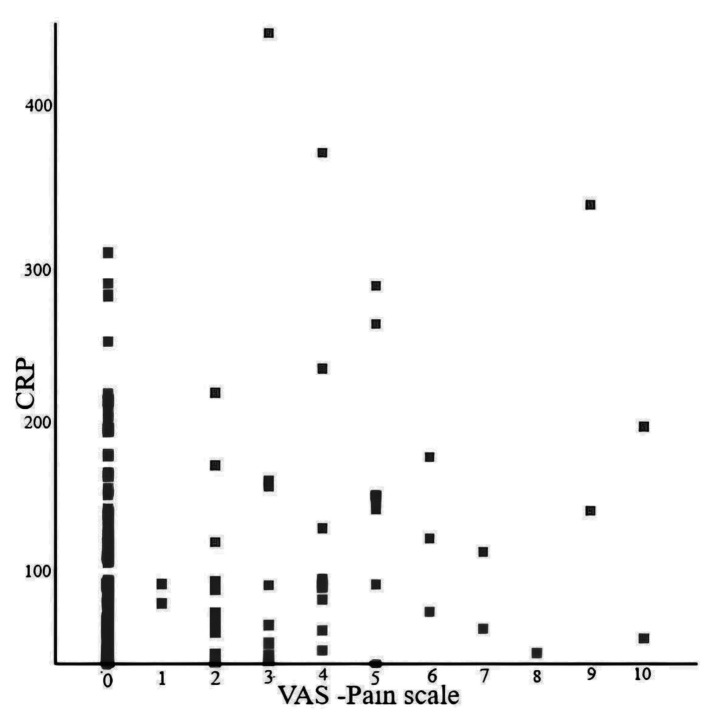
To the best of our knowledge, no previous study has reported characteristics of C-reactive protein (CRP) levels in COVID-19 patients with comorbidities such as sciatica and lumbar syndrome. The objective of this study was to examine whether CRP levels rose significantly in COVID-19 patients with acute sciatica as compared to COVID-19 patients without it. This prospective study was performed on 147 patients previously diagnosed with COVID-19 infection who were admitted to the COVID hospital. Myalgia (p=0.00008) and lower back pain (p=0.00001) occurred much more frequently in the study group than in the control group. There was a high probability that patients with a previous history of sciatica may experience it again during their stay in COVID-19 hospital and that patients without it would not (p=0.00001). There was a significant correlation between the severity of sciatica and CRP levels (r=0.19, p=0.0174). Our results suggest that serum CRP levels are significantly higher in COVID-19 patients with concomitant sciatica in comparison to patients without sciatic pain, indicating a connection between the increased systemic inflammation in COVID-19 and sciatica. Given that the occurrence of COVID-19 in patients with sciatica is not rare, the knowledge about this matter is of high medical relevance.
期刊介绍:
Acta Clinica Croatica is a peer reviewed general medical journal that publishes original articles that advance and improve medical science and practice and that serve the purpose of transfer of original and valuable information to journal readers. Acta Clinica Croatica is published in English four times a year.



 京公网安备 11010802042870号
京ICP备2023020795号-1
京公网安备 11010802042870号
京ICP备2023020795号-1

 分享
分享
 求助内容:
求助内容: 应助结果提醒方式:
 扫码关注我们
