Radiographic, fluoroscopic, and endosonographic predictors of failed EUS-guided transgastric stent placement in patients with Roux-en-Y bypass anatomy.
Benjamin M Moy, Hero Hussain, Jessica X Yu, Kevin D Platt, Jorge D Machicado, Richard S Kwon, Erik-Jan Wamsteker, George M Philips, Allison R Schulman
{"title":"Radiographic, fluoroscopic, and endosonographic predictors of failed EUS-guided transgastric stent placement in patients with Roux-en-Y bypass anatomy.","authors":"Benjamin M Moy, Hero Hussain, Jessica X Yu, Kevin D Platt, Jorge D Machicado, Richard S Kwon, Erik-Jan Wamsteker, George M Philips, Allison R Schulman","doi":"10.1055/a-2499-3468","DOIUrl":null,"url":null,"abstract":"<p><strong>Background and study aims: </strong>Gastric access temporary for endoscopy (GATE) via endoscopic ultrasound-guided stent placement between the gastric pouch/jejunum and remnant stomach is used in Roux-en-Y gastric bypass (RYGB) to facilitate endoscopic retrograde cholangiopancreatography or other maneuvers. This study aimed to identify radiographic predictors of GATE failure and intraprocedure reasons for aborting.</p><p><strong>Patients and methods: </strong>Patients undergoing GATE were matched 3:1 on procedure success. Features indicating quality of the transgastric window were collected including: 1) gastric pouch/blind limb length; 2) location of remnant stomach relative to pouch or blind/roux limb; 3) pouch orientation; 4) remnant orientation; 5) length of contact; 6) tissue thickness; and 7) presence of poor contact (calcification, surgical material, intervening vasculature). Primary outcome was radiographic criteria associated with GATE failure. Secondary outcomes were endoscopic, endosonographic, and fluoroscopic intraprocedure reasons for aborting GATE.</p><p><strong>Results: </strong>Forty patients (30 successful, 10 aborted, 82.5% female) who underwent GATE were included. Mean (±SD) age and time since RYGB were 62.8±11.9 and 15.1±8.6 years, respectively. There were no group demographic differences. The cumulative number of contact-related risk factors was associated with GATE failure (OR 26.1, 95% CI 0.004-0.337; <i>P</i> =0.004). Two or more factors increased the likelihood of GATE failure ( <i>P</i> <0.05). Echoendoscope angulation/tip deflection, intervening vasculature, distance to remnant stomach, rapid emptying and/or insufficient filling of contrast were reported in cases of GATE failure.</p><p><strong>Conclusions: </strong>Radiographic features may predict GATE failure including intervening vasculature or insufficient contact between gastric pouch/blind limb and remnant. Patients demonstrating these features may benefit from alternative treatment approaches early in management.</p>","PeriodicalId":11671,"journal":{"name":"Endoscopy International Open","volume":"13 ","pages":"a24993468"},"PeriodicalIF":2.3000,"publicationDate":"2025-01-29","publicationTypes":"Journal Article","fieldsOfStudy":null,"isOpenAccess":false,"openAccessPdf":"https://www.ncbi.nlm.nih.gov/pmc/articles/PMC11827733/pdf/","citationCount":"0","resultStr":null,"platform":"Semanticscholar","paperid":null,"PeriodicalName":"Endoscopy International Open","FirstCategoryId":"1085","ListUrlMain":"https://doi.org/10.1055/a-2499-3468","RegionNum":0,"RegionCategory":null,"ArticlePicture":[],"TitleCN":null,"AbstractTextCN":null,"PMCID":null,"EPubDate":"2025/1/1 0:00:00","PubModel":"eCollection","JCR":"Q3","JCRName":"GASTROENTEROLOGY & HEPATOLOGY","Score":null,"Total":0}
引用次数: 0
Abstract
Background and study aims: Gastric access temporary for endoscopy (GATE) via endoscopic ultrasound-guided stent placement between the gastric pouch/jejunum and remnant stomach is used in Roux-en-Y gastric bypass (RYGB) to facilitate endoscopic retrograde cholangiopancreatography or other maneuvers. This study aimed to identify radiographic predictors of GATE failure and intraprocedure reasons for aborting.
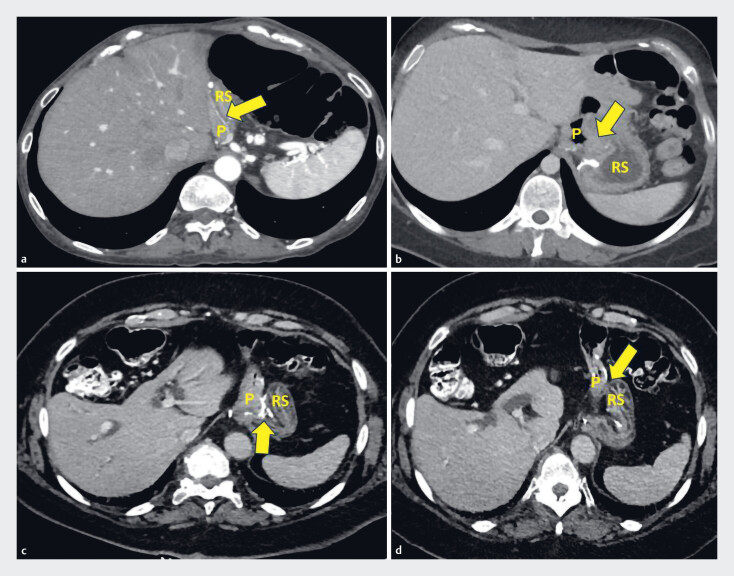
Patients and methods: Patients undergoing GATE were matched 3:1 on procedure success. Features indicating quality of the transgastric window were collected including: 1) gastric pouch/blind limb length; 2) location of remnant stomach relative to pouch or blind/roux limb; 3) pouch orientation; 4) remnant orientation; 5) length of contact; 6) tissue thickness; and 7) presence of poor contact (calcification, surgical material, intervening vasculature). Primary outcome was radiographic criteria associated with GATE failure. Secondary outcomes were endoscopic, endosonographic, and fluoroscopic intraprocedure reasons for aborting GATE.
Results: Forty patients (30 successful, 10 aborted, 82.5% female) who underwent GATE were included. Mean (±SD) age and time since RYGB were 62.8±11.9 and 15.1±8.6 years, respectively. There were no group demographic differences. The cumulative number of contact-related risk factors was associated with GATE failure (OR 26.1, 95% CI 0.004-0.337; P =0.004). Two or more factors increased the likelihood of GATE failure ( P <0.05). Echoendoscope angulation/tip deflection, intervening vasculature, distance to remnant stomach, rapid emptying and/or insufficient filling of contrast were reported in cases of GATE failure.
Conclusions: Radiographic features may predict GATE failure including intervening vasculature or insufficient contact between gastric pouch/blind limb and remnant. Patients demonstrating these features may benefit from alternative treatment approaches early in management.







 京公网安备 11010802042870号
京ICP备2023020795号-1
京公网安备 11010802042870号
京ICP备2023020795号-1

 分享
分享
 求助内容:
求助内容: 应助结果提醒方式:
 扫码关注我们
