Asad Khan, Yasir Salam Siddiqui, Mohammad Baqar Abbas, Ahsan Firoz, Mohammad Arshad Rahman, Mamoon Rashid
{"title":"Longitudinal Management of Progressive Femoral Deformities in a Pediatric Patient: A Case Study on Adaptative Surgical Interventions and Outcomes.","authors":"Asad Khan, Yasir Salam Siddiqui, Mohammad Baqar Abbas, Ahsan Firoz, Mohammad Arshad Rahman, Mamoon Rashid","doi":"10.13107/jocr.2025.v15.i02.5280","DOIUrl":null,"url":null,"abstract":"<p><strong>Introduction: </strong>Pediatric femoral deformities present unique challenges in orthopedics, requiring careful management to accommodate ongoing growth and development in young patients. This case report illustrates the longitudinal treatment of a child who experienced multiple complications following an initial femoral neck fracture in a cystic lesion, highlighting the complexity of managing such conditions over time.</p><p><strong>Case report: </strong>A 4-year-old child presented in 2016 with a femoral neck fracture and a cystic lesion in the proximal femur, initially managed with valgus osteotomy and dynamic compression plate fixation. Two years later, the patient exhibited a malunited fracture leading to coxa vara, which was managed by implant removal. In 2021, the child developed a bowing deformity which was corrected operatively with another osteotomy and TENS wire insertion. The most recent intervention in 2022 involved a valgus osteotomy and fixation with a dynamic hip screw to address persistent coxa vara, resulting in a successful union.</p><p><strong>Conclusion: </strong>This case emphasizes the need for ongoing, adaptive management strategies in pediatric orthopedics, particularly for patients with complex femoral deformities. Each surgical intervention was tailored to the child's evolving anatomical needs, with close follow-up to ensure optimal outcomes as the patient grew. The multidisciplinary approach and continuous reassessment are critical in achieving favorable long-term results in similar pediatric cases.</p>","PeriodicalId":16647,"journal":{"name":"Journal of Orthopaedic Case Reports","volume":"15 2","pages":"193-197"},"PeriodicalIF":0.0000,"publicationDate":"2025-02-01","publicationTypes":"Journal Article","fieldsOfStudy":null,"isOpenAccess":false,"openAccessPdf":"https://www.ncbi.nlm.nih.gov/pmc/articles/PMC11823874/pdf/","citationCount":"0","resultStr":null,"platform":"Semanticscholar","paperid":null,"PeriodicalName":"Journal of Orthopaedic Case Reports","FirstCategoryId":"1085","ListUrlMain":"https://doi.org/10.13107/jocr.2025.v15.i02.5280","RegionNum":0,"RegionCategory":null,"ArticlePicture":[],"TitleCN":null,"AbstractTextCN":null,"PMCID":null,"EPubDate":"","PubModel":"","JCR":"","JCRName":"","Score":null,"Total":0}
引用次数: 0
Abstract
Introduction: Pediatric femoral deformities present unique challenges in orthopedics, requiring careful management to accommodate ongoing growth and development in young patients. This case report illustrates the longitudinal treatment of a child who experienced multiple complications following an initial femoral neck fracture in a cystic lesion, highlighting the complexity of managing such conditions over time.
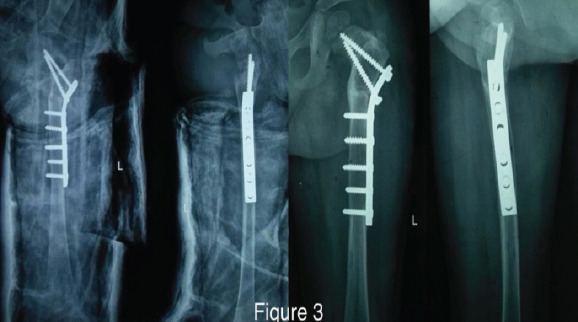
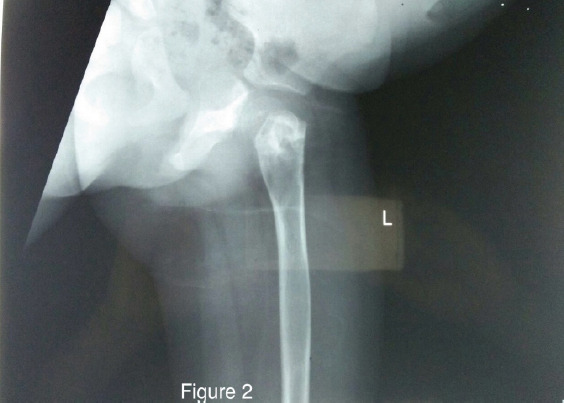
Case report: A 4-year-old child presented in 2016 with a femoral neck fracture and a cystic lesion in the proximal femur, initially managed with valgus osteotomy and dynamic compression plate fixation. Two years later, the patient exhibited a malunited fracture leading to coxa vara, which was managed by implant removal. In 2021, the child developed a bowing deformity which was corrected operatively with another osteotomy and TENS wire insertion. The most recent intervention in 2022 involved a valgus osteotomy and fixation with a dynamic hip screw to address persistent coxa vara, resulting in a successful union.
Conclusion: This case emphasizes the need for ongoing, adaptive management strategies in pediatric orthopedics, particularly for patients with complex femoral deformities. Each surgical intervention was tailored to the child's evolving anatomical needs, with close follow-up to ensure optimal outcomes as the patient grew. The multidisciplinary approach and continuous reassessment are critical in achieving favorable long-term results in similar pediatric cases.




 京公网安备 11010802042870号
京ICP备2023020795号-1
京公网安备 11010802042870号
京ICP备2023020795号-1

 分享
分享

 求助内容:
求助内容: 应助结果提醒方式:
 扫码关注我们
