Oxidation balance scores are positively associated with the occurrence and severity of myopia in adults: results from the National Health and Nutrition Examination Survey 2007-2008.
IF 1.4 3区 医学Q4 BIOCHEMISTRY & MOLECULAR BIOLOGYMolecular VisionPub Date : 2024-12-17eCollection Date: 2024-01-01
Ya-Li Wu, Xin Liu, Lu Xu, Li Ning
{"title":"Oxidation balance scores are positively associated with the occurrence and severity of myopia in adults: results from the National Health and Nutrition Examination Survey 2007-2008.","authors":"Ya-Li Wu, Xin Liu, Lu Xu, Li Ning","doi":"","DOIUrl":null,"url":null,"abstract":"<p><strong>Purpose: </strong>The purpose of this cross-sectional study was to investigate the relationship between oxidation balance scores (OBSs) and myopia.</p><p><strong>Methods: </strong>Participant information came from the National Health and Nutrition Examination Survey (NHANES) 2007-2008. The relationship between OBSs and myopia was analyzed using a restricted cubic spline, generalized linear regression, trend analysis, and ordinal logistic regression. The important components of the OBS in myopia were analyzed using XGBoost, random forest, and AdaBoost.</p><p><strong>Results: </strong>The data of 5,187 participants from NHANES were collected, and a preliminary analysis was conducted. We found that an association between OBSs and myopia was only found in participants aged ≥ 20 years (n = 4,253). There was a linear relationship between OBSs and the occurrence of myopia in them. The logistic regression showed that OBSs were correlated with an increased incidence of myopia after adjusting for all confounders (OR: 1.01, 95% CI [1.00, 1.02]). The trend test showed that the higher the OBS, the higher the likelihood of developing myopia (<i>p</i> for trend < 0.05). There was a nonlinear relationship between OBSs and myopia severity according to a generalized additive model (β = 0.01, 95% CI [0.00, 0.01], <i>p</i> < .01). The ordered logistic regression analysis showed that for every unit increase in OBS, the likelihood of myopia severity increased by 11% after adjusting for all confounders. We also found that calcium was an important OBS component related to the incidence of myopia.</p><p><strong>Conclusions: </strong>OBS is positively associated with the occurrence and severity of myopia in adults ≥ 20 years of age, and calcium is an important OBS component related to the incidence of myopia.</p>","PeriodicalId":18866,"journal":{"name":"Molecular Vision","volume":"30 ","pages":"422-433"},"PeriodicalIF":1.4000,"publicationDate":"2024-12-17","publicationTypes":"Journal Article","fieldsOfStudy":null,"isOpenAccess":false,"openAccessPdf":"https://www.ncbi.nlm.nih.gov/pmc/articles/PMC11829781/pdf/","citationCount":"0","resultStr":null,"platform":"Semanticscholar","paperid":null,"PeriodicalName":"Molecular Vision","FirstCategoryId":"3","ListUrlMain":"","RegionNum":3,"RegionCategory":"医学","ArticlePicture":[],"TitleCN":null,"AbstractTextCN":null,"PMCID":null,"EPubDate":"2024/1/1 0:00:00","PubModel":"eCollection","JCR":"Q4","JCRName":"BIOCHEMISTRY & MOLECULAR BIOLOGY","Score":null,"Total":0}
引用次数: 0
Abstract
Purpose: The purpose of this cross-sectional study was to investigate the relationship between oxidation balance scores (OBSs) and myopia.
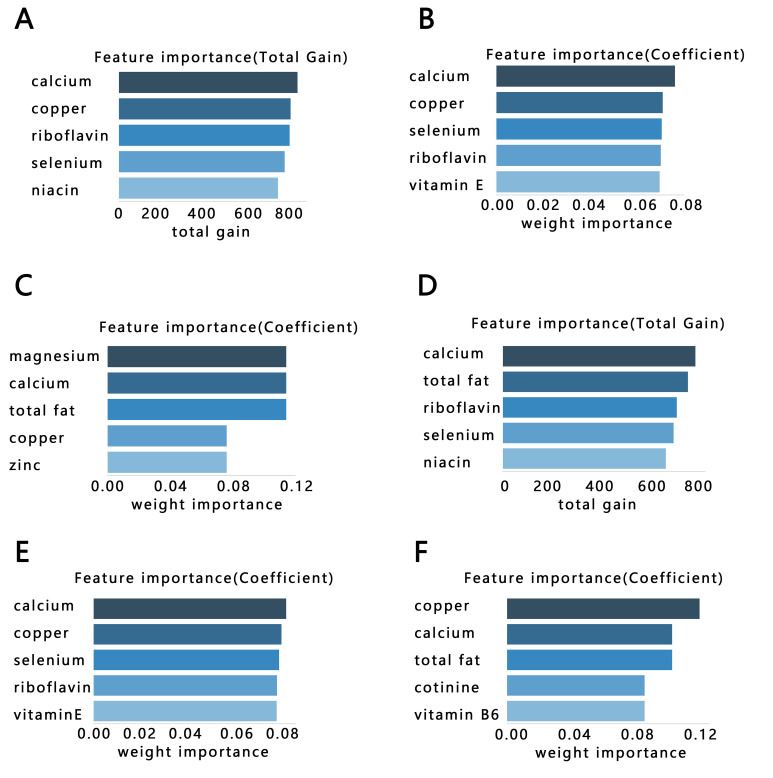
Methods: Participant information came from the National Health and Nutrition Examination Survey (NHANES) 2007-2008. The relationship between OBSs and myopia was analyzed using a restricted cubic spline, generalized linear regression, trend analysis, and ordinal logistic regression. The important components of the OBS in myopia were analyzed using XGBoost, random forest, and AdaBoost.
Results: The data of 5,187 participants from NHANES were collected, and a preliminary analysis was conducted. We found that an association between OBSs and myopia was only found in participants aged ≥ 20 years (n = 4,253). There was a linear relationship between OBSs and the occurrence of myopia in them. The logistic regression showed that OBSs were correlated with an increased incidence of myopia after adjusting for all confounders (OR: 1.01, 95% CI [1.00, 1.02]). The trend test showed that the higher the OBS, the higher the likelihood of developing myopia (p for trend < 0.05). There was a nonlinear relationship between OBSs and myopia severity according to a generalized additive model (β = 0.01, 95% CI [0.00, 0.01], p < .01). The ordered logistic regression analysis showed that for every unit increase in OBS, the likelihood of myopia severity increased by 11% after adjusting for all confounders. We also found that calcium was an important OBS component related to the incidence of myopia.
Conclusions: OBS is positively associated with the occurrence and severity of myopia in adults ≥ 20 years of age, and calcium is an important OBS component related to the incidence of myopia.
期刊介绍:
Molecular Vision is a peer-reviewed journal dedicated to the dissemination of research results in molecular biology, cell biology, and the genetics of the visual system (ocular and cortical).
Molecular Vision publishes articles presenting original research that has not previously been published and comprehensive articles reviewing the current status of a particular field or topic. Submissions to Molecular Vision are subjected to rigorous peer review. Molecular Vision does NOT publish preprints.
For authors, Molecular Vision provides a rapid means of communicating important results. Access to Molecular Vision is free and unrestricted, allowing the widest possible audience for your article. Digital publishing allows you to use color images freely (and without fees). Additionally, you may publish animations, sounds, or other supplementary information that clarifies or supports your article. Each of the authors of an article may also list an electronic mail address (which will be updated upon request) to give interested readers easy access to authors.

 分享
分享



 京公网安备 11010802042870号
京ICP备2023020795号-1
京公网安备 11010802042870号
京ICP备2023020795号-1

 求助内容:
求助内容: 应助结果提醒方式:
 扫码关注我们
