Jeffrey A Bell, Laura E Bell, Tyler J Achatz, Kimberly Bates, Riley D White, Vasyl V Tkach
{"title":"Haemosporidian infection risk and community structure determined by duck feeding guild.","authors":"Jeffrey A Bell, Laura E Bell, Tyler J Achatz, Kimberly Bates, Riley D White, Vasyl V Tkach","doi":"10.1017/S0031182025000137","DOIUrl":null,"url":null,"abstract":"<p><p>Birds possess the most diverse assemblage of haemosporidian parasites, although the true diversity is unknown due to high genetic diversity and insufficient sampling across all avian clades. Waterfowl (Order Anseriformes) are an ideal group to discover hidden parasite diversity and examine the role of host ecology in parasite transmission. Waterfowl contain 2 distinct feeding guilds, dabbling and diving, which differ in niche utilization that likely alters vector encounter rates and haemosporidian parasite risk. To determine the role of feeding guild in haemosporidian parasitism we analysed 223 blood samples collected by hunters from the upper Midwest of the United States from 2017 to 2019. Fifty-four individuals were infected by haemosporidian parasites (24·2% prevalence). Infection prevalence differed significantly between dabbling (34·9%, <i>n</i> = 109) and diving (14·0%, <i>n</i> = 114) ducks. Feeding guild was the only host trait that could predict haemosporidian infection risk, with a significantly higher risk in dabbling ducks. Twenty-four haemosporidian lineages were identified, with 9 identified for the first time. Thirteen lineages were found only in dabbling ducks, 5 only in diving ducks and 6 in both feeding guilds. Community analysis showed that each feeding guild harboured a unique parasite community. There was no phylogenetic signal of feeding guild within a phylogenetic reconstruction of North American waterfowl haemosporidian lineages. Our results demonstrate that waterfowl contain a diverse and distinct community of haemosporidian parasites. The unique composition of each feeding guild determines not only haemosporidian infection risk but also community structure. This is the first report of such an impact for waterfowl feeding guilds.</p>","PeriodicalId":19967,"journal":{"name":"Parasitology","volume":" ","pages":"217-228"},"PeriodicalIF":2.4000,"publicationDate":"2025-02-01","publicationTypes":"Journal Article","fieldsOfStudy":null,"isOpenAccess":false,"openAccessPdf":"https://www.ncbi.nlm.nih.gov/pmc/articles/PMC12089446/pdf/","citationCount":"0","resultStr":null,"platform":"Semanticscholar","paperid":null,"PeriodicalName":"Parasitology","FirstCategoryId":"3","ListUrlMain":"https://doi.org/10.1017/S0031182025000137","RegionNum":3,"RegionCategory":"医学","ArticlePicture":[],"TitleCN":null,"AbstractTextCN":null,"PMCID":null,"EPubDate":"","PubModel":"","JCR":"Q2","JCRName":"PARASITOLOGY","Score":null,"Total":0}
引用次数: 0
Abstract
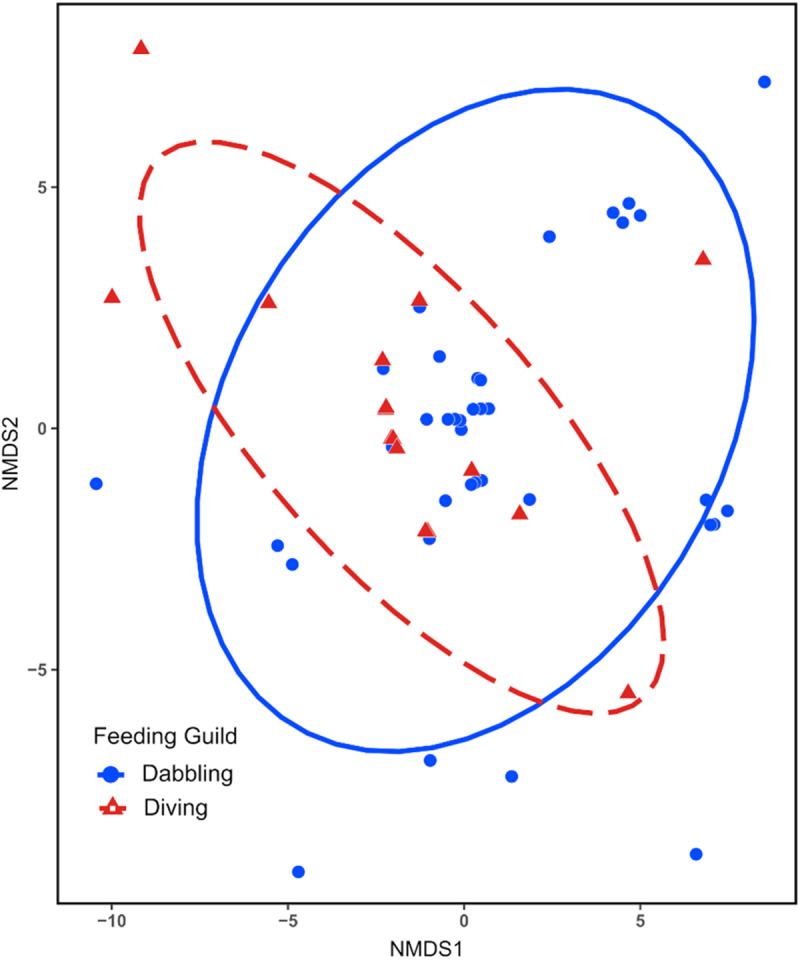
Birds possess the most diverse assemblage of haemosporidian parasites, although the true diversity is unknown due to high genetic diversity and insufficient sampling across all avian clades. Waterfowl (Order Anseriformes) are an ideal group to discover hidden parasite diversity and examine the role of host ecology in parasite transmission. Waterfowl contain 2 distinct feeding guilds, dabbling and diving, which differ in niche utilization that likely alters vector encounter rates and haemosporidian parasite risk. To determine the role of feeding guild in haemosporidian parasitism we analysed 223 blood samples collected by hunters from the upper Midwest of the United States from 2017 to 2019. Fifty-four individuals were infected by haemosporidian parasites (24·2% prevalence). Infection prevalence differed significantly between dabbling (34·9%, n = 109) and diving (14·0%, n = 114) ducks. Feeding guild was the only host trait that could predict haemosporidian infection risk, with a significantly higher risk in dabbling ducks. Twenty-four haemosporidian lineages were identified, with 9 identified for the first time. Thirteen lineages were found only in dabbling ducks, 5 only in diving ducks and 6 in both feeding guilds. Community analysis showed that each feeding guild harboured a unique parasite community. There was no phylogenetic signal of feeding guild within a phylogenetic reconstruction of North American waterfowl haemosporidian lineages. Our results demonstrate that waterfowl contain a diverse and distinct community of haemosporidian parasites. The unique composition of each feeding guild determines not only haemosporidian infection risk but also community structure. This is the first report of such an impact for waterfowl feeding guilds.
期刊介绍:
Parasitology is an important specialist journal covering the latest advances in the subject. It publishes original research and review papers on all aspects of parasitology and host-parasite relationships, including the latest discoveries in parasite biochemistry, molecular biology and genetics, ecology and epidemiology in the context of the biological, medical and veterinary sciences. Included in the subscription price are two special issues which contain reviews of current hot topics, one of which is the proceedings of the annual Symposia of the British Society for Parasitology, while the second, covering areas of significant topical interest, is commissioned by the editors and the editorial board.






 京公网安备 11010802042870号
京ICP备2023020795号-1
京公网安备 11010802042870号
京ICP备2023020795号-1

 分享
分享
 求助内容:
求助内容: 应助结果提醒方式:
 扫码关注我们
